





 The CSM certification is one of the most recognized Agile certifications for professionals who want to become Scrum Masters and lead Agile teams effectively. It provides a strong foundation in Scrum practices, teamwork, and Agile project management.



Overview of Certified Scrum Master Certification
The CSM certification focuses on helping professionals understand how Scrum works in real-world project environments. The certification introduces candidates to Agile values, Scrum roles, and the responsibilities of a Scrum Master within a team.
Professionals who complete the certification gain practical knowledge about facilitating Scrum events, supporting development teams, and ensuring smooth collaboration between stakeholders. The certification also helps individuals learn how to remove obstacles for teams and ensure successful Sprint execution.
Because Agile methodologies are widely used in software development, product management, and digital transformation projects, the CSM certification is considered a valuable credential for professionals aiming to work in Agile environments.
Things to Know Before Starting the CSM Course
Before enrolling in the course, candidates should understand the fundamental concepts behind Scrum and Agile development. While there are no strict prerequisites for the certification, having basic knowledge of Scrum practices can significantly improve the learning experience. Knowing the scrum master certification eligibility also guides candidates on how to prepare effectively for the training and exam.
Candidates should familiarize themselves with key concepts such as Scrum roles, events, and artifacts. Understanding the theoretical aspects of Scrum along with practical examples can help candidates grasp the framework more easily during training.
Reviewing a Scrum Case Study can also be helpful because it demonstrates how Scrum is applied in real project scenarios. These case studies provide insights into team collaboration, Sprint planning, and Agile problem-solving techniques.
Learning these basics before starting the training helps candidates participate more actively in discussions and practical exercises conducted during the certification program.
Get Certified Now! Master the Scrum Master Certification Levels and set yourself apart as a top Scrum leader in the industry.
Certified Scrum Master Certification Eligibility
One of the biggest advantages of the CSM certification is that it has very flexible eligibility criteria. Unlike many professional certifications, there are no strict academic or professional requirements to enroll in the course. Understanding csm certification eligibility helps candidates know what is required to start the certification journey and plan their preparation accordingly.
Anyone interested in learning Agile practices and becoming a Scrum professional can apply for the certification. This makes the program accessible to a wide range of professionals across industries.
Individuals who commonly pursue the certification include:
- Project managers
- Software developers
- .Product managers
- Business analysts
- QA professionals
- Team leads
- Fresh graduates interested in Agile careers
Although formal prerequisites are not required, understanding the certified scrum master eligibility can help candidates gauge how prepared they are for the training and what foundational knowledge of Scrum might be useful before enrolling.
This preparation helps them gain maximum value from the course and improves their chances of passing the certification exam.
Step-by-Step Process to Earn the CSM Certification
Candidates should review their csm eligibility carefully to ensure they meet the basic requirements before starting the certification journey. The process of obtaining the CSM certification is straightforward and usually involves two main steps: completing official training and passing the certification exam.
Step 1 – CSM Training
The first step is attending an official Scrum training program conducted by a certified instructor. The training typically lasts two days and provides a comprehensive understanding of Scrum fundamentals.
During the training, candidates learn about Scrum roles, Agile values, Sprint planning, backlog management, and team collaboration techniques. The sessions often include practical exercises, discussions, and real-world examples.
In many training programs, instructors also use a Scrum Case Study to explain how Agile teams solve problems and deliver product increments during Sprint cycles.
This practical approach helps candidates understand the framework more effectively and prepares them for the certification exam.
Step 2 – CSM Certification Exam
After completing the training, candidates receive access to the certification exam. The exam evaluates the candidate’s understanding of Scrum fundamentals and Agile practices.
The test is conducted online and includes multiple-choice questions based on concepts covered during training.
Once candidates successfully pass the exam, they receive the CSM certification, confirming their knowledge of Scrum principles and Agile project management.
Also Read: How Long Does it Take to Become a Scrum Master?
CSM Certification Exam Format (2026)
The certification exam format remains simple and straightforward for professionals entering the Agile domain.
Typical exam details include:
- Number of Questions: 50 multiple-choice questions
- Exam Duration: 60 minutes
- Passing Score: 74% or higher
- Exam Mode: Online
Candidates usually receive two attempts to pass the exam within a specific period after completing the training. The exam is designed to test the candidate’s understanding of Scrum concepts, roles, events, and Agile values.
Preparing through training sessions and reviewing Scrum examples increases the chances of passing the exam on the first attempt.
Also Read: Scrum Master Learning Path
CSM Certification Cost in 2026
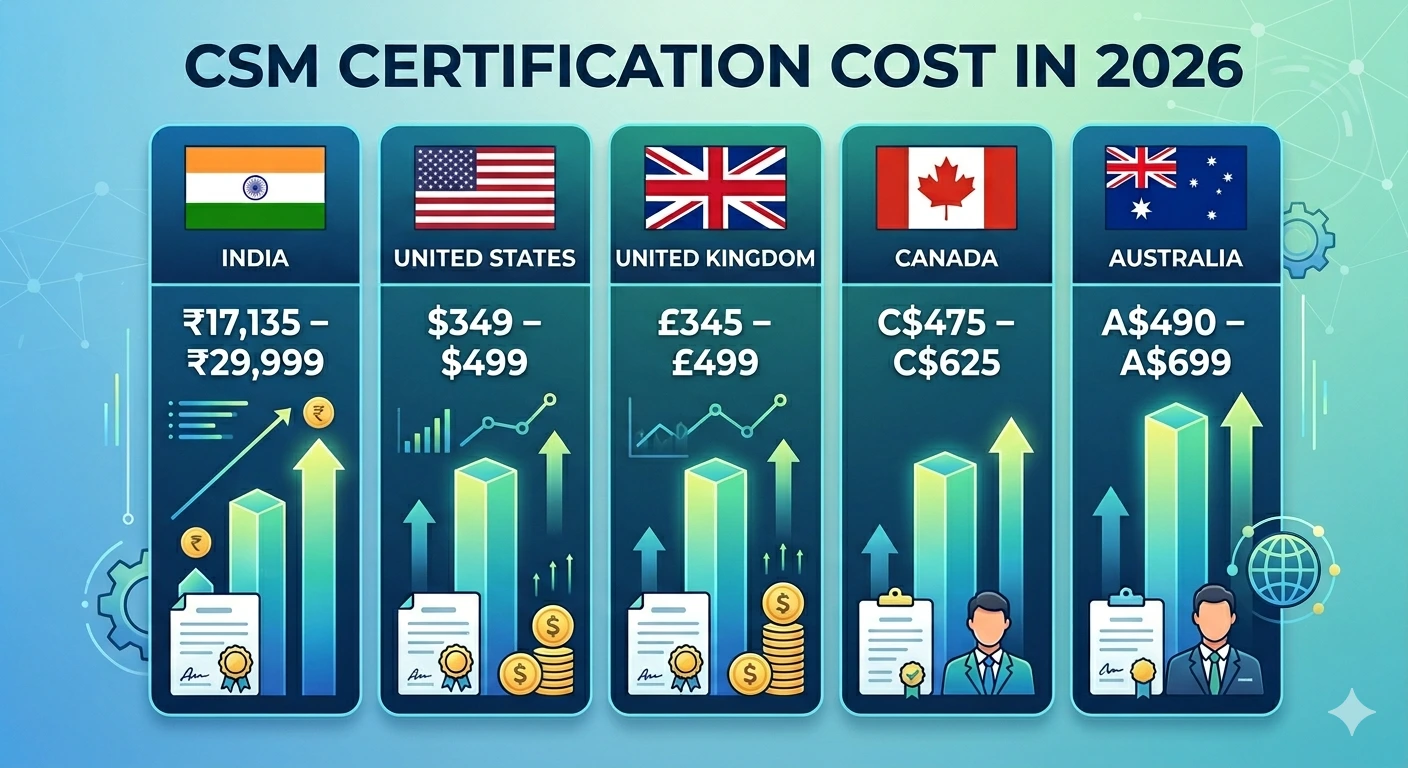
The cost of the CSM certification may vary depending on the training provider, location, and training format (online or classroom). In most cases, the exam fee is included in the training package.
Below are typical estimated price ranges in 2026 for different countries:
| Country | Approximate Cost Range |
| India | ₹17,135 – ₹29,999 |
| United States | $349 – $499 |
| United Kingdom | £345 – £499 |
| Canada | C$475 – C$625 |
| Australia | A$490 – A$699 |
These costs usually include instructor-led training, study materials, and exam access.
Also read: CSM Certification cost
Career Benefits After CSM Certification
Professionals who complete the CSM certification gain several advantages in the job market. Organizations implementing Agile frameworks prefer hiring certified Scrum professionals who understand Agile collaboration and Scrum processes.
Some major benefits include:
- Improved Agile project management skills
- Ability to lead Scrum teams effectively
- Better career opportunities in Agile organizations
- Higher demand for Scrum professionals globally
Because Agile adoption is growing rapidly across industries, many professionals find that CSM certification helps for your career growth by opening new leadership opportunities.
Certified Scrum Master Salary Expectations
Another major reason professionals pursue the certification is the attractive certified scrum master salary offered in Agile-driven organizations.
Salary levels vary based on experience, location, and industry, but Scrum Masters generally receive competitive compensation.
Average salary ranges in 2026:
- India: ₹12 LPA – ₹25 LPA for experienced Scrum Masters
- United States: $95,000 – $130,000 per year
- United Kingdom: £60,000 – £90,000 per year
- Australia: AUD 110,000 – AUD 150,000 per year
Professionals with strong Agile experience and leadership skills can earn even higher salaries as they progress in their careers.
Conclusion
The CSM certification is one of the most accessible and valuable Agile certifications available today. Since there are no strict eligibility requirements, professionals from various backgrounds can enroll in the program and develop strong Scrum knowledge.
Understanding the certification process, training structure, and exam format helps candidates prepare effectively for the certification journey. By learning Scrum fundamentals, reviewing practical examples like a Scrum Case Study, and gaining hands-on training, candidates can successfully pass the certification exam.
For many professionals, earning the certification leads to improved job opportunities, leadership roles, and better salary prospects. Most importantly, CSM certification helps for your career growth by equipping you with the skills required to lead Agile teams and deliver successful projects in modern organizations.
FAQs
1. Is CSM difficult to pass?
Not really. (cite index="3-1">The exam has 35 multiple-choice/true-false questions, a passing score of 24, and a 60-minute time limit.</cite> The bigger challenge is the mandatory two-day course beforehand and truly understanding Scrum concepts, not memorizing them.
2. Is CSM harder than PMP?
Generally no. PMP requires verified experience hours and covers a much broader, more rigorous body of knowledge. CSM is entry-level, with mandatory training instead of an experience requirement, making it more accessible overall.
3. What does CSM certification cost?
Cost depends on the training provider, format, and location, but it usually includes the required two-day course, exam fee, and a Scrum Alliance membership — often ranging from several hundred to over a thousand US dollars. Check current pricing with an authorized trainer since rates change often.
4. Is a CSM certificate worth it?
For those starting out in Agile or Scrum Master roles, yes — it's widely recognized and often listed in job postings. Its real value comes from pairing it with hands-on Scrum experience, not from the credential alone.
5. Does a CSM certificate expire?
Yes, every two years. Renewal requires earning Scrum Education Units (SEUs) and paying a renewal fee.
6. Is PSM harder than CSM?
Often considered so. PSM has no required training, so exam prep is self-driven, and its higher levels get notably tougher. CSM's exam is easier partly because the mandatory two-day course does much of the prep work for you.