






 CSM certification is a top Agile credential for Scrum Masters and Agile practitioners, offering a solid foundation in the Scrum framework.



What is CSM Certification?
The CSM certification is an entry-level credential that validates a professional’s knowledge of the Scrum framework and Agile practices. It is designed for individuals who want to understand how Scrum teams operate and how Agile methodologies help organizations deliver products faster and more efficiently. Candidates can expect the overall scrum master course duration to align closely with the intensive training and practical exercises included in this program.
During the training, candidates learn about:
- The fundamentals of Scrum
- Core Scrum Principles
- Agile team collaboration
- Sprint planning and execution
- Scrum ceremonies and events
Professionals who earn this certification gain knowledge about Scrum best practices, enabling them to guide teams in adopting Agile workflows and improving project delivery outcomes. Organizations across industries often encourage professionals to understand whether Scrum or Agile methodologies are better suited for their projects, making Scrum expertise increasingly valuable.
How Do I get the CSM certification?
To earn the CSM certification, candidates must complete a structured learning and assessment process approved by the Scrum Alliance.
The process generally involves the following steps:
1. Attend the Official Training
Candidates must participate in a two-day training session conducted by a Certified Scrum Trainer (CST).
2. Learn Core Concepts
The training covers Scrum Principles, scrum roles, and responsibilities, and practical applications of the Scrum framework.
3. Take the Certification Exam
After completing the training, candidates receive access to the CSM exam, which tests their understanding of Scrum concepts.
4. Accept the License Agreement
Once the exam is passed, candidates must accept the Scrum Alliance license agreement and complete their membership profile.
After completing these steps, candidates officially receive the CSM certification and become part of the Scrum Alliance community.
What is the CSM certification duration?
The CSM certification duration can be divided into three key stages: training, exam, and certification validity.
| Stage | Duration |
| Training | 16 hours (2 days) |
| Exam | 60 minutes |
| Certification Validity | 2 years |
In most cases, candidates can complete the entire process of obtaining the certification within two days, followed by the exam. This timeline also mirrors typical expectations for the scrum master certification course duration, providing enough time to cover all core concepts and hands-on activities. Once certified, the credential remains valid for two years, after which renewal is required.
CSM Course Duration Explained
The training phase is a crucial part of the CSM certification process. It typically consists of 16 hours of instructor-led learning, usually conducted over two consecutive days.
Key training requirements include:
1. Mandatory Attendance
Candidates must attend the entire training program. Simply purchasing course materials or studying independently is not sufficient to qualify for the certification.
2. Full Participation
Most trainers track attendance carefully. Missing a significant portion of the training may prevent candidates from receiving eligibility for the CSM exam.
3. Live Instruction
Training must be delivered by a Certified Scrum Trainer through either in-person sessions or live virtual classrooms.
During the course, participants gain a deep understanding of Scrum Principles and scrum roles, and responsibilities, preparing them to apply Scrum effectively in real-world projects.
CSM exam Duration and Pattern
After completing the training, candidates must take the CSM exam to earn the certification.
The exam includes the following format:
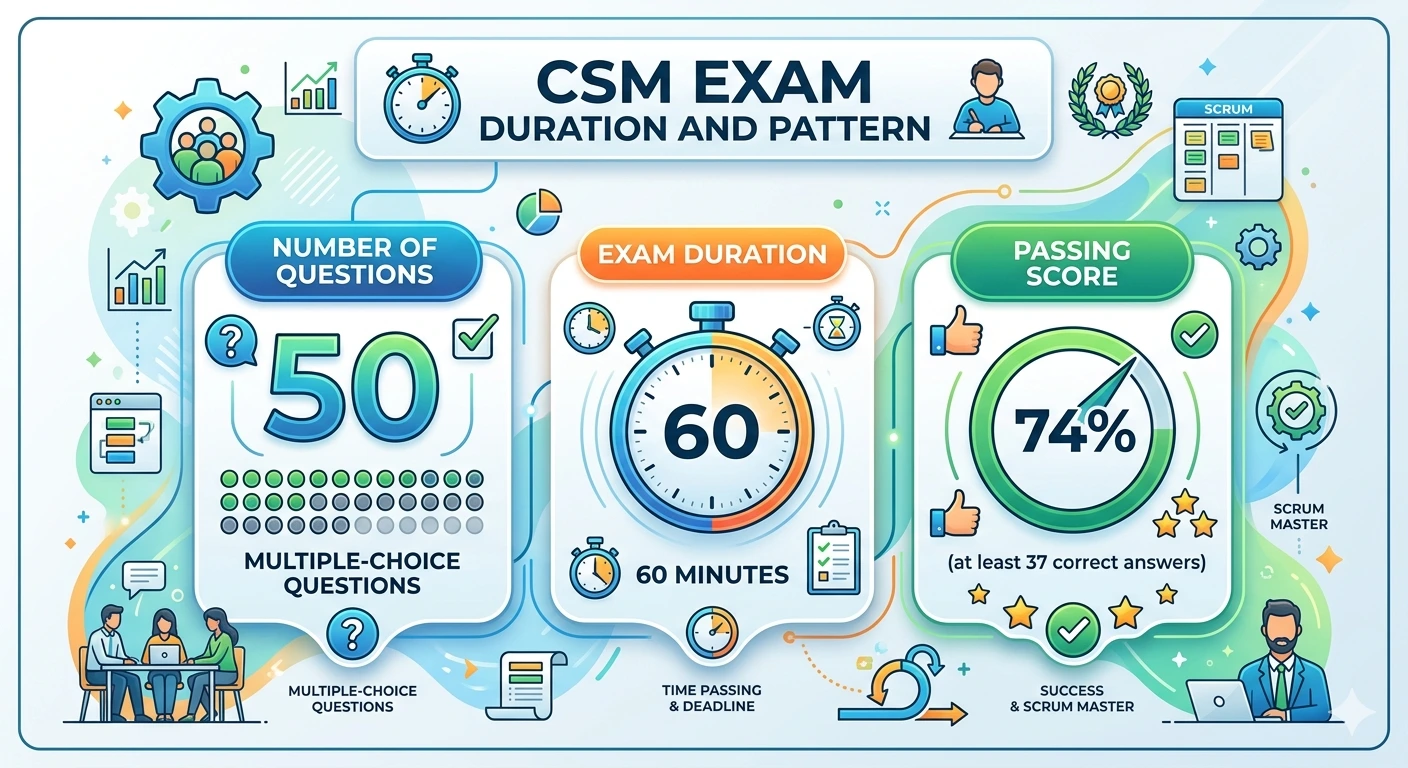
- Number of Questions: 50 multiple-choice questions
- Exam Duration: 60 minutes
- Passing Score: 74% (at least 37 correct answers)
The exam evaluates a candidate’s knowledge of Scrum concepts, Agile practices, and the responsibilities of a Scrum Master. Candidates can also explore updates and structural changes discussed in Scrum Master Exam Format (2026–2027) to better understand the latest exam patterns.
CSM Certification Validity Period
Once you pass the CSM exam, your CSM certification remains valid for two years from the date of issue.
During this period, certified professionals are expected to stay updated with evolving Agile trends and continuously improve their knowledge of Scrum best practices.
Maintaining an active certification demonstrates commitment to professional growth and continuous learning in Agile project management.
How to Renew your CSM certification?
To maintain the validity of the CSM certification, professionals must renew their certification every two years through the Scrum Alliance.
The renewal process involves:
- Earning 20 Scrum Education Units (SEUs) within the two-year period
- Paying a renewal fee of $100
Once these requirements are completed, the certification is renewed and remains active for another two-year cycle.
Activities to Earn SEUs for Renewal
SEUs can be earned by participating in various Scrum and Agile learning activities.
Common ways to earn SEUs include:
- Attending Scrum or Agile workshops and conferences
- Participating in webinars and professional training sessions
- Writing blogs or articles related to Scrum
- Contributing to the Agile community
- Mentoring aspiring Scrum practitioners
These activities help professionals remain updated with the latest developments in Scrum and Agile practices.
Benefits of Renewing your CSM certification
Renewing your CSM certification provides several professional advantages.
Stay Relevant
Renewal ensures that professionals remain updated with evolving Scrum best practices and industry trends.
Career Growth
An active certification strengthens credibility and improves opportunities for leadership roles in Agile organizations.
Access to Resources
Members of the Scrum Alliance gain access to valuable resources, networking events, and professional communities.
Global Recognition
Since the certification is recognized worldwide, maintaining active status demonstrates dedication to continuous professional development.
What Happens If You Don’t Renew Your CSM Certification?
If you fail to renew the CSM certification within the required two-year period, the certification status becomes inactive.
This means:
- You will no longer be recognized as a Certified Scrum Master.
- You will lose access to Scrum Alliance member benefits.
- In some cases, you may need to complete the training again and retake the CSM exam to regain certification.
For this reason, it is recommended to track your renewal timeline carefully and complete the necessary requirements before expiration.
Things To Know About Your CSM Exam
The CSM exam is designed to evaluate your understanding of Scrum fundamentals and Agile workflows.
Important details include:
- Online exam format
- 50 multiple-choice questions
- 60-minute time limit
- Minimum passing score of 74%
Candidates can pause the exam temporarily if needed, but the overall exam duration remains fixed. For more details on the updated exam structure, candidates can review resources related to Scrum Master Exam Format (2026–2027).
What are the best ways to prepare for the CSM Exam?
Preparing effectively for the CSM exam requires a combination of training, reading, and practice.
Recommended preparation strategies include:
Attend the CSM Training
Participate actively in the official training sessions to understand the Scrum framework and Agile practices.
Study the Scrum Guide
The Scrum Guide provides the foundation for understanding Scrum Principles and how Agile teams function.
Practice and Reinforce Learning
Taking practice exams and reviewing real-world scenarios can strengthen your understanding of Scrum concepts.
Many Agile teams also explore frameworks such as Zero Sprint in Agile to prepare the groundwork before the actual sprint cycle begins.
How can I apply for the CSM Exam?
Applying for the CSM exam is a simple process.
Follow these steps:
- Attend the two-day CSM training program.
- After completing the course, you will receive an exam link via email.
- Use the link to access the exam dashboard.
- Complete the test and submit your answers.
Once you pass the exam, you will receive your official CSM certification.
Course Breakdown of the CSM Training
The training program is designed to provide a comprehensive understanding of the Scrum framework in a short period.
The course generally includes:
- Introduction to Scrum and Agile frameworks
- Scrum roles such as Scrum Master, Product Owner, and Development Team
- Scrum events including Sprint Planning, Daily Scrum, Sprint Review, and Sprint Retrospective
- Agile values and teamwork practices
Through this structured curriculum, participants develop the knowledge required to implement Scrum in real organizational environments.
Key Takeaways About CSM Course Duration
Here are the most important points about the CSM certification duration:
- Training typically takes 16 hours over two days
- The CSM exam lasts 60 minutes
- Certification validity is two years
- Renewal requires 20 SEUs and a $100 fee
This short and intensive certification process makes it suitable for working professionals who want to quickly gain Agile expertise.
Conclusion
If you are wondering how long it takes to obtain the CSM certification, the entire process can usually be completed in just two days of training followed by a 60-minute exam. Once certified, the credential remains valid for two years, after which renewal is required to maintain active status.
Renewing your certification ensures you stay updated with evolving Scrum practices and Agile methodologies. Professionals interested in improving organizational performance often explore related concepts like the OKR Cycle and agile Inovation, which complement Scrum frameworks and enhance team productivity.
By completing the certification and maintaining it through continuous learning, professionals can build strong Agile careers and contribute effectively to modern product development environments.