





PgMP Certification Training


-
 Train with a PMI Authorized Training Partner
-
Earn 24 PDUs with live PgMP certification training
-
Real-world case studies and mock exams included
-
Complete PgMP exam application support included

PgMP Certification - Key Features
-
 High quality e-learning content
 High quality e-learning content
PgMP Certification Course Content
- Objectives
- What are PMI-PgMP and PMI
- What are PMI-PgMP and PMI (contd.)
- About the PMBOK® Guide
- Why PgMP Certification
- Prerequisite for the PMI-PgMP Exam
- Important Information About Filling the Application
- PgMP Credentialing Process Overview
- PgMP Credentialing Process Overview (contd.)
- Timeline of the PgMP Credential Process
- PMI-PgMP Exam Syllabus
- Program Strategy Alignment—Tasks
- Program Strategy Alignment—Knowledge and Skills
- Program Life Cycle Management—Tasks
- Program Life Cycle Management—Knowledge and Skills
- Program Benefits Management—Tasks
- Program Benefits Management—Knowledge and Skills
- Program Stakeholder Engagement—Tasks
- Program Stakeholder Engagement—Knowledge and Skills
- Program Governance—Tasks
- Program Governance—Knowledge and Skills
- Objectives
- What is a Project
- What is a Program
- What is a Program (contd.)
- Definition of Program Management
- Key Focus of Program Management
- Example of Program Management
- Ground Rules
- Key Features of Project
- What is a Portfolio
- Hierarchical View: Portfolios, Programs, and Projects
- Relationship between Project, Program, and Portfolio Management
- Definitions of Strategy and Business Value
- Definitions of Vision and Mission
- Strategic Objectives
- Strategic Conditions
- Role of Program Manager
- Responsibilities of a Program Manager
- Prioritization
- Advantages of Using Prioritization Matrix
- Skills of Project and Program Managers
- Skills of Project and Program Managers (contd.)
- Objectives
- What is Strategy
- Migrating from Tactical to Strategic
- Organizational Strategy and Program Alignment
- Organizational Strategy and Program Alignment (contd.)
- Elements of Strategic Alignment
- Key Terms Related to Strategic Alignment
- Example of Strategic Alignment Terms
- Strategic Program Management Tasks
- Program Roadmap
- Environmental Assessment
- Techniques for Environmental Analysis
- Business Scenario
- Knowledge Check
- Business Scenario (contd.)
- Knowledge Check
- Business Scenario (contd.)
- Knowledge Check
- Objectives
- What is a Benefit
- Examples of Benefits
- Relationship Between Program Life Cycle and Program Benefits Management
- Benefits Identification
- Benefits Register
- Benefits Analysis and Planning
- Benefits Realization Plan
- A Typical Pattern of Costs and Benefits
- Benefits Delivery
- Balanced Scorecard: Tracking Benefits Delivery
- Benefits Transition
- Benefits Sustainment
- Business Scenario
- Knowledge Check
- Business Scenario (contd.)
- Knowledge Check
- Objectives
- Introduction to Stakeholder Engagement
- Engagement vs. Management
- Case Study
- Case Study—Solution
- Program Stakeholder Identification
- Classification Models for Stakeholder Analysis
- Case Study
- Case Study—Solution
- Stakeholder Engagement Planning
- Stakeholder Engagement Assessment Matrix
- Stakeholder Engagement
- Program Stakeholder Engagement Tasks
- Program Stakeholder Engagement—Knowledge and Skills
- Objectives
- What is Program Governance
- What is Program Governance (contd.)
- Sample Program Governance Structure
- Program Governance Board Structure
- Program Governance Board Responsibilities
- Program Governance Board Responsibilities (contd.)
- Program Governance Board Responsibilities (contd.)
- Project Management Activities
- Relationship between Program Governance and Program Management
- Common Individual Roles Related to Program Governance
- Program as Governing Bodies: The Governance of Program Component
- Case Study
- Case Study—Solution
- Case Study
- Case Study—Solution
- Other Governance Activities that Support Program Management
- Functional Organization
- Projectized Organization
- Matrix Organization
- Advantages and Disadvantages of Organizational Types
- Objectives
- Program Life Cycle
- Program Life Cycle Attributes
- Program Life Cycle Diagram
- Overview of Life Cycle Phases
- Program Definition
- Program Formulation and Preparation
- Conceptualization Phase
- Setup Phase
- Construction Phase
- Implementation Phase
- Closure Phase
- Program Benefits Delivery
- Program Benefits Delivery (contd.)
- Program Closure
- Mapping of Processes to Life Cycle
- Objectives
- Integration Management Processes
- Program Initiation
- Program Initiation Activities
- Program Roadmap and Program Charter Development
- Program Management Plan Development
- Program Infrastructure Development
- Business Scenario
- Knowledge Check
- Program Scope Planning
- Schedule Management Processes
- Program Schedule Planning
- Financial Management Processes
- Program Cost Estimation
- Program Financial Framework Establishment
- Program Financial Management Plan Development
- Quality Management Processes
- Program Quality Planning
- Resource Planning
- Risk Management Processes
- Program Risk Management Planning
- Communications Management Processes
- Communications Planning
- Program Procurement Planning
- Business Scenario
- Knowledge Check
- Objectives
- Integration Management Processes
- Program Delivery Management
- Program Performance Monitoring and Control
- Program Scope Control
- Program Schedule Control
- Component Cost Estimation
- Program Cost Budgeting
- Program Financial Monitoring and Control
- Financial Management Activities
- Program Quality Assurance
- Program Quality Control
- Resource Prioritization
- Resource Interdependency Management
- Case Study
- Case Study—Solution
- Program Risk Identification
- Program Risk Analysis
- Program Risk Response Planning
- Program Risk Monitoring and Control
- Risk Supervision
- Information Distribution
- Information Gathering and Retrieval Systems
- Information Distribution Methods
- Program Performance Reporting
- Case Study
- Case Study—Solution
- Program Procurement
- Program Procurement Administration
- Objectives
- Program Transition and Benefits Sustainment
- Program Closure
- Generation of Final Reports
- Resource Disposition
- Knowledge Transition
- Program Closeout
- Case Study
- Case Study—Solution
- Financial Management Processes
- Program Financial Closure
- Case Study
- Case Study—Solution
- Program Procurement Closure


Upcoming PgMP Certification Training Batches

Currently, we don't have any batch scheduled in your region.
You can request a new batch on your preferred date!
The work force is your asset. Up-Skill them with our Corporate Training Programs!
-
Unleash In-Demand Skills Across the Enterprise
-
Align Skill Development with Business Objectives
-
Drive Increased Employee Productivity
-
Leverage Immersive Learning
Program Management Professional Course - Overview
a. Valuable Insights of StarAgile's PgMP Certification Training
- Gain 24 PDUs upon completing our PMI PgMP certification training, fully recognized by PMI.
- PgMP online courses include access to real-world case studies, mock exams, and 50+ practice questions designed by industry experts.
- Receive complete PgMP exam application support — from documentation to Panel Review preparation.
- Learn from PMI-authorized trainers with hands-on program management experience across global industries.
b. How PgMP Certification Impacts Your Career
The program management professional certification positions you among the most sought-after professionals in the world. With fewer than 5,000 PgMP holders globally, earning this credential instantly sets you apart. PgMP-certified professionals earn 42% more than non-certified peers, with average salaries reaching USD 134,000 annually. Whether you are aiming for a Program Manager, Senior Program Manager, or Principal Program Manager role, this certification accelerates your path to senior leadership. Enroll in the best PgMP online training at StarAgile and take the most important step in your program management career.
c. PgMP Eligibility and Prerequisites
Pathway A — High School Diploma, 4 years of project management experience or + 7 years of program management experience, all within the last 15 years.
Pathway B — Bachelor's Degree 4 years of project management experience or 4+ years of program management experience, all within the last 15 years.
Pathway C — GAC Accredited Degree 3 years of project management experience or + 3 years of program management experience, all within the last 15 years.
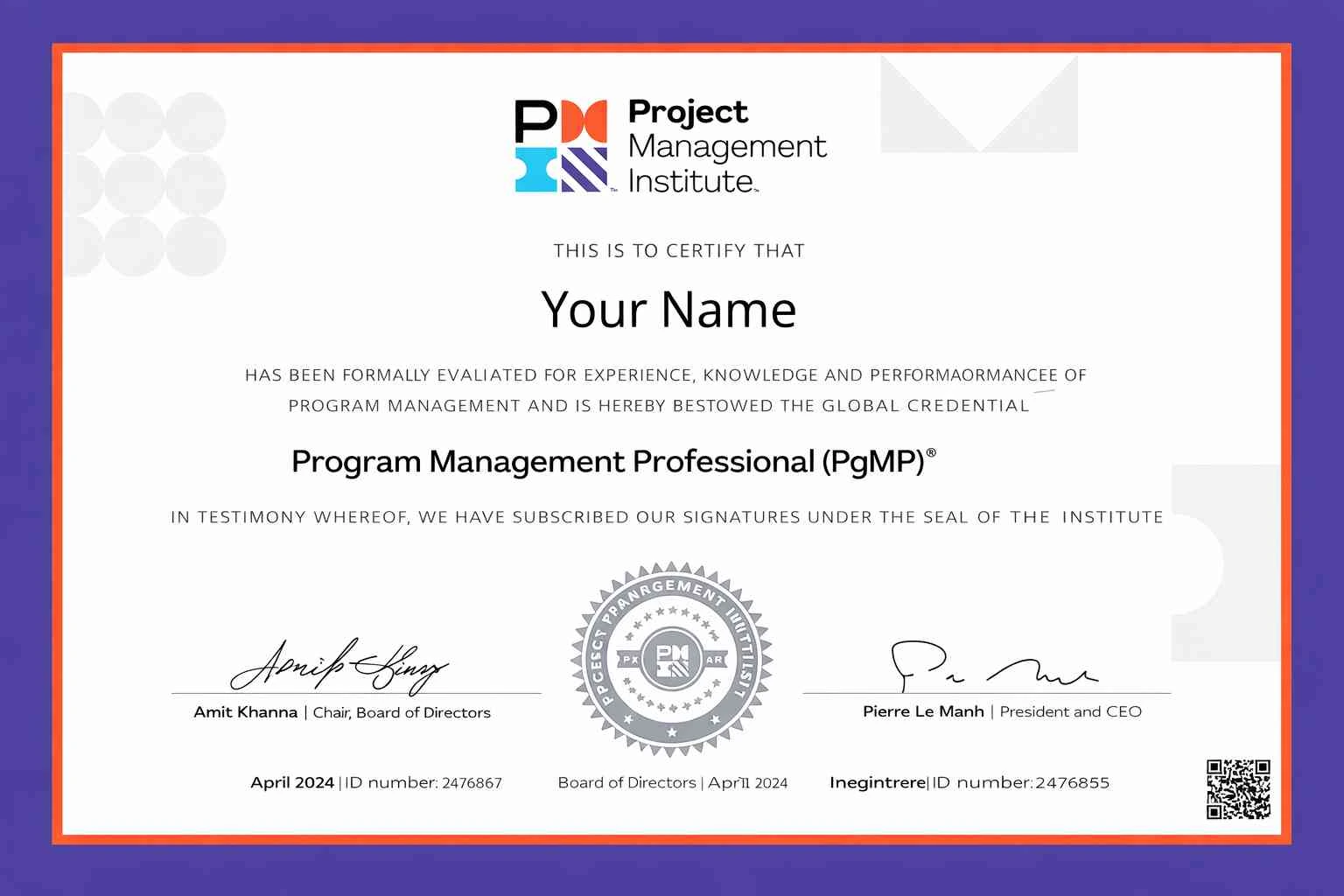
Program Management Professional Certificate
Program Management Professional Certification FAQs
StarAgile's program management professional training includes live instructor-led sessions delivered by PMI-authorized experts, PMI-approved study materials, mock exams, practice questions, and real-world case studies. The PgMP training covers all key domains — Program Strategy Alignment, Governance, Benefits Management, Stakeholder Engagement, and Program Lifecycle. Application support and post-training mentorship are also included to help you navigate the two-phase evaluation process confidently.
StarAgile is a PMI Authorized Training Partner (ATP), meaning the program management courses delivered meets PMI's global quality standards. This ensures curriculum alignment with the latest PgMP Exam Content Outline, PMI-approved instructors, and fully recognized PDUs. As an ATP, StarAgile is an officially endorsed provider for PMI PgMP certification training, giving learners confidence in the quality and credibility of their preparation.
StarAgile's PgMP training program fulfills PMI's minimum requirement of 24 contact hours of formal program management training. Sessions are structured across multiple live online classes and available in weekday and weekend formats to suit working professionals. Additional self-study using the provided materials, mock tests, and revision resources is recommended to ensure full exam readiness after completing the scheduled sessions.
The program management professional pgmp certification cost at StarAgile varies based on PgMP certification fees charged by PMI: USD 800 for PMI members and USD 1,000 for non-members. The re-examination fee is USD 600 for members and USD 800 for non-members. Contact StarAgile directly for the most current program management professional PgMP course fee and available discounts.
Visit the StarAgile website, select the program management professional course, choose your preferred schedule — weekend, weekday, or PgMP online training course — and complete enrollment. StarAgile's counselors can help you verify your eligibility for PMI requirements and guide you through the application documentation before enrollment. Group enrollments and flexible payment options are also available. Reach out to the StarAgile team directly for personalized guidance.
Yes, StarAgile offers live instructor led training. The live instructor-led option is the best PgMP online training — it provides real-time interaction, peer collaboration, and immediate resolution of doubts.
Yes, StarAgile issues a course completion certificate upon finishing the program management courses. As a PMI Authorized Training Partner, this certificate is recognized by PMI and can be submitted as part of your exam application to meet the training-hour requirement. You also earn PDUs on completion, which are credited to your PMI account and are valid for both exam eligibility and maintaining existing PMI certifications.
The PgMP training course curriculum covers the complete PgMP Exam Syllabus across three structured modules. Module 1 includes Program Management Foundation, Framework and Lifecycle, Program Definition, Strategic Alignment, and Benefits Management. Module 2 covers Program Governance, Stakeholder Engagement, and Supporting Process Activities across Definition, Benefit Delivery, and Closure phases. Module 3 focuses on Program Management Applications, exam tips, and sample exam questions.
Yes, StarAgile provides comprehensive PgMP Study Materials, including PMI-approved courseware, study guides, practice question banks, and reference notes. Session recordings are available for a defined period after live training for revision. Mock exams and timed practice tests are also accessible for ongoing PgMP Exam Preparation.
Yes, real-world case studies are integrated throughout program management courses. These scenarios are drawn from actual organizational challenges across industries such as IT, Finance, Healthcare, Energy, and Government. They help candidates develop the contextual judgment required for scenario-based exam questions and prepare them for the real challenges of program management practice — not just exam performance.
Yes. StarAgile's PgMP certification training is designed for working professionals. Weekend batches, weekday evening sessions, and fully online PgMP training online formats allow you to attend without disrupting your career. The PgMP program management professional training is structured to allow full-time professionals to complete it without taking time off work.
Yes, StarAgile offers weekend batches, weekday evening sessions, and a fully flexible PgMP online training course format to accommodate diverse schedules. The best PgMP online training option lets you join live sessions remotely from anywhere or access recorded content on your own schedule. These flexible formats ensure that the program management professional PgMP training fits seamlessly into your professional and personal commitments.
StarAgile's PMI PgMP training sessions are conducted by PMI-authorized, industry-certified trainers with direct hands-on experience managing programs across sectors, including IT, Finance, Energy, Healthcare, and Government. Beyond curriculum delivery, these instructors serve as mentors — providing personalized feedback on mock exam performance, guidance on application documentation, and ongoing support to resolve any doubts throughout the best PgMP training experience.
Yes, StarAgile's PgMP online training course is highly interactive. Live sessions include dedicated Q&A time and open discussions after each topic. Participants can raise questions in real time via audio, video, or chat. Between sessions, structured doubt-clearing is available, and post-training support extends this access further — ensuring no concept remains unclear during your program management professional training journey.
Yes, mock exams and practice tests are a core part of StarAgile's PgMP certification training. Full-length timed mock exams simulate the actual exam format, while topic-specific practice questions after each module support domain-level PgMP Exam Preparation. Detailed answer explanations are provided for each practice question, helping candidates understand the reasoning behind correct responses and build the exam confidence needed to pass the PgMP certification exam.
Yes, StarAgile provides comprehensive application support as part of its program management professional PgMP training. Trainers assist you in structuring your experience summaries correctly, understanding what PMI's Panel Review requires, and avoiding common application errors that can delay your application. Guidance on audit readiness and documentation is also included, ensuring your PgMP certification training online experience covers the full application journey — not just exam preparation.
Yes, StarAgile provides continued access to session recordings, study materials, and mock exam resources for a defined period after the scheduled PgMP certification training concludes. Post-training mentorship also remains available for application queries, domain revision, and mock exam feedback — ensuring your preparation remains supported through the program management professional exam day.
Yes, post-training mentorship is a key part of StarAgile's program management professional PgMP training. After sessions conclude, participants continue to receive support for resolving doubts, finalizing applications, receiving mock exam feedback, and targeted revision in specific domains. This extended support ensures that every participant who completes StarAgile's PgMP course online has the guidance needed to cross the finish line — earning the certification, not just completing the coursework.
Yes, the best PgMP online training is ideal for experienced project managers transitioning into program management. The program management professional training online bridges conceptual gaps between the two roles, covering strategic alignment, governance, and benefits realization. StarAgile's PgMP online training course includes case studies and practical exercises that simulate real program management decision-making, giving transitioning professionals both exam readiness and genuine on-the-job preparedness.
StarAgile's PgMP certification training builds practical skills in program lifecycle management, stakeholder engagement strategy, governance structure design, benefits tracking, and cross-project risk management. Through scenario workshops and case studies, you also develop situational judgment for real program management decisions. These skills are directly transferable to the workplace — ensuring that after completing the program management professional training, you are ready to perform, not just certified.
StarAgile's program management professional PgMP training course prepares you for real roles through a combination of PMI-aligned curriculum, real-world case studies, governance frameworks, and practical scenario workshops. The training builds the strategic thinking, stakeholder leadership, and decision-making skills that program managers use daily — not just what the exam requires. Combined with post-training mentorship and a structured learning journey, the PgMP training course gives you the tools and confidence to lead programs and deliver organizational impact from day one.
Program Management Professional Training - Exam FAQS
The PgMP certification exam is a two-phase evaluation administered by PMI. The first phase is a Panel Review, where PgMP-certified professionals assess your program management experience summaries. Candidates who clear the panel review then sit for a computer-based exam of 170 multiple-choice questions, to be completed within four hours. The exam tests strategic thinking, governance, stakeholder management, and lifecycle decision-making through scenario-based questions.
The PgMP exam includes 170 multiple-choice questions. Of these, 150 are scored, and 20 are unscored pretest questions embedded throughout the exam. Since pretest questions cannot be identified during the exam, every question must be approached with equal effort. The total time allotted for the program management professional exam is four hours.
The PgMP certification exam must be completed within four hours (240 minutes). The exam consists of 170 questions, allowing just over 1 minute per question, making strong time management essential. StarAgile's PgMP certification training includes a timed mock exam to help candidates develop the pace and accuracy needed to complete the program management professional exam within the allotted time.
PMI does not disclose a fixed numerical PgMP passing score. Instead, performance is evaluated through psychometric analysis across all exam domains. Your result report indicates proficiency levels ranging from "Below Target" to "Above Target" in each domain. StarAgile's PgMP certification training builds well-rounded competency across all domains, enabling candidates to perform consistently rather than aiming for a minimum threshold.
The PgMP exam consists primarily of scenario-based multiple-choice questions. Each presents a real-world program management situation and asks candidates to choose the most appropriate response. Questions test practical judgment across governance, stakeholder engagement, strategic alignment, and benefit realization scenarios. Rote memorization is insufficient — contextual application of PMI's program management standards is what the program management professional exam truly measures.
Yes, the PgMP exam is one of the most demanding credentials in the profession. Its difficulty lies in the scenario-based question format, the two-phase evaluation including a Panel Review, and the depth of experience and knowledge required. However, with structured PgMP exam preparation through StarAgile's certified training program, including mock tests and expert guidance, candidates consistently clear the exam on their first attempt.
To register for the PgMP exam, create an account on pmi.org and complete the online application by documenting your education, project management, and program management experience as per PMI's eligibility requirements. After PMI reviews and approves your application, pay the PgMP certification fees to trigger the Panel Review phase. Once you pass the panel review, schedule your exam through Pearson VUE. StarAgile provides application support as part of the PgMP certification training to streamline this process.
Yes, PMI offers the PgMP exam in an online proctored format through Pearson VUE, allowing candidates to take it from home or the office. You will need a stable internet connection, a webcam, a microphone, and a quiet, private space for the full four hours. StarAgile's PgMP training online program includes guidance on preparing for the remote proctoring experience, so candidates are fully ready on exam day.
Results are available immediately upon completing the computer-based PgMP exam — you will see your pass or fail outcome on screen as soon as you submit. A performance report showing domain-wise proficiency is also provided. PMI processes the official certification and updates your credential registry within a few business days of passing, after which you can use the PgMP designation professionally.
If you do not pass the program management professional exam on your first attempt, PMI allows up to three attempts within one year of the first exam date. Each retake requires payment of re-examination fees: USD 600 for PMI members and USD 800 for non-members. StarAgile provides post-training support to help candidates revisit weak domains and improve performance for subsequent attempts using mock tests and targeted study guidance.
Yes, PMI allows candidates to retake the program management professional exam up to 2 additional times within 1 year of their first attempt, for a total of 3 attempts. Each retake incurs a fee of USD 600 for PMI members or USD 800 for non-members. After each failed attempt, a performance report is provided to guide targeted preparation. If all three attempts are unsuccessful within the year, candidates must wait before reapplying.
Yes, PMI specifies clear PgMP Eligibility Criteria. Set A (secondary diploma holders): 48 months of project management experience OR an active PMP, plus 84 months of program management experience within the last 15 years. Set B (bachelor's degree holders): 48 months of project management experience OR an active PMP, plus 48 months of program management experience within the last 15 years. All candidates must also complete at least 24 hours of formal program management training.
Essential PgMP Study Materials include The Standard for Program Management (5th Edition), the PMBOK Guide, the PgMP Examination Content Outline (ECO), and the PgMP Handbook published by PMI. PMI's official sample questions are also valuable. StarAgile supplements these with curated mock exams, timed practice tests, and topic-specific notes as part of the PgMP training course — providing a comprehensive PgMP Study Guide for effective exam preparation.
PMI allows a maximum of three PgMP exam attempts within one year from the date of the first sitting. If you do not pass on the first try, two additional attempts are available within the same eligibility year. Each retake requires payment of re-examination fees. StarAgile's PgMP certification training online is designed to maximize your first-attempt success rate through comprehensive preparation, mock tests, and expert mentorship.
Yes, scenario-based questions are the predominant format in the program management professional exam. Each question presents a realistic program management situation and asks candidates to identify the most appropriate action. Effective answers require applying PMI's program management standards contextually, not just recalling definitions. StarAgile's PgMP certification training dedicates significant time to scenario analysis workshops that build the situational judgment the exam demands.
Effective PgMP Exam Preparation starts with reviewing the PgMP Examination Content Outline (ECO) and The Standard for Program Management (5th Edition). Enroll in a PMI Authorized Training Partner's program management professional PgMP training for structured, expert-led study. Use mock exams regularly to assess readiness, target weaker domains, and simulate timed exam conditions. Supplement with PMI's official sample questions and join a PMI chapter for peer learning and networking support.
After completing the PgMP certification training, apply for eligibility with PMI if not already done, complete the Panel Review, and pay the PgMP certification fees. Once approved, you can schedule the exam through Pearson VUE at a time that suits your preparation timeline. PMI allows a 12-month window to schedule after payment. StarAgile recommends scheduling the program management professional exam only when mock exam scores reflect consistent readiness.
Yes, the PgMP exam is available globally through Pearson VUE testing centers in over 180 countries, as well as in an online proctored format for candidates without a convenient testing center nearby. This makes the PMI PgMP certification accessible to professionals worldwide. Whether you complete the program management professional training online in India, the US, the UK, the Middle East, or Southeast Asia, you can sit for the exam without any geographical barrier.
PMI periodically reviews and updates the PgMP Exam Syllabus based on Role Delineation Studies that gather input from practicing program managers worldwide. Updates may involve changes to domain weightings, new task categories, or the removal of outdated content. StarAgile continuously monitors PMI announcements and updates its program management professional PgMP training curriculum accordingly — ensuring learners always study the current, exam-relevant version of the content.
The PgMP exam is based on PMI's official standards. The primary reference is The Standard for Program Management — Fifth Edition, which defines the five performance domains tested in the exam: Strategy Alignment, Benefits Management, Stakeholder Engagement, Governance, and Life Cycle Management. The PMBOK Guide provides supplementary context, and the PgMP ECO outlines specific exam tasks. StarAgile's program management professional PgMP training is fully aligned with these current PMI standards.
PgMP Certification - Advanced FAQs
The program management professional certification (PgMP) is an advanced, globally recognized credential issued by PMI. It validates a senior-level professional's ability to coordinate multiple related projects as a unified program, aligning outcomes with organizational strategy. It is one of the most exclusive credentials in the profession, with fewer than 5,000 holders worldwide, and it demonstrates expertise in governance, benefits realization, and strategic leadership.
The program management professional course is ideal for experienced professionals, including Program Managers, Senior Program Managers, Project Directors, PMO Heads, Portfolio Managers, and Project Sponsors. It is also valuable for IT Project Managers, Product Managers, and Project Coordinators who manage or contribute to large programs and are ready to move into strategic, enterprise-level leadership roles.
Project management focuses on delivering a specific output within defined constraints of time, cost, and quality. Program management coordinates multiple related projects as a unified program to deliver strategic benefits that individual projects cannot achieve independently. A program manager aligns project outcomes with long-term organizational goals, manages interdependencies, and ensures benefits realization beyond project closure — a broader, more strategic scope than project management.
The program management professional certification opens doors to high-value roles, including Program Manager (~USD 123,000/year), Senior Program Manager (~USD 195,000/year), Program Manager IV (~USD 150,000/year), and Principal Program Manager (~USD 220,000/year). Top hiring companies include Google, Apple, Cisco, JP Morgan, and Walmart. PgMP Job Opportunities span IT, Finance, Healthcare, Energy, and Government sectors, with demand projected to grow 33% through 2027.
PgMP-certified professionals are in high demand across IT, Banking and Finance, Healthcare, Energy and Utilities, Government, Manufacturing, Telecommunications, and Construction. Companies such as Oracle, Cisco, Apple, JP Morgan, Walmart, and Symantec actively hire PgMP-certified professionals for senior roles. The PgMP certification is relevant across all industries where large-scale, multi-project programs are central to strategic organizational execution.
The program management professional certification directly improves career prospects by validating senior-level program management expertise recognized globally. PgMP-certified professionals earn 42% more than non-certified peers, with an average salary of USD 134,000. PgMP Career Growth statistics show 58% of holders advanced to higher roles after certification, and 23% received an immediate salary hike — making it one of the highest-return credentials in the management profession.
Yes. PgMP-certified professionals earn, on average, 42% more than their non-certified counterparts. The average annual PgMP Salary is approximately USD 134,000. Role-specific averages range from USD 123,000 for Program Managers to USD 220,000 for Principal Program Managers. The program management professional PgMP course online is among the most financially rewarding professional investments, with 23% of certified professionals receiving an immediate salary increase upon certification.
Yes, the program management professional certification is globally recognized and issued by PMI — the world's most authoritative project management body. Organizations across North America, Europe, Asia-Pacific, the Middle East, and Africa value it. PMI's talent gap analysis shows that 75% of global program management demand is expected to come from rapidly growing economies, reinforcing the international relevance of the PMI PgMP certification across industries and geographies.
PgMP certification training builds strategic thinking, governance, and stakeholder management skills. You will develop program lifecycle expertise, program-level risk management, resource and budget allocation across multiple projects, and benefits realization planning. Leadership competencies, including communication, conflict resolution, and decision-making under ambiguity, are also developed through scenario-based exercises and case studies throughout the program management professional training.
The program management professional certification is valid for three years. To maintain it, PgMP holders must earn 60 Professional Development Units (PDUs) within the three-year cycle through PMI-recognized activities such as training, events, self-study, mentoring, and active practice. After earning the required PDUs, certification holders submit a renewal application through the PMI portal along with the applicable renewal fee.
Yes, the PgMP certification must be renewed every three years by earning 60 PDUs through PMI's Continuing Certification Requirements (CCR) program. PDUs can be earned via PMI-approved training, webinars, chapter events, self-directed learning, active practice, and mentoring. Once the required PDUs are logged in the PMI portal and the renewal fee is paid, the certification is extended for another three-year cycle.
PgMP holders must earn 60 PDUs every three years under PMI's Continuing Certification Requirements program. PDUs should be distributed across PMI's Talent Triangle — Technical, Leadership, and Strategic and Business Management. Qualifying activities include PMI-approved training programs, events, self-directed learning, active program management practice, and mentoring. StarAgile's program management professional course contributes PDUs toward both exam eligibility and ongoing certification maintenance.
Yes, many experienced project managers transition into program management roles after completing PgMP certification training. The program management professional course bridges the conceptual gap between the two roles — helping project managers expand their thinking from individual project delivery to strategic program coordination, interdependency management, and benefits realization. StarAgile's PgMP training online includes practical exercises and governance frameworks that candidates can begin applying immediately.
Key leadership skills for the program management professional certification include stakeholder influence and communication, strategic decision-making in ambiguous contexts, conflict resolution across project teams, change management, and the ability to mentor and develop project managers. These competencies are central to both the PgMP exam and real program management practice. StarAgile's PgMP training course integrates leadership skill development through scenario workshops and interactive case discussions.
Program management serves as the bridge between organizational strategy and execution. Program managers ensure that the collective output of multiple projects delivers strategic benefits aligned with the organization's long-term objectives. Through Program Strategic Alignment and Benefits Management — core domains in the PgMP exam — program managers track, adjust, and sustain strategic value delivery. This makes certified program management professionals essential to any organization's strategic execution.
Program managers commonly use scheduling tools like Microsoft Project and Primavera, collaboration platforms such as JIRA, Confluence, and SharePoint, risk registers and heat maps for program-level risk management, benefits realization dashboards, and stakeholder engagement matrices. The PgMP training course builds conceptual proficiency in applying these tools within governance and lifecycle frameworks, equipping you to confidently adapt to any organization's technology suite.
Yes, the program management professional course is specifically designed for senior professionals. The PgMP certification targets practitioners operating at the strategic and enterprise level — including Program Directors, Portfolio Managers, PMO Heads, and organizational leaders. The curriculum addresses governance, strategic alignment, and benefits realization, all of which directly apply to senior leadership responsibilities. Extensive real-world experience is a prerequisite, ensuring the PgMP peer community remains a group of accomplished, credentialed practitioners.
The PgMP is positioned above the PMP in PMI's certification hierarchy. While PMP validates individual project management expertise, the program management professional certification validates the ability to manage multiple related projects as a strategic program. The PgMP requires more experience, includes a Panel Review, and is held by fewer than 5,000 professionals globally — making it more exclusive. It commands 42% higher earnings than non-certified peers, surpassing the salary premium of most other PMI credentials.
Program managers are responsible for strategic alignment, coordinating multiple project managers, managing cross-project interdependencies, overseeing program finances and resources, tracking benefits realization, and engaging senior stakeholders. They establish governance frameworks, manage steering committees, resolve cross-project conflicts, and communicate program progress at the executive level. The program management professional course equips you to handle all of these responsibilities effectively with PMI-aligned frameworks and practical tools.
Organizations prefer PgMP-certified professionals because certification provides verified proof of competence in managing complex, high-stakes programs. It signals mastery of governance, benefits realization, and strategic alignment — reducing the risk of program failure. The projected talent shortage in program management is expected to cost the global economy USD 208 billion in GDP over the next decade, making certified professionals even more valuable. The 42% salary premium reflects the real organizational value organizations place on the program management professional certification.
Distinctions and Achievements

About Program Management Professional Course
What is Program Management Professional (PgMP) Certification?
The Program Management Professional (PgMP) certification is an advanced, globally recognized credential offered by the Project Management Institute (PMI). It is designed for experienced professionals who manage multiple related projects as a coordinated program, driving strategic outcomes that individual projects cannot deliver on their own. Unlike foundational certifications, PgMP validates your ability to align programs with organizational strategy, govern complex interdependencies, manage senior stakeholders, and sustain long-term benefits realization. With fewer than 5,000 holders worldwide, it is one of the most exclusive credentials in the profession — a true mark of senior-level program management expertise.
Benefits of Program Management Professional Certification
StarAgile's program management professional training is structured to give you every advantage on your journey to PgMP certification. As a PMI Authorized Training Partner, StarAgile ensures that every aspect of your learning experience is aligned with the highest global standards — from curriculum design to trainer quality and post-training support.
What is Included in StarAgile's PgMP Course
- Live Instructor-Led Sessions — Learn directly from PMI-authorized trainers with real-world program management expertise across diverse industries.
- 24 PDUs — Earn 24 Professional Development Units upon completing the PgMP course, fully recognized by PMI for certification eligibility and renewal.
- PMI-Approved Courseware — Study with materials aligned to the latest PgMP Exam Content Outline, including the Standard for Program Management.
- Mock Exams and Practice Questions — Build exam confidence through timed full-length mock tests and domain-specific practice questions.
- Application and Panel Review Support — Receive step-by-step guidance on documenting your experience and preparing for PMI's Panel Review process.
- Flexible Learning Formats — Access the PgMP training in a live virtual format to match your schedule.
- Post-Training Mentorship — Continue receiving expert support for doubt resolution and exam preparation even after sessions conclude.
Benefits of Earning the PgMP Certification
- Step into high-value roles across IT, Finance, Healthcare, Government, and Manufacturing globally.
- Join an elite group of fewer than 5,000 PgMP-certified professionals worldwide.
- Gain recognition from top employers, including Google, Apple, Cisco, JP Morgan, and Walmart.
- Demonstrate strategic leadership capability that organizations trust for enterprise-level programs.
- Sustain your credential with a clear PDU roadmap supported by StarAgile's ongoing learning.
Comprehensive Training Solutions for Enterprises













People also viewed courses like