






 The CSM exam, offered by the Scrum Alliance, is essential for professionals seeking expertise in Agile and Scrum.



What is the CSM Exam?
The CSM exam is designed to test a candidate’s knowledge of the Scrum framework, Agile values, and collaborative team practices. After completing the official training from a Certified Scrum Trainer (CST), candidates become eligible to take the certification exam.
The exam primarily evaluates your understanding of:
- Scrum roles and responsibilities
- Scrum events and ceremonies
- Scrum artifacts and documentation
- Agile principles and Scrum framework
- Team collaboration practices
Professionals who gain this certification often see increased Job opportunities across technology, finance, healthcare, and product-based organizations. Many industries are rapidly adopting Agile frameworks, where Scrum practices are driving faster delivery and improved team productivity.
Also Read: Role of Scrum in The New York Fintech Industry
Eligibility for the CSM
There is no strict educational requirement or professional prerequisite to apply for the certification. However, completing official training is mandatory before taking the CSM exam.
To meet the Eligibility for the CSM, candidates must:
- Attend a two-day Scrum training conducted by a Certified Scrum Trainer (CST)
- Understand the fundamentals of Scrum and Agile principles
- Learn about Scrum roles, events, and workflow processes
Although prior experience in Agile environments is not compulsory, having a basic understanding of Scrum concepts can significantly help candidates perform well in the exam.
Also Read: Agile and Scrum in HealthCare Australia
How to Obtain the Certification
To obtain the certification, candidates must follow a structured learning path.
First, enroll in an official CSM Certification course conducted by a Certified Scrum Trainer. The training usually lasts two days and provides an in-depth
understanding of Scrum practices, frameworks, and real-world implementation.
During the course, participants learn about:
- Scrum framework and Agile principles
- Scrum roles and responsibilities
- Sprint planning and daily scrum meetings
- Product backlog management
- Agile performance tracking using Scrum Metrics
After successfully completing the training, candidates receive access to the CSM exam platform where they can take the online certification test.
CSM Exam Format in 2026 (Quick Overview)
| Feature | Details |
| Exam Type | Online, Web-based |
| Number of Questions | 50 Multiple Choice Questions |
| Time Limit | 60 Minutes |
| Passing Score | 74% |
| Minimum Correct Answers | 37 Questions |
| Attempts | Two free attempts |
This format allows candidates to complete the exam within an hour while testing their understanding of Scrum concepts and Agile methodologies.
Key Features of the CSM exam
The CSM exam has several candidate-friendly features that make the testing process easier and more flexible.
Open Book Exam
Candidates are allowed to refer to the Scrum Guide, training materials, and course notes while taking the exam. This helps reinforce conceptual understanding rather than memorization.
Navigation Flexibility
The exam platform allows candidates to:
- Skip questions
- Bookmark questions for later review
- Move forward and backward within the exam
Immediate Results
Once the exam is submitted, candidates immediately see their score displayed on the screen.
Pause and Restart Option
Unlike proctored exams, the exam platform may allow candidates to pause and resume the exam if technical issues occur. However, it is always recommended to check the official instructions provided during registration.
CSM Examination Pattern
The CSM exam format is designed to test the practical understanding of Scrum principles rather than theoretical memorization.
The exam consists of 50 multiple-choice questions that must be completed within 60 minutes. To pass the exam, candidates must answer at least 37 questions correctly, which corresponds to a 74% passing score.
Important highlights of the examination pattern include:
- Online web-based exam
- 50 objective questions
- 1 hour time duration
- Minimum 37 correct answers required to pass
- Flexible navigation during the exam
The questions mainly evaluate a candidate’s understanding of Scrum roles, Agile values, team collaboration, and iterative development practices.
Exam Topics Covered
The CSM exam evaluates multiple areas of the Scrum framework. These topics ensure candidates understand how Scrum teams operate in real project environments.
Major exam topics include:
- Scrum roles and responsibilities
- Scrum events and timeboxes
- Scrum framework and principles
- ScrumMaster role and servant leadership
- Scrum artifacts and Definition of Done
Candidates are also expected to understand concepts related to scrum artfacts, backlog management, sprint reviews, and retrospective meetings.
CSM Exam Question Types: What to Expect
The CSM exam typically mixes three kinds of questions:
- Direct knowledge/definition questions — straightforward recall of Scrum terms, roles, artifacts, and events (e.g., "Who owns the Product Backlog?" or "What is a
- Sprint Retrospective for?"). These test whether you know the Scrum Guide itself.
- Application/scenario-based questions — short situational prompts where you must decide what a Scrum Master, Product Owner, or Developer should do next (e.g., a team struggling with mid-sprint changes, or a Daily Scrum turning into status reporting). These test whether you can apply Scrum concepts in practice, not just recite them.
- Best-response questions — questions with multiple plausible-looking answers, where you must pick the one most aligned with Scrum values (self-management, empiricism, minimal top-down control). These are designed to catch candidates who default to traditional project-management thinking instead of a true Scrum mindset.
CSM Exam Difficulty: What Makes the Exam Challenging?
The CSM exam trips up more candidates than its reputation suggests, and it's usually not because the material is obscure. A few specific factors make it harder than a typical memorization-based test:
It tests application, not just recall: You can know every definition in the Scrum Guide by heart and still struggle, because most questions ask you to apply Scrum principles to a specific situation rather than define a term. The exam wants to know whether you'd recognize the right move in a messy, real-world moment — not whether you can recite what a Sprint Backlog is.
The Scrum Master role is easy to misunderstand: Many candidates come from traditional project-management backgrounds and instinctively reach for command-and-control answers — assigning tasks, enforcing deadlines, stepping into decisions that belong to the team. The exam is specifically designed to catch that instinct. Truly understanding the Scrum Master as a servant-leader and facilitator (not a manager) is one of the harder mental shifts candidates have to make.
Choosing the "most" correct answer, not just "a" correct answer: Several answer options often sound reasonable at first glance. The difficulty isn't spotting the wrong answers — it's distinguishing between two or three answers that all seem plausible and picking the one that best reflects genuine Scrum values like self-management, transparency, and empiricism. This requires deeper internalization of the mindset, not just familiarity with the vocabulary.
Domain Breakdown of the CSM Exam
The exam covers different Scrum domains with specific weightage. Understanding this distribution helps candidates focus on the most important topics during preparation.
Typical domain weightage includes:
- Scrum Master Role – 22%
- Scrum Team – 20%
- Scrum Events – 20%
- Scrum Artifacts – 20%
- Agile Fundamentals – 6%
- Scrum Theory and Values – 6%
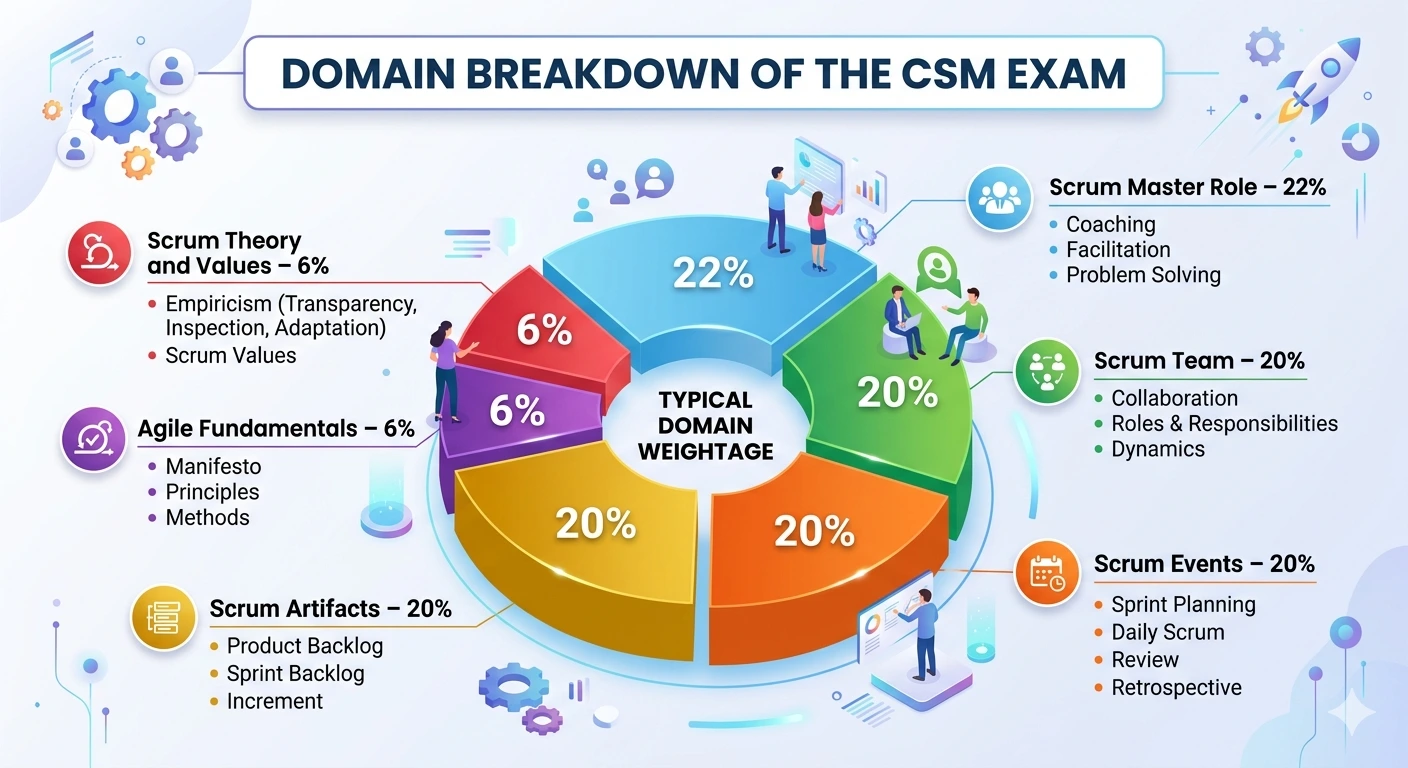
Since the Scrum Master role carries the highest weightage, candidates should focus on leadership responsibilities, facilitation, and team collaboration practices.
Attempting the Questions in the CSM exam
The CSM exam format provides flexibility while answering questions.
During the test, candidates can:
- Skip questions they are unsure about
- Bookmark questions for review later
- Navigate freely between questions
- Review all answers before submission
If any question remains unanswered, the system will display a warning message before submission. Once the exam is submitted, the final score appears immediately on the screen.
Receiving the Scrum Alliance Certificate
After passing the exam, candidates will receive certification from the Scrum Alliance.
The process typically includes the following steps:
- Candidates receive an email with login credentials from Scrum Alliance.
- They log into the official portal and complete a short online evaluation.
- After agreeing to the license terms, they gain access to their certification.
- The certificate can then be downloaded directly from the Scrum Alliance website.
Candidates must also complete their membership profile as part of the certification process.
CSM Exam Attempts and Retake Policy
Most candidates receive two free attempts to pass the CSM exam after completing the training course.
Important policies include:
- Two free attempts are included with the course fee
- Attempts must be used within 90 days of completing training
- If both attempts are unsuccessful, additional attempts cost $25 each
This flexible retake policy allows candidates to improve their preparation and successfully clear the exam.
What to Do If You Fail the CSM Exam
Failing the exam on the first attempt is not uncommon, especially for candidates who are new to Agile frameworks. If this happens, it is important to review the Scrum Guide, training materials, and practical concepts before retaking the exam.
Many candidates choose to revisit their CSM Certification course content and focus on areas such as Scrum events, artifacts, and Agile values before attempting the exam again.
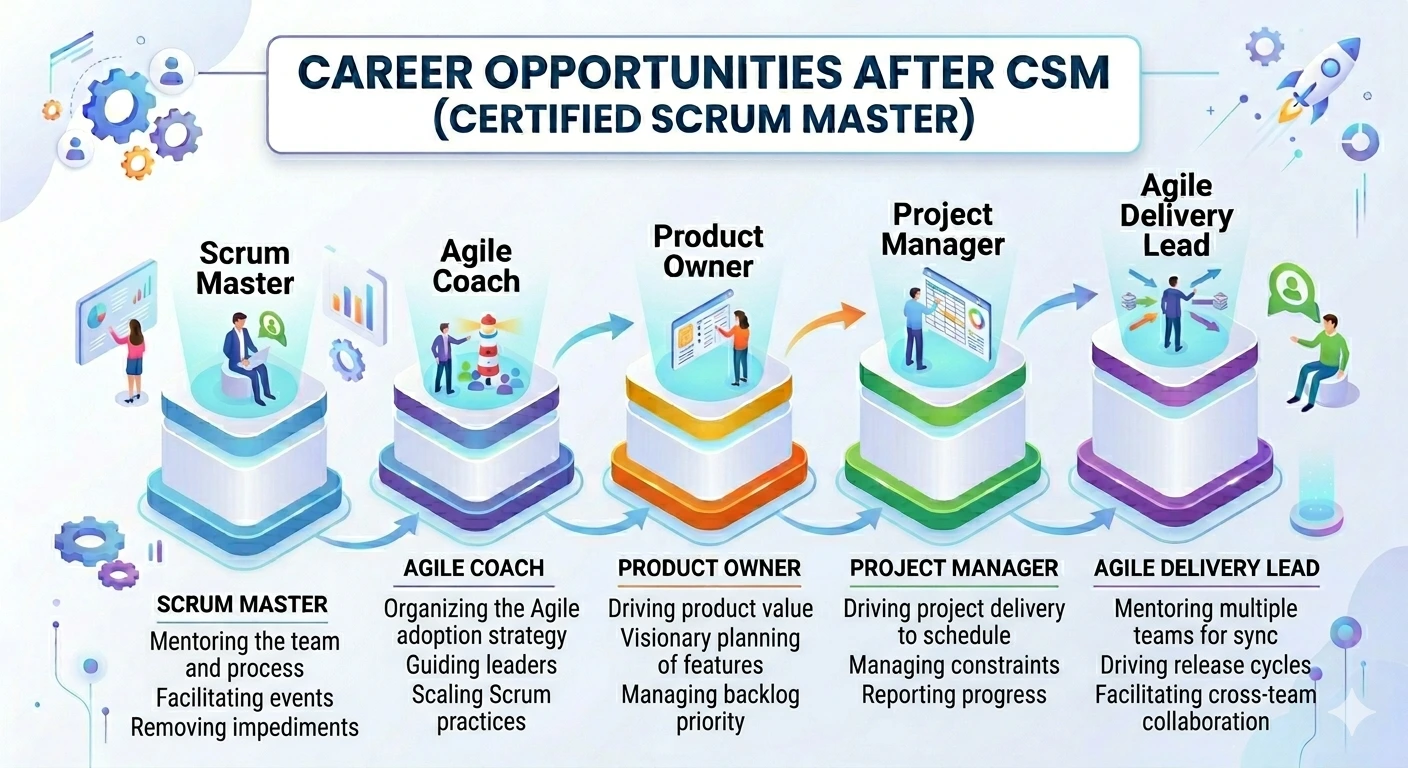
Career Opportunities After CSM
Achieving the certification significantly improves professional growth and creates new Job opportunities in Agile organizations.
Common career roles after certification include:
- Scrum Master
- Agile Coach
- Product Owner
- Project Manager
- Agile Delivery Lead
Professionals transitioning into Agile roles often explore career guidance resources such as CSM Certification: Transition from Management to Tech, which explains how managers and non-technical professionals can shift into Agile environments successfully.
Final Thoughts on the CSM Exam Format in 2026
The CSM exam format in 2026 remains straightforward and accessible for professionals who want to build a career in Agile project management. With 50 questions, a 60-minute duration, and a 74% passing score, the exam focuses on testing real understanding of Scrum practices rather than complex theoretical knowledge.
By completing the training, understanding Scrum concepts, and reviewing practical scenarios, candidates can confidently pass the CSM exam and move forward toward better Job opportunities in the growing Agile ecosystem.
For professionals planning to adopt Agile methodologies, obtaining this certification is a valuable step toward mastering Scrum and becoming an effective Agile leader.
FAQs
1. Are the CSM exam questions based on the latest Scrum Guide?
Yes. The exam is aligned with current Scrum Alliance guidance and the Scrum Guide, so it reflects the framework's accepted terminology, roles, and events as they stand today rather than an outdated version.
2. What happens after completing the CSM exam?
Once you submit the exam, you'll receive an email from Scrum Alliance with a link to create your login credentials, after which you'll need to complete the test, accept a license agreement, and set up your online profile — a process that can take up to two weeks to fully process. After passing, you officially hold the Certified ScrumMaster credential and gain access to Scrum Alliance member resources.
3. Can candidates change their answers before submitting the CSM exam?
Generally, yes — most versions of the exam allow you to move between questions and revise answers before final submission, similar to a standard online multiple-choice test. Exact navigation rules can vary slightly depending on the testing platform, so it's worth confirming the current interface details on the official Scrum Alliance site before test day.
4. What technical requirements are needed to take the CSM exam online?
You'll need a stable internet connection, a computer (rather than relying solely on a phone), an updated browser, and a quiet environment to complete the test without interruption. Specific system requirements can change over time, so checking the latest technical guidelines from Scrum Alliance shortly before your exam date is the safest approach.
5. Is the CSM exam available on mobile devices?
The exam is designed primarily for desktop or laptop use rather than mobile devices, since it involves extended multiple-choice/true-false navigation that's easier to manage on a full screen. Candidates should not assume mobile compatibility without confirming it directly with Scrum Alliance.
6. How does the CSM exam assess practical Scrum knowledge?
Beyond testing definitions, the exam includes scenario-style questions that ask what a Scrum Master, Product Owner, or team should do in a specific situation. This checks whether a candidate can actually apply Scrum values — like self-management, transparency, and empiricism — rather than just recite terminology.
7. Are CSM exam questions updated when the Scrum Guide changes?
Yes, in general. Since the exam is meant to reflect current Scrum practice, Scrum Alliance periodically reviews and updates its question bank to stay consistent with revisions to the Scrum Guide.
8. Are CSM exam questions different for each candidate?
Most large-scale certification exams, including CSM, typically draw from a broad question bank and may present questions in a randomized order or selection to reduce repetition between test-takers. This is common practice, though the exact mechanics aren't always publicly detailed.
9. Can candidates take the CSM exam from any location?
Yes — the CSM exam is taken online, so candidates can generally complete it from any location with a reliable internet connection, as long as they meet the basic technical and environment requirements (quiet space, functioning device, etc.).
10. Does the CSM exam include questions about Scrum scenarios?
Yes. The exam covers key areas like general Scrum knowledge, Scrum roles, Scrum meetings, and Scrum artifacts, and a portion of the questions present short scenarios to test how well you can apply that knowledge in realistic team situations, rather than only asking for definitions.