





PMI-CP® Certification Training Course


-
 Only internationally recognised construction-specific credential issued by PMI — covered in StarAgile's PMI-CP® certification training
-
All four exam domains covered: Contracts (50%), Stakeholder Engagement (30%), Strategy & Scope (15%), Governance (5%)
-
Four self-paced PMI modules (6–10 hrs each) + scenario-based mock tests for the 120-question exam
-
PMI construction professional training for Project Managers, Contract Managers, Site Directors, and Engineers
-
30 PDUs on completion — weekend and weekday batches available

PMI-CP Certification Training Course - Key Features
-
 Only internationally recognised construction-specific credential issued by PMI — covered in StarAgile's PMI-CP® certification training
-
All four exam domains covered: Contracts (50%), Stakeholder Engagement (30%), Strategy & Scope (15%), Governance (5%)
-
Four self-paced PMI modules (6–10 hrs each) + scenario-based mock tests for the 120-question exam
 Only internationally recognised construction-specific credential issued by PMI — covered in StarAgile's PMI-CP® certification training
-
PMI construction professional training for Project Managers, Contract Managers, Site Directors, and Engineers
-
30 PDUs on completion — weekend and weekday batches available
PMI-CP Certification Training Course Content


Upcoming Batches for PMI-CP Certification

Currently, we don't have any batch scheduled in your region.
You can request a new batch on your preferred date!
The work force is your asset. Up-Skill them with our Corporate Training Programs!
-
Unleash In-Demand Skills Across the Enterprise
-
Align Skill Development with Business Objectives
-
Drive Increased Employee Productivity
-
Leverage Immersive Learning
PMI-CP Certification - Overview
The PMI-CP certification is the only internationally recognised credential issued by PMI that is exclusively focused on construction project management. It validates advanced competency in contracts management, stakeholder engagement, scope control, and project governance — the four pillars of professional construction delivery. For practising construction professionals, it is the most direct route to formalising expertise that is already being applied on the job.
How PMI-CP Certification Will Impact Your Career?
- The PMI-CP training course positions holders for senior roles — Project Director, Programme Manager, and Contract Manager
- Certified professionals earn 20–30% more than their non-certified counterparts globally
- PMI construction professional training provides internationally recognised credibility across the UK, the Middle East, Asia-Pacific, and North America
- Serves as the mandatory prerequisite for the advanced PMI-SCP™ credential
- PMI-CP holders are actively recruited by major contractors, infrastructure agencies, and global consultancies
What StarAgile Offers?
- Full PMI-CP® certification training across all four exam domains
- Scenario-based exercises, mock tests, and structured exam preparation
- Flexible weekend and weekday batches for working professionals
- 30 PDUs earned towards renewal upon completion
PMI-CP Certification — Eligibility and Prerequisites
- Secondary degree (high school diploma or equivalent)
- Minimum 3 years of construction or built environment project experience within the last 10 years
- Completion of all four PMI foundational e-learning modules (6–10 hours each) before sitting the exam
- No prior PMI certification required — the PMP is not a prerequisite for the PMI construction professional training
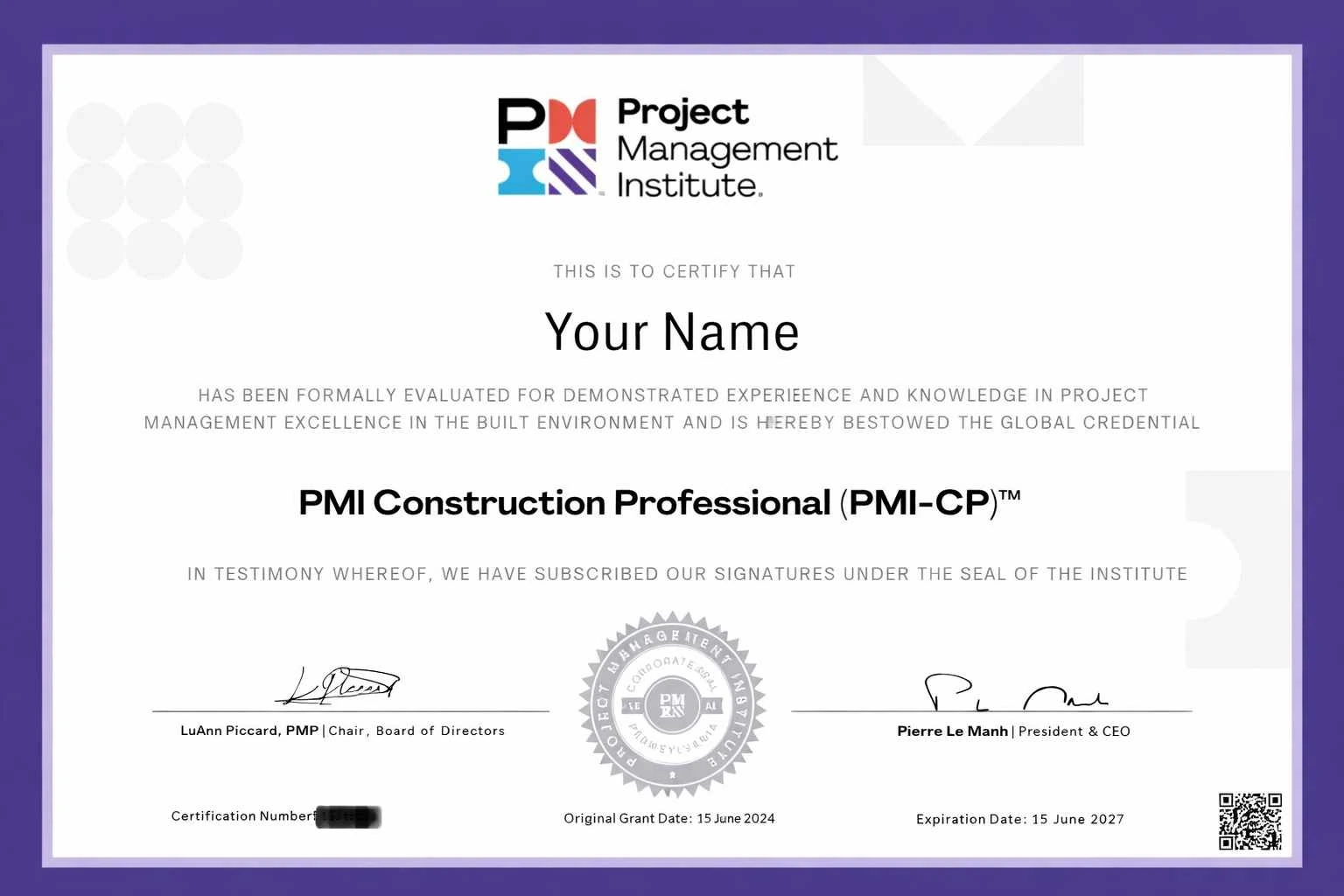
PMI-CP Certificate after the Completion of the Course
PMI-CP Certification FAQs
The PMI-CP certification is PMI's internationally recognised credential for construction and built environment project management professionals. Unlike the general PMP, it focuses exclusively on construction — covering contract management, stakeholder engagement, scope control, and project governance. The PMI-CP certification training course at StarAgile prepares candidates through structured instruction aligned with PMI's official Exam Content Outline.
The PMI construction professional training is designed for Construction Project Managers, Site Managers, Contract Administrators, Civil Engineers in management roles, Quantity Surveyors, Infrastructure Project Leads, and Programme Directors. It is also relevant for architects and built environment consultants carrying delivery and governance responsibilities. Anyone managing construction project delivery, contracts, or stakeholders will find this credential directly applicable to their day-to-day role.
Per PMI, the PMI-CP certification requires a secondary degree, a minimum of three years of construction or built environment project experience within the last ten years, and completion of all four mandatory foundational e-learning modules before the exam. Each module is a 6–10-hour self-paced commitment. No prior PMI certification is required. StarAgile's PMI-CP® certification training covers content aligned with these modules and the Exam Content Outline.
Yes. Issued by PMI — one of the most respected project management bodies globally — the PMI-CP certification is recognised across construction, infrastructure, and built environment sectors in North America, the UK, the Middle East, Australia, Asia-Pacific, and Europe. It carries particular weight for professionals working on international construction programmes or targeting cross-border career opportunities.
The PMI-CP training course validates competency across four domains: Contracts Management (50%) — contract administration, claims, and dispute resolution; Stakeholder Engagement (30%) — communication and alignment across construction project teams; Strategy and Scope Management (15%) — scope definition, change control, and strategic alignment; and Project Governance (5%) — risk, compliance, safety, and quality assurance in a construction context.
The PMP is a broad credential applicable across all industries. The PMI construction professional training leads to a construction-specific credential — with 50% of the exam dedicated to contracts management alone, plus construction-specific stakeholder, governance, and risk content that the PMP does not cover in depth. The two are complementary — many construction professionals hold both, using PMP for general project management credibility and PMI-CP for construction-sector recognition.
The PMI-CP certification is valid for three years. To maintain an active status, holders must earn 30 PDUs within each three-year cycle — half the renewal requirement of the PMP. This continuing education requirement ensures certified practitioners stay current with evolving construction management standards throughout their careers.
Register on PMI.org, complete the online application documenting your construction project experience and module completions, and await review (typically five to ten business days). If audited, provide supporting documentation within 90 days. Once approved, pay the exam fee and schedule through Pearson VUE — at a test centre or online. StarAgile's PMI-CP® certification training includes application guidance to help candidates document experience accurately.
The PMI-CP Certification cost is $399 for PMI members and $499 for non-members. The four mandatory foundational modules cost $99–$199 each for members ($149–$249 for non-members). The total estimated cost, including modules and the exam, is approximately $696 for members. PMI membership ($139/year) reduces both module and exam fees significantly. Contact StarAgile for current PMI-CP training course pricing and available discounts.
PMI membership is not mandatory but is strongly recommended. It reduces the exam fee by approximately $100 and lowers module costs — typically more than offsetting the $139 annual membership fee. Members also receive access to the PMI digital library, PMBOK® Guide downloads, webinars, and community resources that support both PMI-CP certification exam preparation and ongoing professional development.
PMI mandates completion of all four foundational e-learning modules before exam eligibility. These self-paced modules are 6–10 hours each and can be completed in any order. Live instructor-led alternatives are available through PMI Authorised Training Partners. StarAgile's PMI construction professional training complements these modules with structured exam preparation, scenario-based exercises, and expert guidance covering the full Exam Content Outline.
No. The PMI-CP certification requires a minimum of three years of construction project experience within the last ten years — it is designed for practising professionals, not those at the start of their careers. Early-career professionals should build their experience base while completing the foundational modules, positioning themselves to apply once the three-year threshold is met.
The PMI-CP® certification training benefits Construction Project Managers, Site and Programme Managers, Contract Administrators, Civil Engineers in delivery roles, Quantity Surveyors, Infrastructure Project Leads, and Project Directors. Employers across major contractors, infrastructure agencies, consultancies, and property developers actively recruit PMI-CP certified professionals for mid-to-senior project leadership positions.
Yes. PMI research consistently shows certified construction professionals earn significantly more than non-certified peers. In the UK, certified construction project managers commonly earn £50,000–£80,000+, with senior roles considerably higher. The PMI-CP certification signals internationally validated construction project management competency — a credible differentiator in competitive hiring processes and internal promotion conversations alike.
Yes. The PMI construction professional training leads to a credential issued by PMI — present in over 200 countries — and its emphasis on contracts management, stakeholder alignment, and governance translates directly to cross-border construction programmes. For professionals managing infrastructure projects in the Middle East, Asia-Pacific, or European markets, the PMI-CP provides a commonly recognised framework for international project delivery.
The PMI-CP certification is recognised across construction, civil engineering, infrastructure, oil and gas, energy, utilities, property development, transportation, and government-led built environment programmes. Employers in the UK, UAE, India, Australia, Singapore, and North America — including major EPC contractors, infrastructure agencies, and consultancies — actively list the PMI-CP as a preferred or required qualification.
The PMI-CP training course follows a two-phase structure: first, completing PMI's four mandatory foundational modules; second, sitting the 120-question, 230-minute exam through Pearson VUE. StarAgile's PMI-CP® certification training provides structured exam preparation across all four domains, scenario-based practice, and mock tests to maximise first-attempt pass rates. Candidates may attempt the exam up to three times within a one-year eligibility window.
Most candidates complete the full PMI-CP certification process within two to six months. The four mandatory modules alone represent 24–40 hours of learning. Additional exam preparation — practice questions, mock tests, and Exam Content Outline review — typically requires four to eight more weeks. Candidates with recent active construction management experience from their PMI construction professional training tend to require less preparation time overall.
The PMI-CP exam is moderately to highly challenging. It's 120 scenario-based questions require applied judgement in realistic construction situations — particularly across contracts management, which accounts for 50% of the paper. Candidates who complete the foundational modules, review the Exam Content Outline thoroughly, and work through structured practice tests from PMI-CP certification consistently achieve better first-attempt outcomes than those relying on experience alone.
PMI-CP holders must earn 30 PDUs within each three-year cycle through recognised activities — training courses, PMI on-demand modules, industry events, mentoring, or presenting. Once 30 PDUs are logged in PMI's CCR system, the renewal fee is paid to PMI to extend the credential for another three years. The 30-PDU requirement is half that of the PMP, reflecting the more specialised scope of the PMI-CP certification.
PMI-CP® Certification Training - Exam FAQs
The PMI-CP certification exam is a computer-based, multiple-choice test via Pearson VUE. It covers four domains: Contracts Management (50%), Stakeholder Engagement (30%), Strategy and Scope Management (15%), and Project Governance (5%). Questions are scenario-based, testing applied judgement in realistic construction situations — not definition recall.
The PMI-CP certification exam contains 120 multiple-choice questions, some of which are unscored pretest items embedded throughout the paper. Treat all 120 equally. StarAgile's PMI-CP® certification training includes mock tests mirroring this format so candidates are fully prepared before their actual sitting.
Candidates have 230 minutes — approximately 3 hours and 50 minutes — to complete the PMI-CP certification exam. That is roughly 115 seconds per question. StarAgile's PMI construction professional training includes timed mock papers to help candidates develop the consistent pace needed to complete all 120 questions comfortably.
Both options are available. The PMI-CP certification can be taken at a Pearson VUE test centre (recommended by PMI) or through Pearson VUE's online proctored platform from home. The online format requires a stable connection, webcam, and a quiet room. StarAgile's PMI-CP® certification training prepares candidates equally for either format.
PMI does not disclose a fixed passing score for the PMI-CP certification. Results are based on PMI's psychometric scoring methodology and reported as pass or fail, with domain-level performance diagnostics. The threshold reflects the competency expected of a qualified construction project management professional.
Predominantly practical. The PMI-CP certification exam presents realistic construction scenarios — contract disputes, stakeholder conflicts, scope changes — and asks for the most appropriate response. Memorising definitions is not sufficient. StarAgile's PMI construction professional training uses scenario-based exercises throughout to build the applied decision-making these questions require.
No. The PMI-CP certification does not apply negative marking. Incorrect answers do not reduce your score, so candidates should attempt every question. Leaving items blank is a guaranteed zero — always select your best answer, even under uncertainty.
Yes. PMI allows up to three attempts within the one-year eligibility window. After three unsuccessful attempts, a new application must be submitted. StarAgile's PMI-CP certification training course includes post-training support to help candidates prepare thoroughly before any retake sitting.
The PMI-CP certification exam is available in English. Candidates should confirm current language options directly on PMI.org before scheduling. All official prep materials, foundational modules, and the Exam Content Outline are published in English — the primary language used throughout PMI construction professional training at StarAgile.
Yes. StarAgile's PMI-CP® certification training includes structured mock papers aligned with the official Exam Content Outline, covering all four domains in proportion to their exam weighting. Timed mock tests are one of the strongest predictors of first-attempt pass rates and are strongly recommended before your actual sitting.
The PMI-CP certification exam covers: Contracts Management (50%) — contract types, administration, claims, and dispute resolution; Stakeholder Engagement (30%) — communication and alignment; Strategy and Scope Management (15%) — scope control and change management; and Project Governance (5%) — risk, safety, and compliance. StarAgile's PMI-CP certification training course covers all four domains in full.
PMI requires four foundational e-learning modules — each 6–10 hours — as mandatory prerequisites before sitting the PMI-CP certification exam. All four must be completed; none can be waived. Advanced optional courses are also available through PMI for those progressing towards the senior-level PMI-SCP™ credential.
Yes. The four modules can be completed in any order and at your own pace — they do not need to be taken consecutively. All four must be done before finalising the exam application. This flexibility makes the PMI-CP training course accessible for working construction professionals managing full-time responsibilities alongside their studies.
No. The PMI-CP certification exam is strictly closed book — no notes or reference materials are permitted, whether at a test centre or online. This is why structured PMI construction professional training covering all four domains through applied practice is essential, rather than simply knowing where to look things up.
Moderately to highly challenging. The PMI-CP certification exam's 120 scenario-based questions require applied construction knowledge under time pressure. The contracts management domain alone accounts for 50% of the paper. Candidates who complete structured PMI-CP® certification training, study the Exam Content Outline, and take timed mock tests consistently achieve stronger first-attempt outcomes.
The PMI-CP certification exam is not calculation-heavy. Most questions are scenario-based and require judgment rather than computation. Some questions may involve interpreting contract values or cost implications — but these are decision-making scenarios, not quantitative exercises. PMI construction professional training at StarAgile prepares candidates for this applied, judgment-focused question style.
Complete all four mandatory PMI modules, study the official Exam Content Outline, and enrol in StarAgile's PMI-CP training course for structured guidance across all exam domains. Take full-time mock tests under exam conditions and review every incorrect answer carefully. Combining structured training with consistent practice is the most reliable path to a first-attempt pass.
Passing the PMI-CP certification exam awards the full three-year credential immediately — there is no separate validity period for the result itself. To maintain the credential beyond three years, 30 PDUs must be earned and the renewal fee paid to PMI. PMI-CP® certification training preparation also counts towards PDU requirements.
Yes. All four foundational e-learning modules are a non-negotiable PMI prerequisite before sitting the PMI-CP certification exam. These cannot be skipped or substituted. Beyond the modules, structured preparation through a PMI-CP® certification training programme is strongly recommended — particularly for the heavily weighted contracts management domain.
PMI issues your digital PMI-CP® badge upon passing, which can be shared on LinkedIn and professional profiles. Your three-year certification cycle begins immediately. The PMI-CP certification also serves as the stepping stone to the advanced PMI-SCP™ credential — the next level in PMI's construction professional training pathway.
PMI Construction Professional Training - Advanced FAQs
The PMI-CP certification is built around actual construction challenges — contract disputes, stakeholder conflicts, scope creep, delays, and safety compliance. Unlike generic credentials, the PMI-CP certification training course addresses construction-specific scenarios directly, giving practitioners applicable frameworks rather than broad theory.
The PMI construction professional training draws from PMI's PMBOK® standards, adapted to construction contexts — construction contract management, built environment governance, risk frameworks, and stakeholder engagement models specific to on-site and infrastructure delivery across all four exam domains.
The PMI-CP certification focuses on construction delivery rather than software-aligned Agile. However, PMI's principles of iterative planning, continuous stakeholder engagement, and adaptive scope management are embedded throughout. The PMI-CP® certification training covers governance and stakeholder frameworks that support hybrid delivery in complex built environment programmes.
It is the most important domain — contracts management accounts for 50% of the PMI-CP certification exam. It covers contract types, administration, change orders, claims, and dispute resolution. The PMI-CP certification training course dedicates substantial coverage here, reflecting how frequently construction cost and schedule issues originate from poorly managed contracts.
Risk management sits within the Project Governance domain of the PMI-CP certification. The PMI construction professional training covers safety risks, regulatory exposure, environmental risk, and contractual risk — equipping practitioners to build risk registers, define mitigation strategies, and escalate issues before they affect cost or programme.
The PMI-CP certification covers multi-party contracts, complex stakeholder landscapes, long-duration scope management, and governance across distributed sites — all central to large infrastructure programmes. The PMI-CP® certification training equips professionals for exactly this level of programme complexity across civil, transport, and energy infrastructure.
PMI-CP certification practitioners typically use Primavera P6, MS Project, contract management platforms, risk registers, and BIM tools. The PMI construction professional training focuses on frameworks and governance competency rather than specific software, ensuring skills transfer across whichever tools a construction organisation uses.
Stakeholder Engagement accounts for 30% of the PMI-CP certification exam. The PMI-CP certification training course covers stakeholder identification, power and interest mapping, communication planning, and expectation management across clients, contractors, regulators, and communities — developing structured communication skills that reduce conflict and keep projects aligned.
Safety is embedded within the PMI-CP certification's Project Governance domain. The PMI construction professional training covers safety planning, incident management, and regulatory compliance — equipping practitioners to manage safety obligations as a core governance responsibility, particularly in how they intersect with contract requirements on construction sites.
Cost control is primarily addressed through Contracts Management in the PMI-CP certification, since most construction cost overruns stem from change orders, claims, and contract mismanagement. The PMI-CP® certification training covers variation management, financial impact assessment of scope changes, and contract-based cost reporting.
Lean construction focuses on eliminating waste and maximising value delivery. While the PMI-CP certification has no dedicated Lean module, its scope management and governance frameworks align with Lean principles. The PMI construction professional training equips practitioners to identify and reduce process inefficiency as part of standard construction project delivery.
The PMI-CP certification's governance domain covers environmental compliance, regulatory obligations, and responsible project delivery. PMI's sustainability principles — evaluating environmental, social, and economic impacts — are embedded in the strategic scope content of the PMI-CP® certification training, encouraging practitioners to consider long-term project impacts throughout delivery.
The PMI-CP certification directly addresses contract disputes, scope creep, stakeholder misalignment, safety incidents, delays, cost overruns, and regulatory non-compliance. The PMI-CP training course works through these systematically, giving practitioners both frameworks and applied judgment to manage them on real construction projects.
The PMI construction professional training covers schedule management within the Strategy and Scope domain, alongside contract administration for time-related claims and extension of time processes. The PMI-CP certification equips practitioners to anticipate delay risks, document events accurately, and manage contractual obligations when delays arise.
The PMI-CP certification focuses on governance, contracts, and stakeholder frameworks rather than specific software training. The PMI-CP® certification training develops the process competency and judgement that make digital tools — BIM, scheduling platforms, contract management systems — effective in practice across construction project environments.
The PMI-CP certification positions professionals for senior roles — Project Director, Programme Manager, Contract Manager — and serves as the prerequisite for the advanced PMI-SCP™. Employers across major contractors, infrastructure agencies, and consultancies actively seek PMI-CP certified professionals for construction leadership appointments globally.
Yes. The PMI-CP certification training course develops the competencies employers look for in construction leadership — strategic scope management, stakeholder engagement, contract governance, and programme-level risk oversight. Many PMI-CP holders use the credential to transition from technical or site roles into project director and client-facing delivery leadership positions.
Global infrastructure investment — driven by government programmes, energy transition, urban development, and transport — is growing steadily. The PMI construction professional training leads to a credential that positions holders ahead of uncertified peers in an expanding global market, particularly for senior and cross-border construction roles.
The PMI-CP certification carries broader international recognition than regionally focused credentials like CIOB or APM qualifications, which are largely UK-centric. The PMI-CP® certification training equips practitioners with internationally applicable frameworks recognised in North America, the Middle East, Asia-Pacific, and beyond — making it stronger for globally mobile construction professionals.
Yes. As construction projects grow more complex and globally distributed, demand for professionals with validated, construction-specific project management credentials is rising. The PMI construction professional training and PMI-CP certification improve career positioning, salary negotiations, and access to senior roles — making it one of the strongest career investments for practising construction professionals.
Both are challenging, but in different ways. The PMP covers broad project management across industries in 180 questions. The PMI-CP certification is narrower but deeply technical — its 120 questions are 50% contracts management, which candidates without deep construction contract experience often find demanding. The PMI-CP® certification training specifically prepares candidates for this construction-focused depth.
The PMP validates broad project management skills across all industries. The PMI-CP certification is exclusively for construction and built environment professionals, with its exam weighted heavily towards contracts management and construction governance. The PMP requires 35 hours of formal education; the PMI-CP requires four specific foundational modules plus construction experience. Many construction professionals pursue both credentials.
Distinctions and Achievements

About the PMI-CP Certification
The PMI Construction Professional (PMI-CP®) is the only internationally recognised credential issued by PMI exclusively for construction and built environment professionals. Unlike general project management certifications, the PMI-CP certification is designed specifically around the challenges of construction delivery — multi-party contracts, on-site risk management, stakeholder alignment, scope control, and project governance across complex, long-duration programmes.
The PMI-CP training course is structured around four domains: Contracts Management (50%), Stakeholder Engagement (30%), Strategy and Scope Management (15%), and Project Governance (5%). These weightings reflect the real drivers of construction project failure — poor contract administration and weak stakeholder management account for the majority of cost overruns and delays in the industry. By earning the PMI-CP, practitioners demonstrate validated competency in exactly the areas where construction projects most commonly go wrong.
Benefits of PMI-CP Certification
- Only internationally recognised credential exclusively focused on construction project management — issued by PMI
- Validates competency across Contracts Management, Stakeholder Engagement, Scope Management, and Project Governance
- Certified professionals earn 20–30% more than non-certified peers globally
- Opens senior roles — Project Director, Programme Manager, Contract Manager — across major contractors and infrastructure agencies
- Recognised across the UK, the Middle East, Asia-Pacific, and North America
- Mandatory prerequisite for the advanced PMI-SCP™ credential
- 30 PDUs earned towards renewal through StarAgile's PMI-CP® certification training
- Builds the applied, construction-specific competency that the PMI construction professional training is structured to develop
Comprehensive Training Solutions for Enterprises












People also viewed courses like