





Professional in Business Analysis (PMI-PBA)® Certification


-
 Earn the globally recognized PMI PBA certification
-
Train with a PMI Authorized Training Partner (ATP)
-
Master all 5 PMI PBA exam domains with live training
-
Fulfill the 35 contact hours required for PMI PBA exam
-
Access mock exams and scenario-based practice tests
-
Build real-world BA skills with practical case studies

Key Features of PMI-PBA® Certification Training Program
-
 PMI ATP-certified training with globally aligned curriculum
-
35 PMI contact hours included for exam eligibility
-
Complete coverage of all 5 PMI-PBA exam domains
 PMI ATP-certified training with globally aligned curriculum
-
Live interactive classes with expert BA instructors
-
Scenario-based mock tests and exam-focused practice
-
Real-world case studies for practical business analysis skills
PMI-PBA® Certification Training – Course Curriculum


Upcoming PMI-PBA® Certification Batch Schedule

Currently, we don't have any batch scheduled in your region.
You can request a new batch on your preferred date!
The work force is your asset. Up-Skill them with our Corporate Training Programs!
-
Unleash In-Demand Skills Across the Enterprise
-
Align Skill Development with Business Objectives
-
Drive Increased Employee Productivity
-
Leverage Immersive Learning
PMI-PBA® Certification Course Overview

The Professional in Business Analysis PMI PBA certification is your gateway to senior BA roles, higher salaries, and global recognition. Offered by PMI, this credential validates your ability to define requirements, engage stakeholders, and ensure projects deliver real business value.
What StarAgile Offers:
- Live instructor-led training covering all 5 PMI PBA exam domains
- Training by PMI Authorized Training Partner (ATP) certified instructors
- 35 contact hours fulfilling the mandatory PMI PBA exam eligibility requirement
- Scenario-based mock exams and exam-focused preparation support
- Real-world case studies and practical BA exercises
How the PMI PBA Certification Impacts Your Career:
- Move into Senior Business Analyst, BA Manager, or Requirements Lead roles
- Earn significantly higher salaries than non-certified peers
- Gain a globally recognized PMI credential valued across industries
- Build credibility with employers in IT, healthcare, finance, and consulting
Eligibility and Prerequisites
To sit the PMI PBA exam, candidates must meet one of three requirements:
- Set A: Secondary degree + 60 months of BA experience (last 8 years) + 35 contact hours
- Set B: Bachelor's degree or higher + 36 months of BA experience (last 8 years) + 35 contact hours
- Set C: GAC-accredited bachelor's or postgraduate degree + 24 months of BA experience + 35 contact hours
PMI-PBA® Course Completion Certificate
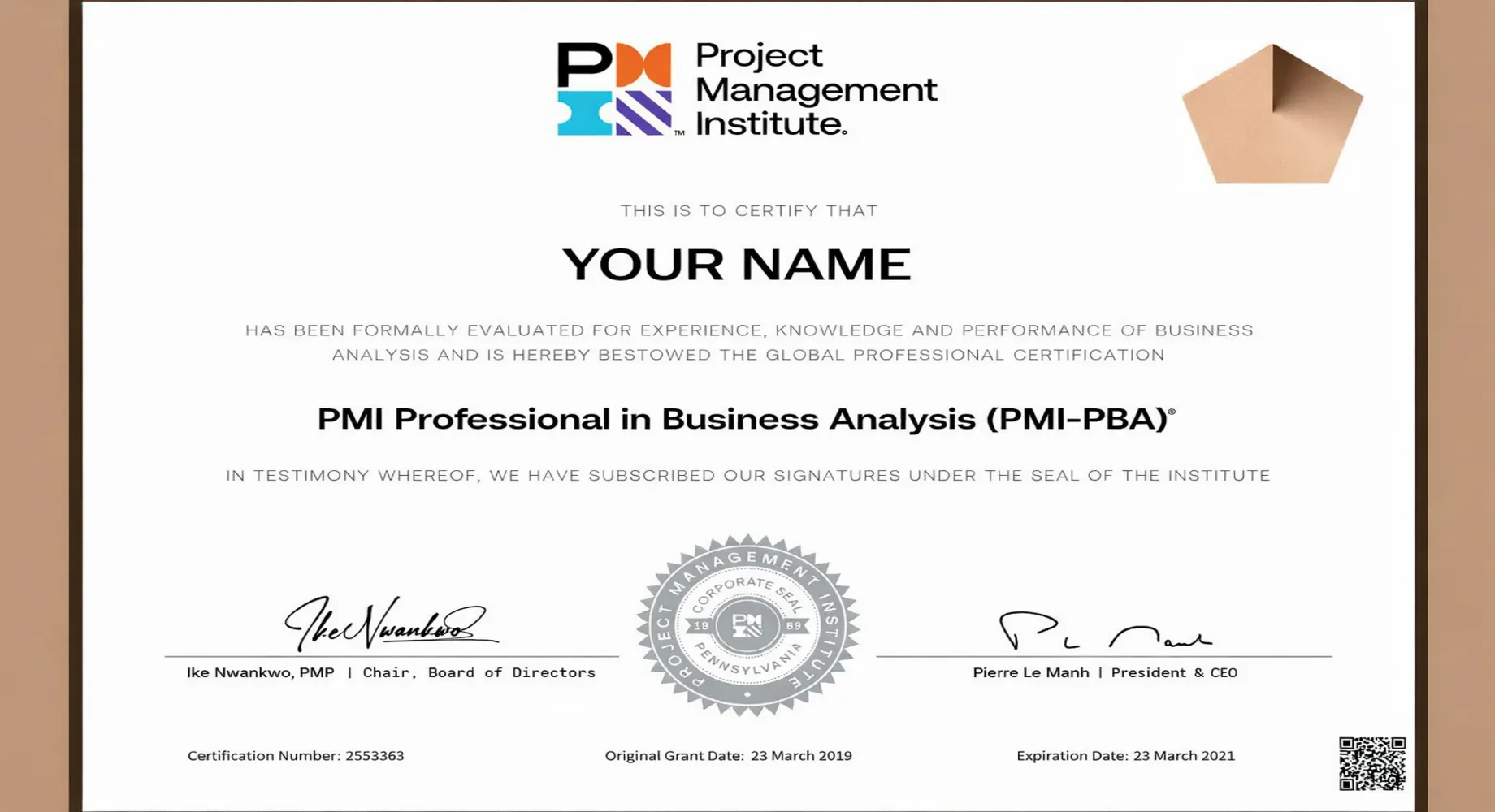
PMI-PBA Certification Course FAQs
The PMI PBA, or Professional in Business Analysis certification, is a globally recognized credential offered by the Project Management Institute. It validates a professional's ability to define business requirements, manage stakeholder expectations, and ensure that project deliverables align with real business needs. For anyone working at the intersection of business analysis and project management, the PMI-PBA certification is a credible, internationally respected way to formalize and demonstrate that expertise.
The PMI Professional in Business Analysis certification has three eligibility pathways based on education and experience:
|
Educational Background |
BA Experience |
Contact Hours |
|
Secondary Degree |
60 months (last 8 years) |
35 hours |
|
Bachelor's Degree or higher |
36 months (last 8 years) |
35 hours |
|
GAC-accredited Degree |
24 months minimum |
35 hours |
All experience must have been earned within the last 8 years. Candidates under the secondary degree pathway must also show 2,000 hours of project team experience, which can overlap with BA experience hours.
Absolutely. The PMI business analysis certification remains one of the most valuable credentials for BA professionals in 2026. Organizations continue to face project failures caused by poor requirements management and unclear business objectives — precisely the problems the PMI PBA addresses. Certified professionals report stronger career prospects, higher earning potential, and greater credibility with employers across industries. If you have the experience to qualify, it is a worthwhile investment in your career.
The professional in business analysis, PMI PBA, validates practical, scenario-based skills across five areas:
- Needs Assessment — Identifying business problems and defining solution scope
- BA Planning — Structuring the requirements management approach and change control processes
- Requirements Elicitation and Analysis — Gathering, analyzing, and documenting stakeholder requirements
- Traceability and Monitoring — Tracking requirements through the project lifecycle and managing changes
- Solution Evaluation — Assessing whether delivered solutions meet defined business acceptance criteria
The PMI-PBA course is ideal for anyone whose work involves defining, managing, or validating requirements within a project environment. This includes Business Analysts, Business Systems Analysts, Project Managers, Project Coordinators, IT Managers, Systems Architects, QA Professionals, Software Developers, and Business Users or Partners involved in shaping project scope. If requirements management is a meaningful part of how you contribute to projects, the PMI-PBA is the right credential for you.
To apply for the PMI-PBA certification exam, candidates need three things: a qualifying educational background (minimum secondary degree), documented business analysis experience ranging from 24 to 60 months depending on education level, and 35 contact hours of training in business analysis practices. All experience must fall within the last 8 years. A structured PMI PBA training course fulfills the contact hours requirement and prepares candidates for the exam at the same time.
The experience required for the PMI Professional in Business Analysis certification depends on your education. Candidates with a secondary degree need 60 months of BA experience. Those with a bachelor's degree or higher need 36 months. Candidates from a GAC-accredited program need a minimum of 24 months. In all cases, the experience must be recent — earned within the last 8 years — and must reflect genuine business analysis practice rather than general project involvement.
The PMI business analysis certification is recognized across virtually every major industry because its core competencies — requirements management, stakeholder engagement, and solution evaluation — apply wherever projects exist. Key industries include Information Technology, Banking and Financial Services, Healthcare, Government and Public Sector, Manufacturing, Telecommunications, Energy and Utilities, Retail, and Consulting. The PMI-PBA carries the same global authority as other PMI credentials, making it valuable across sectors and geographies.
The training course covering the 35 contact hours is typically completed within a few weeks. PMI's application review takes a few additional weeks once submitted. Most candidates complete the end-to-end process in 3 to 6 months, though some may take slightly longer depending on study pace. Candidates with strong existing BA knowledge and a structured study approach can move through this timeline faster.
The PMP validates broad project management competency — planning, leading, and delivering projects across predictive and agile environments. The PMI-PBA, or professional in business analysis certification, focuses specifically on the requirements dimension — identifying business needs, managing stakeholder requirements, and ensuring delivered solutions produce the expected business value. The two credentials are highly complementary. For professionals in full project leadership roles, the PMP is typically the priority. For those focused on requirements and business analysis, the PMI PBA is the more targeted and relevant credential.
The PMI-PBA certification exam fees are:
- PMI Members: USD 405
- Non-Members: USD 555
Always verify current pricing on PMI's official website before applying, as fees are subject to change. PMI membership often offsets the fee difference while also providing access to study resources, digital tools, and discounts on training. Beyond the exam fee, candidates should also factor in the cost of their training course and eventual renewal fees.
The professional in business analysis, PMI PBA, opens pathways to senior and specialized roles, including Senior Business Analyst, Lead Business Analyst, Business Analysis Manager, Requirements Manager, Functional Consultant, Product Manager, Business Architect, and Program Analyst. Beyond role advancement, the credential supports career mobility across industries and geographies, often leading to meaningfully higher compensation compared to non-certified peers. It also serves as a natural stepping stone toward senior PMI credentials such as the PgMP.
For business analysts, the PMI Professional in Business Analysis credential formally validates the expertise they apply every day — giving them recognized credibility with employers, clients, and project stakeholders. For project managers, it adds depth in requirements management, one of the most common sources of project failure. In organizations where PMs and BAs work closely — or where one person fills both roles — the PMI-PBA is a clear differentiator. Both groups benefit from having a credential that demonstrates they understand not just how a project runs, but what it needs to deliver for the business.
To maintain the PMI-PBA certification, holders must earn 60 PDUs every 3 years through PMI's Continuing Certification Requirements (CCR) program. PDUs must cover PMI's Talent Triangle areas — Ways of Working, Power Skills, and Business Acumen — with minimum hours required in each. They can be earned through courses, webinars, self-directed reading, mentoring, volunteering, or applying certified skills professionally. Once PDU requirements are met, professionals log hours in PMI's online CCRS platform and pay the renewal fee to continue their active certified status.
The PMI-PBA certification is valid for a 3-year cycle. Rather than requiring re-examination at the end of each cycle, PMI operates a Continuing Certification Requirements (CCR) program that allows holders to renew by earning 60 Professional Development Units (PDUs) and paying a renewal fee. This approach ensures that certified professionals stay current with evolving business analysis practices throughout their career, not just at the point of initial certification.
PMI-PBA Certification Eligibility & Exam Details FAQ
The PMI-PBA certification exam is a computer-based, multiple-choice test administered through Pearson VUE — either at an authorized test center or via online proctoring. All questions are scenario-based, meaning candidates are presented with real-world business analysis situations and must select the most appropriate course of action. The exam is designed to assess applied judgment, not just theoretical recall, making preparation through practical study and mock tests essential.
The PMI-PBA exam contains 200 multiple-choice questions in total. Of these, 175 are scored and contribute to the final result, while the remaining 25 are unscored pre-test questions that PMI uses for future exam development. Candidates have no way of identifying which questions are scored and which are not, so every question should be treated with equal focus and care throughout the exam.
Candidates are given 4 hours to complete the PMI-PBA certification exam. This works out to just over a minute per question on average, which is manageable for well-prepared candidates but can become a challenge if too much time is spent on difficult questions early on. Effective time management — moving through questions steadily and flagging uncertain ones for review — is an important part of performing well on exam day.
The PMI-PBA exam syllabus is built around the full lifecycle of business analysis within a project context. Core topics include identifying and assessing business needs, planning the business analysis approach, eliciting and analyzing requirements from stakeholders, documenting and validating requirements specifications, managing requirements traceability, handling requirement changes, and evaluating whether delivered solutions meet defined business objectives. The PMI-PBA Exam Content Outline (ECO), available on PMI's website, provides a detailed breakdown of all tested topics and their relative weightings.
The professional in business analysis PMI PBA exam is organized into five domains:
- Needs Assessment — Defining business problems, opportunities, and solution scope
- Planning — Establishing the business analysis approach, traceability strategy, and change control processes
- Analysis — Eliciting, decomposing, validating, and obtaining sign-off on requirements
- Traceability and Monitoring — Tracking requirements status, managing changes, and communicating with stakeholders
- Evaluation — Assessing whether solutions meet acceptance criteria and deliver expected business value
Each domain carries a specific percentage weighting in the exam, outlined in PMI's official Exam Content Outline.
PMI does not publish a fixed numerical passing score for the PMI-PBA certification exam. Instead, the passing threshold is determined through psychometric analysis, which means it can vary slightly across exam versions to account for differences in question difficulty. Rather than targeting a specific percentage, candidates are evaluated against a performance standard that reflects competent professional practice. PMI reports results using performance ratings rather than a raw score, so the focus during preparation should be on genuine understanding across all five domains rather than chasing a particular number.
The PMI-PBA certification exam is available through both options. Candidates can sit the exam at an authorized Pearson VUE test center or choose online proctored testing from a suitable location. The online option offers flexibility for those who prefer to test from home or office, but it comes with specific technical and environmental requirements — a stable internet connection, a compatible device, a quiet private space, and no unauthorized materials within reach. Both delivery methods present the same exam content and carry the same validity.
The PMI-PBA is considered a challenging exam, primarily because of its scenario-based format. Candidates are not simply asked to recall definitions — they are expected to apply business analysis principles to complex, realistic project situations and identify the most appropriate response. The difficulty is compounded by the fact that multiple answer options may appear plausible on the surface. Candidates who rely purely on memorization tend to struggle, while those who develop genuine applied understanding across all five exam domains are far better positioned to pass on their first attempt.
PMI allows candidates up to three attempts to pass the PMI-PBA exam within their one-year eligibility period, which begins from the date exam authorization is granted. The first attempt can be scheduled at any point during that year. If a candidate does not pass on the first attempt, they can retake the exam — though a waiting period and a new exam fee apply to each subsequent attempt. Candidates who do not pass within three attempts or within the eligibility period must reapply, fulfilling the full application process again.
The most effective preparation for the PMI PBA exam combines structured training, thorough content review, and consistent practice testing. Start with a quality PMI-PBA training course that covers all five exam domains and fulfills the 35 contact hours requirement. Follow this with a focused review of PMI's official Exam Content Outline and the PMI-PBA Handbook. Then build exam readiness through timed practice tests that simulate the scenario-based format of the actual exam. Spacing study sessions over several weeks — rather than cramming — produces significantly better retention and exam-day performance.
Strong preparation for the pmi professional in business analysis exam typically draws on a combination of the following resources:
- PMI-PBA Exam Content Outline (ECO) — the definitive guide to what is tested and how heavily
- PMI-PBA Handbook — covers eligibility, application process, and exam policies
- PMI-PBA Reference Materials — study guides and workbooks provided as part of StarAgile's authorized training program
- PMI Authorized Courseware — provided through PMI ATP training programs
- Full-length practice tests and simulators — essential for developing exam-day pacing and scenario judgment
- PMI's online digital library — accessible to PMI members, includes reference texts and articles
Relying on a single resource is rarely sufficient. A layered approach combining official materials with quality practice tests gives the most complete preparation.
Most candidates benefit from 6 to 12 weeks of dedicated study after completing their PMI-PBA training course. The right duration depends on how familiar you already are with business analysis concepts, how much time you can realistically commit each week, and how consistently you perform on practice tests as preparation progresses. A useful benchmark: when you are scoring well and consistently on full-length timed practice exams — and can explain why each answer is correct — you are likely ready to sit the PMI PBA certification exam.
All questions in the professional business analysis certification exam are scenario-based. Each question presents a realistic project situation and asks the candidate to identify the most appropriate action, decision, or response a business analysis professional would take. Purely theoretical or definition-based questions are not part of the exam format. This is an important distinction for preparation — candidates need to develop the ability to apply concepts in context, not just define them. Reading through real-world BA scenarios during study and practising with scenario-based mock questions is essential preparation.
The most useful practice resources for the PMI Business Analysis Certification Exam are those that mirror the actual exam format — scenario-based questions, 200-item timed tests, and detailed explanations for both correct and incorrect answers. PMI's own authorized prep resources are the most reliable starting point. Beyond that, simulators from reputable PMI Authorized Training Partners offer high-quality practice aligned to the current Exam Content Outline. When evaluating any practice test, the key criteria are: alignment to the five PMI-PBA domains, scenario-based question style, and answer explanations that reinforce the underlying principles — not just identify the right option.
Several preparation and exam-day mistakes consistently affect PMI-PBA candidates:
- Studying content without practicing application — understanding concepts theoretically without developing scenario-based judgment.
- Ignoring the Exam Content Outline — preparing without knowing which domains carry the most weight.
- Rushing through practice tests — completing mock questions without reviewing and understanding incorrect answers.
- Poor time management on exam day — spending too long on difficult questions and running short of time later.
- Underestimating the scenario complexity — assuming that "common sense" answers are always correct without grounding responses in BA principles.
- Neglecting weaker domains — focusing study time only on familiar topics while avoiding areas of lower confidence.
PMI-PBA Career Growth & Roadmap FAQs
The PMI PBA certification marks a clear turning point in a business analysis career. From here, the typical progression moves from mid-level BA roles into senior, lead, or managerial positions — Senior Business Analyst, BA Manager, or Requirements Lead. With added experience, professionals can advance further into Business Architecture, Program Analysis, or Product Management. Many PMI-PBA holders also pursue complementary PMI credentials such as the PMP or PgMP to broaden their scope into project or program leadership. The credential essentially converts practical experience into a recognized professional standing that opens structured growth paths.
After earning the professional in business analysis certification, candidates become competitive for a range of specialized and senior roles, including:
- Senior Business Analyst
- Lead Business Analyst
- Business Analysis Manager
- Requirements Manager
- Functional Consultant
- Business Architect
- Product Manager
- Program Analyst
- IT Business Analyst
- Process Improvement Specialist
The PMI-PBA signals to employers that you can independently handle complex requirements work, which qualifies you for roles that carry more responsibility, greater visibility, and stronger compensation.
Salaries for PMI-PBA certified professionals vary by country, industry, and experience level, but the credential consistently correlates with above-average compensation in the BA field. Based on recent industry surveys, certified business analysts in the United States commonly earn between USD 90,000 and USD 120,000 annually — figures that vary by experience, industry, and location. In markets like the UK, Australia, and the Middle East, the PMI-PBA similarly positions professionals at the higher end of BA salary bands. PMI's own salary surveys consistently show that certification holders across all PMI credentials — including the PMI Professional in Business Analysis — earn meaningfully more than their non-certified counterparts.
The PMI-PBA is most effective as a career switcher tool when the candidate already has some exposure to project environments or requirements-related work — even if not under a formal BA title. The certification validates analytical thinking, stakeholder management, and requirements expertise that many professionals develop in adjacent roles such as project coordination, systems testing, or IT management. If you are transitioning into business analysis from a related field, the PMI Business Analysis Certification provides a recognized credential that reduces the credibility gap with hiring managers who may otherwise prioritize candidates with formal BA experience.
Yes — significantly. Project managers who earn the PMI PBA certification develop a sharper understanding of the requirements dimension that sits beneath every project. Poor requirements definition is one of the leading causes of project failure, and PMs who can identify, manage, and validate requirements with the rigor the PMI-PBA demands are better equipped to prevent scope creep, stakeholder misalignment, and delivery gaps. For project managers already holding a PMP, adding the professional in business analysis PMI PBA creates a powerful dual-credential profile that is increasingly valued in organizations running complex, requirements-heavy projects.
After earning the PMI-PBA, the most logical next credentials depend on your career direction. For those moving into broader project leadership, the PMP (Project Management Professional) is the natural complement. For program-level roles, the PgMP (Program Management Professional) is a strong choice. Professionals interested in agile environments can consider the PMI-ACP (Agile Certified Practitioner). Professionals seeking broader enterprise-level BA recognition can explore further credentials available in the market based on their career goals. The PMI-PBA also earns PDUs that count toward renewal of other PMI certifications held simultaneously.
Progressing to a senior business analyst role requires more than accumulated experience — it requires demonstrated competency that employers and stakeholders can trust. The PMI PBA certification provides exactly that. It validates the ability to handle complex requirements environments independently, lead stakeholder engagement, manage the full requirements lifecycle, and evaluate whether solutions genuinely deliver business value. These are the core responsibilities of a senior BA role. For professionals who are ready for that step but lack a formal credential to support the move, the PMI-PBA removes that barrier directly.
Organizations that run large-scale, complex, or regulated projects tend to actively prefer professionals with the PMI PBA certification. This includes global technology companies, multinational consulting firms, financial institutions, government agencies, healthcare organizations, and enterprise software vendors. Companies that have standardized on PMI frameworks for project governance — or that work with PMI-aligned clients — often list the PMI-PBA as a preferred or required credential in senior BA and requirements management job postings. As business analysis becomes more central to digital transformation initiatives, the credential's relevance across company sizes and sectors continues to grow.
Both the PMI-PBA and CBAP (Certified Business Analysis Professional from IIBA) validate business analysis expertise, but they approach it from different angles. The professional in business analysis PMI PBA is specifically designed for professionals who perform business analysis within project and program environments — it is grounded in a project management context and recognized under PMI's credentialing framework. In terms of market recognition, the PMI-PBA carries strong weight in organizations that use PMI frameworks, while the CBAP is widely recognized in organizations that follow enterprise-level business analysis frameworks beyond a project context. Many senior BA professionals eventually pursue both.
The professional in business analysis certification directly addresses two of the most common drivers of project failure — unclear requirements and poor stakeholder engagement. The PMI-PBA trains professionals to identify real business needs before requirements are defined, involve the right stakeholders at the right stages, manage requirements changes with structure and accountability, and validate that solutions actually deliver what was promised. These are not soft improvements — they translate into fewer scope changes, reduced rework, faster stakeholder sign-off, and stronger project outcomes. Organizations that employ PMI-PBA certified professionals benefit from a more disciplined approach to the front end of project delivery.
StarAgile offers a structured, exam-aligned PMI-PBA training experience delivered by experienced, PMI-certified instructors who bring real-world business analysis knowledge into every session. The curriculum is built around PMI's Exam Content Outline, covering all five domains with a balance of conceptual clarity and practical application. Learners benefit from live interactive sessions, real-world case studies, exam-focused preparation support, and access to learning resources beyond the classroom. For professionals serious about earning the PMI PBA certification on their first attempt, StarAgile provides both the training quality and the preparation depth to make that outcome achievable.
Yes. StarAgile is an Authorized Training Partner (ATP) of PMI, which means its PMI-PBA training program is officially recognized by PMI. This is an important distinction for candidates — completing training through a PMI ATP ensures that the 35 contact hours earned are fully valid for the PMI-PBA application. It also means the curriculum is aligned with PMI's current standards and exam requirements, and that the training quality has been verified against PMI's own benchmarks. Candidates training through StarAgile can submit their contact hours with confidence during the application process.
StarAgile offers live, instructor-led online training for the PMI PBA certification, delivered through interactive virtual classrooms. Sessions are designed to replicate the engagement and depth of in-person training while providing the flexibility of remote access. Learners participate in live discussions, group exercises, and real-world scenario walkthroughs with PMI-certified instructors. Recorded sessions are also made available through StarAgile's LMS platform, giving learners the ability to revisit content between sessions. This format is particularly suited to working professionals managing training alongside active careers.
Yes. StarAgile's PMI-PBA training includes exam preparation support as a core part of the learning experience — not an afterthought. This includes access to mock exams and practice questions that reflect the scenario-based format of the actual PMI PBA certification exam, along with guidance on time management, domain-specific focus areas, and common exam pitfalls. Instructors help learners understand not just what the correct answers are, but why — building the applied judgment that the PMI-PBA exam consistently demands. Learners leave training feeling prepared for exam day, not just trained on course content.
StarAgile's approach to first-attempt success is built on three foundations: curriculum depth, practical application, and ongoing support. The training covers all five PMI-PBA exam domains thoroughly, ensuring no topic area is left underprepared. Real-world case studies and scenario-based exercises throughout the course mirror the type of applied thinking the exam tests. Post-training, learners have access to practice tests, revision resources, and instructor guidance to work through gaps before exam day. For professionals pursuing the PMI Professional in Business Analysis credential, this combination of structured learning and targeted exam readiness support makes a measurable difference in first-attempt outcomes.
Distinctions and Achievements

About PMI Professional in Business Analysis (PMI-PBA®) Certification
What is PMI PBA Certification?
The PMI Professional in Business Analysis PMI-PBA certification is a globally recognized credential offered by the Project Management Institute (PMI). It is designed for professionals who work with stakeholders to define business requirements, shape project outputs, and ensure that projects deliver the expected business value.
Unlike general business analysis credentials, the PMI PBA is built specifically for professionals operating within project and program environments. It validates practical competency across five core domains — Needs Assessment, Planning, Analysis, Traceability and Monitoring, and Solution Evaluation. These practices also support organisations undergoing agile transformatiom, where strong requirements management becomes critical for project success. — covering the complete requirements lifecycle from problem identification to solution validation.
The PMI PBA certification is relevant across industries, including IT, healthcare, banking, manufacturing, and consulting. It is particularly valuable for Business Analysts, Project Managers, and Systems Analysts who want to formalize their expertise and advance into senior roles. As a PMI credential, it carries global authority and is recognized by organizations that rely on structured, requirements-driven project delivery to achieve business outcomes.
Benefits of Professional in Business Analysis PMI PBA
Benefits of StarAgile's PMI PBA Certification Training
StarAgile's PMI-PBA certification training is designed to give you more than exam preparation — it delivers a structured, practical learning experience that builds the real-world business analysis skills employers actively seek. As a PMI Authorized Training Partner (ATP), StarAgile ensures that every aspect of the professional in business analysis training meets PMI's highest standards, setting you up for first-attempt success and long-term career growth.
Benefits of StarAgile's PMI PBA Training:
- First-attempt readiness — structured curriculum and timed mock exams build the confidence and judgment needed to clear the PMI-PBA certification on your first try
- Flexible learning schedules — weekday and weekend batches designed specifically for working professionals pursuing pmi pba professional in Business Analysis certification
- PMI ATP-recognized contact hours — fully valid for your PMI PBA application submission, removing any eligibility uncertainty
- Career acceleration — the PMI Business Analysis Certification positions you for Senior BA, Requirements Manager, Business Architect, and Program Analyst roles
- Higher earning potential — PMI professional in business analysis, PMI PBA certified professionals consistently earn above-average salaries compared to non-certified peers
- Global credential recognition — the PMI PBA course prepares you for a credential accepted across industries, particularly in organisations implementing Scaled Agile Framework initiatives that drive business results and geographies worldwide
- Post-training support — continued LMS access, doubt-clearing sessions, and application guidance after your professional certificate program in business analysis is complete.
- Industry-relevant learning — every session connects professionals in business analysis training concepts directly to real project environments, not just exam theory, similar to collaborative refinement techniques such as the three amigos in agile used in Agile teams.
Whether you are a practicing PMI business analysis formalizing your expertise or a project manager expanding into BA capabilities, StarAgile's PMI PBA training provides the depth, structure, and support to help you earn your certification and move your career forward with confidence.
Comprehensive Training Solutions for Enterprises













People also viewed courses like