





CSM® Certification in Delhi with AI - Certified ScrumMaster in 2 Days
 100% Money Back Guarantee


-
 Learn from experts during live Certified Scrum Master Training in Delhi
-
Study with an official Licensed Training Partner for your Scrum Master Certification
-
Clear your test on the first try using our proven CSM Course in Delhi
-
Exam fees fully covered in your CSM Certification Course in Delhi
-
Learn from elite CSTs with over 15 years of experience
-
A free two-year Scrum Alliance membership with this Certified Scrum Master Online Course in Delhi
-
Collect twenty PDUs and sixteen SEUs right after finishing your CSM Training

Scrum Master Certification in Delhi - Key Features
-
 2 Days Online Training
-
Delivered by CSTs
-
20 PDUs and 16 SEUs
-
Get certified on 2nd Day
 2 Days Online Training
-
Scrum Alliance Exam Fee Included
-
2-year Scrum Alliance Membership
-
100% Money Back Guarantee
The Proven Path to CSM Certification Success
Certified ScrumMaster® Course Content
- Individual and Interaction over Processes and tools
- Working software over comprehensive documentation
- Customer collaboration over contract negotiation
- Responding to change over following a plan
- Our highest priority is to satisfy through early and continuous delivery of valuable software.
- Welcome changing requirements even late in development. Agile processes harness change for the customer’s competitive advantage.
- Deliver working software frequently, from a couple of weeks to a couple of months, with a preference to the shorter timescal
- Business people and developers must work together daily throughout the project.
- Build projects around motivated individuals. Give them the environment and support they need, and trust them to get the job done
- The most efficient and effective method of conveying information to and within the development team is a face-to-face conversation.
- Working software is the primary measure of progress.
- Agile processes promote sustainable development. The sponsors, developers, and users should be able to maintain a constant pace indefinitely.
- Continuous attention to technical excellence and good design enhances agility.
- Simplicity — the art of maximizing the amount of work not done is much essential.
- The best architectures, requirements, and designs emerge from self-organizing teams
- At regular intervals, the team reflects on how to become more effective, then tunes and adjusts its behavior accordingly.
- Defined/Empirical Process
- Agile Introduction
- Scrum Values
- Aerial view of Scrum
- Scrum Framework
- Scrum Artifacts – Product Backlog, Sprint Backlog, Increment
- Product Backlog Refinement
- Scrum Roles – Product Owner, Development Team, ScrumMaster
- Sprint Planning
- Sprint execution
- Daily Scrum
- & Sprint Retrospective
- Definition of Done & Acceptance Criteria
- Requirements in agile
- Estimation – Story points & Ideal days
- Sprint and Release Burn charts
- Release planning using Velocity
- Self organizing teams
- Working agreements
- Tools & Techniques used by scrum teams
- Distributed team
- Role of Managers in Scrum
- QA Role
- Dedicated teams
- User stories
- Velocity
- Burn down charts
- Definition of done
- Relative estimating
- Don’t be afraid to ask for help and communicate your problems and schedules
- Always be on time for the meetings
- Transparency– This leads to transparent flow of information throughout the project and organization thereby creating a very open work culture.
- Inspection – Inspection of the scrum activities through the use of different techniques and feedback from client
- Adaptation- Adaptation involves making improvements in the process by learning through inspection.
- What went well?
- What did not go well?
- What did not go well? What needs improvement and what are the points to improve?
Every product backlog item gets declared as DONE it must be accepted by all team members and they must in advance know when it is called DONE. Here the team must be appraised of how a work is done, what are the standards required to be obeyed, and the different ways to verify whether it is done.
Each user story will have a specific criteria description called the acceptance criteria for that story.
Learn the need for being agile in your software development projects. Understand the key concepts of the development using the agile approach which is driven by value. It is a well-organized project management process. Also, know how to embrace flexible planning methods. Become collaborative with the team, scrum master, and product owner.
a)Trivia About Agile Methodology
In order to correct issues cropping up due to the waterfall method, a new development practice was introduced in 2001 by a set of people called Agile Methodology. The main concept adapted in Agile is the iterative way. Set of software industry giants met in Snowbird, UT in 2000 to discuss this method. Then they decided to differentiate agile from the traditional method with some values and called them Agile Manifesto
b) Agile Framework – A Brief Overview
Agile's iterative software development method follows many frameworks including Scrum, Lean, Kanban, Extreme Programming, Feature-driven development etc. It is a big list and Scrum is the most commonly used framework. The scrum will focus on three roles to go through the development cycle: the scrum masters, developers and product owners.
c) Agile Manifesto
The set of values defined for Agile methodology is called Agile Manifesto. It was written in Feb 2001 by 17 independent software techies. There were several written among which 4 values were accepted by all which is given below.
- The project can become successful when it depends on people than tools, and discussions must be encouraged than implementing hardcore
- Working on the product should be encouraged rather than focussing on documentation.
- Customer satisfaction is the key over negotiating the contract.
- Reacting to the changes and not strictly following a plan.
d) Key Principles in Agile
The Agile Manifesto gave birth to 12 agile principles.
- Customer satisfaction is the prime objective and this can be achieved by delivering projects on-time with the expected outcome.
- Accept changes at any stage of development and produce a competitive product to the customer
- Continuously sharing working software with the client instead of sharing documentation about project status
- Business team and development team work collaboratively.
- Provide support to the team with a motivated working environment.
- Conducting daily stand up meetings to let the team meet face to face.
- Measure work progress with the working software.
- Promote sustainable development.
- Good design will improve agility.
- Keep the entire process simple and discuss solutions more than worrying about the problem.
- Empower team to come up with ideas.
- Introduce games during meetings to ease team tension and increase productivity.
- How to get to these principles will be explained during the training.
Learn about how the Scrum Master facilitates the Scrum Team and conditions where he doesn’t.
Unlike in waterfall method, QA role is to write test cases and report bugs, in a scrum team QA has an extended role. QA team takes part in the daily meetings along with all team members. They are allowed to discuss with the business analyst and development team. They are part of the test planning phase. The team not only writes test cases but also the acceptance test cases to provide support to the product owner. Story estimation sessions will not happen without the QA team. They help in providing more realistic estimates. In short, the QA team is as equal to the development in the scrum projects.
Yes, that’s how you can easily remember the five values of the scrum process. C FOR C means to Commit you to need Courage. To develop Courage you need to Focus With Open mind and Respect all in the team.
You got it right, it is Commitment – Focus – Openness – Respect – Courage
Scrum process empowers the team to speak and share their views. Therefore scrum managers must understand the team strength and the product owner need. The manager should discuss with the team and let know the product owner to decide on the product backlog item. This will motivate the team to work towards delivery. The manager must never be biased and push team for delivery. Ensure that the team commits and support them during every sprint to combat issues. The manager must not think of bossing around but work along with the team to lead them to successful completion.
The framework of Scrum is simple and it deals efficiently with the changing situations. The work gets split into iterations. It is because during the development process the priority changes due to the situation, user mindset, technology etc. Therefore, the framework focuses on splitting the project into sequences of iterations called sprint. Every sprint will last for a maximum of 4 weeks. Therefore the complexity of the project is split and all changes are accommodated during the sprint meeting. There is not much of a loss and also the user gets the output per the expectation.
The framework is simply understood as Planning – Executing – Learning – Taking Actions. This will continue until the end result is achieved. Every sprint meeting will be in length to plan from the education of the previous sprint.
These days working with people across the globe on projects cannot be avoided. It is not possible to meet all at one table to discuss. Therefore managing teams with documentation might be effective but time-consuming and hence organization must embrace an agile way to work with distributed teams.
Even though it has its own flip side, still it is the best way to work with distributed teams. Remember that people remain the same irrespective of the geography and hence getting work done by setting expectation is quick. Also, use technology to meet people for daily stand up and execute the project efficiently.
- Tuckman’s Group Development Tools and Technique – Forming, Storming, Norming, Performing, Adjourning.
- Scrum Master tools Cynefin Framework – Simple, Complicated, Complex, and Chaotic.
- The Japanese Shu Ha Ri – Shu – self-disciplining, Ha – Innovate things, Ri – Execution
- Root cause analysis
Scrum artifacts are basically the set of information that the scrum team uses to make future decisions and set their goals. These details help in discussing how the product is developed, actions to produce it and actions performed during the projects. It includes the following elements:
- Product Backlog
- Product Increment and Definition of Done
- Sprint Backlog
- Burndown Charts
Scrum meetings happen when the scrum master, product owner, and development team meet to discuss the goals and the procedure to implement the same. There are many aspects of scrum meetings including:
- Sprint planning meeting
- Daily scrum meeting
- Sprint review meeting
- Sprint retrospective meeting
- Release planning meeting
- Every team member is given stick-it notes and asked to write their views about the project, deadline, completion etc.
- A good 3 minutes is given to each person to fill the following blank we can complete the task when we ……………………. Let each write their want. They can write 3 to 5 ideas.
- Ask everyone to read one idea each and make sure that the other person does not repeat the same idea.
- Have one person to make a note of all the ideas on the board.
- Take voting from all to come to a common working agreement from the list mentioned in the board.
The people responsible for coding and developing the project is called the development team. The team that test the bug and fixes the issues is called the testing team. As far as scrum projects are considered the entire team is called a scrum team which includes developers, testers, product owners, scrum master, and the high-level stakeholders. These teams are self-organising in agile development and are independent to complete their task. They don’t require anyone to monitor but they manage themselves.
The objective of release planning is to plan and make the scope, budget, and date for the incremental delivery in an agile project. Planning to have multiple sprints until the final product is released is discussed in the release planning meeting.
Every member of the scrum team and the stakeholders are part of this release plan meeting and it happens during each sprint activity. The release planning is done with the help of the product planning output and the pace at which the team completes the product backlog item per each sprint. This pace is nothing but the speed of the team and termed as velocity in agile projects.
- Four or more week longer sprints
- Bigger team size
- Complex backlog items
Choose the plan that fits you best!
| Standard Plan | StarX Plan | StarMax Plan | |
|---|---|---|---|
| Delivered by CSTs , Get 16 PDUs and SEUs |

|
|
|
| 100% Money Back Guarentee |
|
|
|
| Enjoy 2-Year Membership with Scrum Alliance |
|
|
|
| 100 -Interview Preparation Questions |
|
|
|
| Get 10 Sample Resumes |
|
|
|
| 3 High quality Mock Exams |
|
|
|
| Exclusive 11 hours video course from Industry Leader, to lay a solid foundation in agile project management principles and the Scrum Framework |

|
|
|
| Exclusive 13 hours video course from Industry Leader, to lay a solid foundation in agile scrum Master and the Scrum Framework |
|
|
|
| Microsoft certification: Transform business workflows with generative AI certification from StarAgile In Collaboration with Microsoft |
|
|
|
| Additional 2 High Quality Mock Exam |
|
|
|
| Microcredentials: AI For Scrum Master Certification by Scrum Alliance* |
|
|
|
| Talk to a Hiring Manager, 1:1 for 20 mins |
|
|
|
| 6 Hours Jira Live Virtual Training with 6 PDUs |
|
|
|
| 6 hours AI For Scrum Master - Live Virtual session with 6 PDUs |
|
|
|
| A 2 hours chatgpt fresher course |
|
|
|
| A 1 hour course to improve coaching and mentoring |
|
|
|
| A 1 hour course to resolve conflict resolution and Problem Solving |
|
|
|
| A 1 hour course to 'Creating and Maintaining a Positive Remote Team Culture' |
|
|
|


Upcoming Batches for CSM® Training in Delhi
your batch request?



The work force is your asset. Up-Skill them with our Corporate Training Programs!
-
Unleash In-Demand Skills Across the Enterprise
-
Align Skill Development with Business Objectives
-
Drive Increased Employee Productivity
-
Leverage Immersive Learning
Certified Scrum Master Certification Training in Delhi - Overview
Earning your Scrum Master Certification in Delhi is a powerful way to accelerate your CSM career in today's fast-paced corporate market. CSM Course Fees in Delhi also include exam fees as well. As organisations rapidly shift from traditional frameworks to Agile methodologies, professionals with a verified Certified Scrum Master Certification in Delhi are highly sought after to lead cross-functional teams and streamline product delivery.
How This Course Impacts Your Career
- In-Demand Leadership: Transition smoothly from a traditional scrum role into lucrative Scrum Master roles.
- Higher Pay Scale: Completing a Scrum Master Course in Delhi significantly boosts your market value and salary potential.
- Global Credibility: Acquire a globally recognised badge that validates your expertise across top multinational companies.
What We Offer
- Comprehensive 16-hour live virtual training matching the official Scrum Alliance curriculum.
- Full support for the CSM Exam in Delhi with mock tests and included exam fees for your CSM Course in Delhi.
- A bonus 8-hour module on Generative AI for Scrum Masters and a free 2-year Scrum Alliance membership.
CSM Certification Eligibility in Delhi and Prerequisites
Our Certified Scrum Master Training in Delhi is open to everyone:
- No Technical Bar: Developers, project leads, business analysts, and freshers can all apply.
- CSM Prerequisites in Delhi: There are no strict Certified Scrum Master Requirements in Delhi or any experience to take this CSM Certification Course in Delhi; you only need to attend the 2-day live CSM Class in Delhi to become eligible for the test.
Meet Your CSM Trainer
Learn CSM from Narasimha Reddy Bommaka, a globally renowned Scrum trainer, Scrum Alliance Certified Scrum Trainer (CST), and CEO of StarAgile, with 18+ years of experience. His 250+ CSM trainings reflect deep expertise in practical, industry-focused ScrumMaster training.
Certified ScrumMaster (CSM®) Sample Certificate

Testimonials

Certified ScrumMaster® Training in Delhi - Certification FAQs
Yes, StarAgile is a globally recognised Premier Licensed Training Partner (LTP) of Scrum Alliance. Every official Certified Scrum Master Class in Delhi we deliver is led by an accredited Certified Scrum Trainer (CST).
The CSM Course in Delhi package encompasses all aspects of your certification. The total fee covers the 16-hour mandatory training, the official Scrum Alliance exam fee, and a 2-year premium membership.
As a Licensed Training Partner (LTP) of Scrum Alliance, StarAgile provides eligible Scrum Alliance certification training through authorized Scrum Alliance trainers.
No hidden fees apply. Your upfront investment for the CSM Certification Course in Delhi covers all learning assets, test access, certification issuance, and administrative charges with zero hidden components.
We offer live, interactive online classrooms accessible from any location. This comprehensive CSM Certification Online Course in Delhi mirrors physical workshops through advanced collaboration tools and interactive digital whiteboards.
Absolutely. Our complete Certified Scrum Master Online Course in Delhi features real-time, face-to-face virtual sessions with certified instructors, promoting live discussions, instant doubt clearance, and interactive break-out room exercises.
Yes, we organise dedicated weekend classes designed for busy professionals. This ensures you can successfully complete your Certified Scrum Master Training in Delhi without interrupting your weekday office commitments.
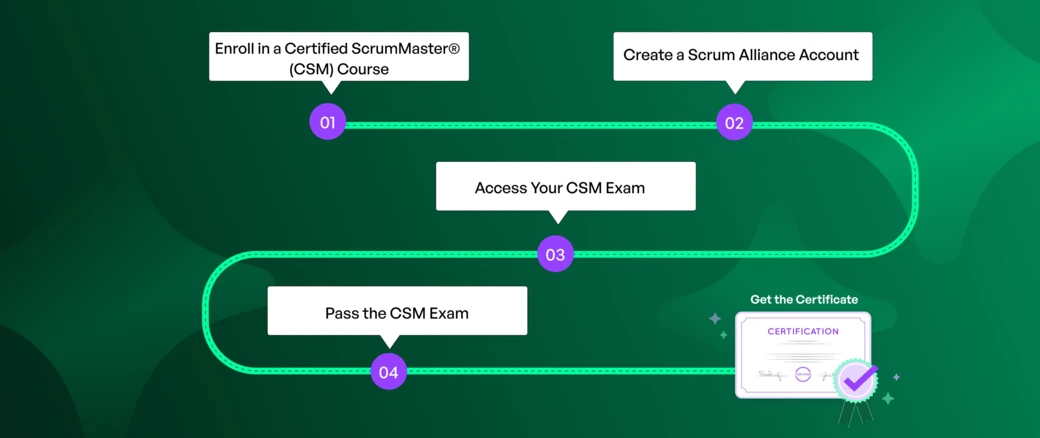
The formal training takes exactly two days, comprising 16 hours of live instruction. Most candidates pass their online test and download their official Scrum Master Certification in Delhi within 48 hours of completing the course.
Yes, all participants receive access to the live session recordings via our learning management system. This serves as an excellent resource for exam preparation and reviewing complex topics discussed during your CSM Class in Delhi.
Yes, every student receives the official Scrum Alliance workbook and student guide. These materials are paired with StarAgile's exclusive exam prep kits to ensure success in your CSM Training in Delhi.
Yes, our curriculum avoids boring slideshows. The Scrum Master Course in Delhi uses immersive simulations, role-plays, and interactive games to replicate real-world sprint challenges and team dynamics.
The sessions are conducted by elite Certified Scrum Trainers (CSTs) from Scrum Alliance. These instructors bring over 15 years of practical Agile experience to your Certified Scrum Master Class in Delhi.
We offer extensive post-training support, including exam preparation guidance, career advice, and interview preparation bootcamps to help you leverage your new Certified Scrum Master Certification in Delhi effectively.
Yes, we understand that emergencies happen. You can request a change of schedule to a different upcoming batch for your CSM Course in Delhi by contacting our customer support team ahead of time.
Yes, we deliver customised corporate learning programs. We can conduct private virtual or on-site workshops tailored to your organisation's specific transformation goals using our Certified Scrum Master Training in Delhi framework.
Yes, StarAgile provides flexible financial payment methods. You can choose from zero-cost EMI plans and installment options during checkout to make your enrollment for the CSM Certification Course in Delhi highly affordable.
Yes, upon successfully completing the full 16 hours of interactive training, you will receive a formal course completion certificate from StarAgile, followed by your test eligibility from Scrum Alliance.
You will receive lifetime access to our digital learning portal. This allows you to revisit the updated study resources, mock guides, and materials long after your CSM Training in Delhi concludes.
Absolutely. You can schedule a free consultation with our expert academic advisors to clear up queries regarding batch availability, exam formats, or career alignments before securing your seat.
StarAgile is a trusted industry leader boasting a 100% exam success rate and excellent student reviews. We combine official Scrum guidelines with valuable industry bonuses like GenAI insights to make our CSM Course in Delhi stand out.
Yes, it is perfectly tailored for beginners. The course starts with the fundamental basics of the Agile manifesto before moving into technical frameworks, ensuring every participant builds a solid foundation.
Certified ScrumMaster Certification Training - Exam FAQs
Yes, the complete assessment profile is fully integrated. Enrolling in StarAgile's comprehensive CSM Certification Course in Delhi automatically covers your mandatory training hours, official registration paperwork, and structural evaluation expenses with zero hidden demands.
The online validation includes exactly 50 objective-based queries. These are entirely built on standard Scrum components and core performance parameters taught during your interactive Certified Scrum Master Class in Delhi.
Candidates receive a strict time box of 60 minutes to evaluate all items. This quick timeframe evaluates your core cognitive alignment alongside standard principles established in your foundational Scrum Master Course in Delhi.
You must hit a mandatory passing threshold of 74% to clear the evaluation. This translates to responding to at least 37 out of 50 questions accurately during your dynamic Scrum Master Certification in Delhi assessment.
Yes, the test is fully digital and non-proctored. You can comfortably finish the assessment directly from home or office in Delhi using a standard browser once your interactive Certified Scrum Master Online Course in Delhi wraps up.
As soon as your live training logs are updated by StarAgile, Scrum Alliance sends over an account validation link. This grants immediate access to the portal, allowing you to take the exam right after your CSM Certification in Delhi course wraps up.
Your base registration covers two official validation attempts at no extra fee. You must utilise these complementary attempts within a 90-day window following your active Certified Scrum Master Training in Delhi.
Yes, StarAgile provides continuous access to multiple realistic mock test simulators. These simulated environments are accessible right on our LMS platform to prepare you thoroughly before you finish your CSM Course in Delhi.
Absolutely. Our elite instructors provide dedicated test preparation modules, walk through tricky scenario structures, and break down complex concepts during the live iterations of your chosen Scrum Master Training in Delhi.
The evaluation is widely considered moderate and highly achievable. Pay close attention during your 16 hours of live interactive CSM Class in Delhi and review the basic Scrum Guide to clear the threshold comfortably on your first try.
The assessment consists entirely of straightforward multiple-choice and scenario-driven questions. These evaluate your foundational understanding of team metrics, which are deeply covered in our comprehensive CSM Certification Online Course in Delhi.
The evaluation covers Scrum values, empirical foundations, accountabilities (Scrum Master, Product Owner, Developers), events, and artifacts. These core pillars form the foundation of our structured Scrum Master Course in Delhi.
Yes, we deliver customised corporate learning programs. We can conduct private virtual or on-site workshops tailored to your organisation's specific transformation goals using our Certified Scrum Master Training in Delhi framework.
Yes, StarAgile provides flexible financial payment methods. You can choose from zero-cost EMI plans and installment options during checkout to make your enrollment for the CSM Certification Course in Delhi highly affordable.
Yes, upon successfully completing the full 16 hours of interactive training, you will receive a formal course completion certificate from StarAgile, followed by your test eligibility from Scrum Alliance.
You will receive lifetime access to our digital learning portal. This allows you to revisit the updated study resources, mock guides, and materials long after your CSM Training in Delhi concludes.
Absolutely. You can schedule a free consultation with our expert academic advisors to clear up queries regarding batch availability, exam formats, or career alignments before securing your seat.
StarAgile is a trusted industry leader boasting a 100% exam success rate and excellent student reviews. We combine official Scrum guidelines with valuable industry bonuses like GenAI insights to make our CSM Course in Delhi stand out.
Yes, it is perfectly tailored for beginners. The course starts with the fundamental basics of the Agile manifesto before moving into technical frameworks, ensuring every participant builds a solid foundation.
CSM Course in Delhi - Information Based FAQs
Yes, the CSM Certification in Delhi is highly sought after. Major corporate bodies across the National Capital Region actively track down certified Scrum experts to drive modern digital transformations and framework structure migrations.
Absolutely. Graduating from a professional Certified Scrum Master Course in Delhi boosts your professional standing. It showcases your capability to successfully manage complex sprint backlogs and increase development speeds.
StarAgile’s CSM trainers bring international recognition, extensive Scrum and Agile experience, and practical industry knowledge. Trainers include Narasimha Reddy Bommaka and Madhavi Ledalla.
Leading multinational corporations—including corporate powerhouses like HCL, TCS, Wipro, Paytm, and Nagarro—frequently look for professionals who have cleared a top-tier Scrum Master Course in Delhi.
Yes, completing an official Certified Scrum Master Training in Delhi establishes the precise cross-functional authority needed to comfortably assume high-level servant-leader or agile manager positions.
Definitely. Traditional project leads transitioning into Agile frameworks find this CSM Certification Course in Delhi invaluable for learning iterative value creation models and removing rigid delivery processes.
Yes, a business analyst trained through a comprehensive Certified Scrum Master Online Course in Delhi can bridge the gap between clients and development teams much more efficiently by using accurate story slicing techniques.
Yes, the credential acts as a solid launching pad. Attaining your Certified Scrum Master Certification in Delhi proves you possess a deep operational understanding of Agile principles and real-world execution.
Carrying a validated badge from an authorised Certified Scrum Master Class in Delhi signals to hiring managers that you possess high-level practical knowledge in executing iterative sprint architectures.
Yes, certified individuals often secure impressive compensation hikes. The initial investment for your CSM Training in Delhi is typically offset quickly by the premium salaries offered across the regional job market.
Yes, as a premium global standard backed by Scrum Alliance, this specific Scrum Master Training in Delhi credential is universally accepted across elite business organisations and technology parks throughout NCR.
Yes, engineers routinely utilise the Scrum Master Course in Delhi to master product increment delivery cycles, manage development boundaries, and transition into senior technical leadership tracks.
Yes, aligning your team through a premium CSM Certification Online Course in Delhi ensures everyone utilises standard definitions of done, accelerating internal baseline deployment benchmarks.
You can apply these principles immediately. The mock simulations and case studies integrated into your CSM Class in Delhi provide practical strategies that can be implemented at your workplace from day one.
Yes, publishing your badge from an official Certified Scrum Master Online Course in Delhi helps your profile stand out against competitive algorithm filters, increasing relevant recruiter profile visits.
Yes, StarAgile organises flexible weekend options. This allows you to complete your chosen Certified Scrum Master Training in Delhi without missing a single minute of your regular weekday office schedule.
Yes, modern delivery leaders use the knowledge gained from this Scrum Master Certification in Delhi to reduce burnout, manage external scope creep, and enhance general product release predictability.
Yes, corporate groups can easily register together. StarAgile frequently hosts dedicated multi-member tracks tailored around specific company needs using our premier CSM Training in Delhi delivery model.
Yes, we offer scaled financial incentives for collective registrations. Corporate groups enrolling for the CSM Certification Course in Delhi can connect with our support advisors to lock in specialised pricing structures.
Scrum Master Jobs in Delhi require credentials for roles such as Agile Team Facilitator, Scrum Master, Delivery Lead, Technical Project Manager, and Agile Transformation Consultant across the regional job sector.
Simply head over to StarAgile’s main portal, choose your preferred batch for the CSM Course in Delhi, click register, and select your payment method to secure your virtual seat.
Distinctions and Achievements
About Certified ScrumMaster® Course in Delhi
The Certified Scrum Master Course in Delhi is an immersive and transformative training program designed to ground professionals in the core tenets of Agile product development. This specialised CSM Certification Course in Delhi focuses extensively on the operational mechanics of the Scrum framework, detailing its essential roles, events, and artifacts. By participating in this interactive workshop, you will learn how to effectively champion empirical process control, shield development teams from external disruptions, and facilitate seamless collaborative environments.
Our Certified Scrum Master Training in Delhi curriculum goes far beyond mere theoretical text. It offers a practical deep dive into managing product backlogs, defining clear sprint goals, and removing organisational impediments. CSM Course Duration in Delhi is a 2-day online training. Whether you are attending a weekend or weekday Certified Scrum Master Class in Delhi, you will engage in real-world case studies and agile simulations that replicate modern workspace challenges, as well as preparation for the Certified Scrum Master Exam Delhi. Enrolling in this Scrum Master Training in Delhi ensures you can confidently help companies build self-organising teams, drastically improve release predictability, and deliver high-value product increments in any industrial sector.
Benefits of CSM Certification in Delhi
Enrolling with StarAgile secures a seamless path toward your Scrum Master Certification in Delhi. As an authorised Premier Licensed Training Partner, we assume complete ownership of your academic success by delivering a 100% exam pass blueprint and an ironclad money-back guarantee. Your comprehensive CSM Training Duration in Delhi package features mandatory test registration fees, a two-year premium Scrum Alliance membership, full access to realistic simulator question banks, and an exclusive eight-hour bonus masterclass focusing on Generative AI capabilities for managing automated sprint metrics.
Key Advantages for Professionals
- Exceptional Career Transition: CSM Job Opportunities in Delhi give an effortless move into formal Scrum Master tracks across leading multi-national corporations.
- Premium Salary Hikes: Attaining your official Certified Scrum Master Certification in Delhi commands a 25% to 40% pay premium for CSM Jobs in Delhi.
- Optimised Group Execution: Apply the skills gained from this CSM Training in Delhi to immediately reduce workplace friction, remove delivery bottlenecks, and improve general release predictability inside active operational units.
Comprehensive Training Solutions for Enterprises













People also viewed courses like