





CSM® Certification Training UK
 100% Money Back Guarantee


-
 2 days of live, instructor-led online certified scrum master training UK
-
Delivered by Certified Scrum Trainers (CSTs) with 15+ years of experience
-
CSM exam fee included in the course fee
-
2-year Scrum Alliance membership included
-
Earn 20 PDUs and 16 SEUs
-
100% money-back guarantee

CSM Certification Training in UK Key Features
-
 2 Days Online Training
-
Delivered by CSTs
-
20 PDUs and 16 SEUs
-
Get certified on 2nd Day
 2 Days Online Training
-
Scrum Alliance Exam Fee Included
-
2-year Scrum Alliance Membership
-
100% Money Back Guarantee
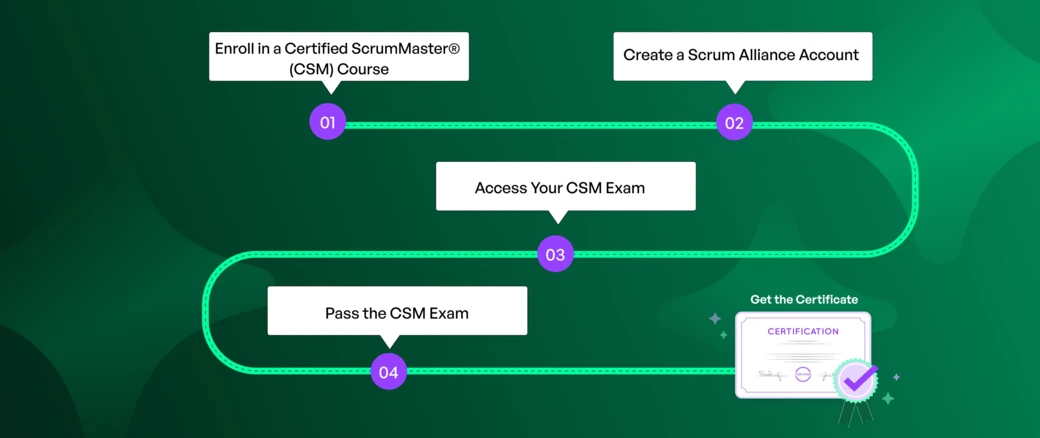
The Proven Path to CSM Certification Success
Scrum Master Course in UK Course Content
Every product backlog item gets declared as DONE it must be accepted by all team members and they must in advance know when it is called DONE. Here the team must be appraised of how a work is done, what are the standards required to be obeyed, and the different ways to verify whether it is done.
Each user story will have a specific criteria description called the acceptance criteria for that story.
Unlike in waterfall method, QA role is to write test cases and report bugs, in a scrum team QA has an extended role. QA team takes part in the daily meetings along with all team members. They are allowed to discuss with the business analyst and development team. They are part of the test planning phase. The team not only writes test cases but also the acceptance test cases to provide support to the product owner. Story estimation sessions will not happen without the QA team. They help in providing more realistic estimates. In short, the QA team is as equal to the development in the scrum projects.
Scrum process empowers the team to speak and share their views. Therefore scrum managers must understand the team strength and the product owner need. The manager should discuss with the team and let know the product owner to decide on the product backlog item. This will motivate the team to work towards delivery. The manager must never be biased and push team for delivery. Ensure that the team commits and support them during every sprint to combat issues. The manager must not think of bossing around but work along with the team to lead them to successful completion.
These days working with people across the globe on projects cannot be avoided. It is not possible to meet all at one table to discuss. Therefore managing teams with documentation might be effective but time-consuming and hence organization must embrace an agile way to work with distributed teams.
Even though it has its own flip side, still it is the best way to work with distributed teams. Remember that people remain the same irrespective of the geography and hence getting work done by setting expectation is quick. Also, use technology to meet people for daily stand up and execute the project efficiently.
- Tuckman’s Group Development Tools and Technique – Forming, Storming, Norming, Performing, Adjourning.
- Scrum Master tools Cynefin Framework – Simple, Complicated, Complex, and Chaotic.
- The Japanese Shu Ha Ri – Shu – self-disciplining, Ha – Innovate things, Ri – Execution
- Root cause analysis
- Every team member is given stick-it notes and asked to write their views about the project, deadline, completion etc.
- A good 3 minutes is given to each person to fill the following blank we can complete the task when we ……………………. Let each write their want. They can write 3 to 5 ideas.
- Ask everyone to read one idea each and make sure that the other person does not repeat the same idea.
- Have one person to make a note of all the ideas on the board.
- Take voting from all to come to a common working agreement from the list mentioned in the board.
The people responsible for coding and developing the project is called the development team. The team that test the bug and fixes the issues is called the testing team. As far as scrum projects are considered the entire team is called a scrum team which includes developers, testers, product owners, scrum master, and the high-level stakeholders. These teams are self-organising in agile development and are independent to complete their task. They don’t require anyone to monitor but they manage themselves.
The objective of release planning is to plan and make the scope, budget, and date for the incremental delivery in an agile project. Planning to have multiple sprints until the final product is released is discussed in the release planning meeting.
Every member of the scrum team and the stakeholders are part of this release plan meeting and it happens during each sprint activity. The release planning is done with the help of the product planning output and the pace at which the team completes the product backlog item per each sprint. This pace is nothing but the speed of the team and termed as velocity in agile projects.
- Four or more week longer sprints
- Bigger team size
- Complex backlog items
Choose the plan that fits you best!
| Standard Plan | StarX Plan | StarMax Plan | |
|---|---|---|---|
| Delivered by CSTs , Get 16 PDUs and SEUs |

|
|
|
| 100% Money Back Guarentee |
|
|
|
| Enjoy 2-Year Membership with Scrum Alliance |
|
|
|
| 100 -Interview Preparation Questions |
|
|
|
| Get 10 Sample Resumes |
|
|
|
| 3 High quality Mock Exams |
|
|
|
| Exclusive 11 hours video course from Industry Leader, to lay a solid foundation in agile project management principles and the Scrum Framework |

|
|
|
| Exclusive 13 hours video course from Industry Leader, to lay a solid foundation in agile scrum Master and the Scrum Framework |
|
|
|
| Microsoft certification: Transform business workflows with generative AI certification from StarAgile In Collaboration with Microsoft |
|
|
|
| Additional 2 High Quality Mock Exam |
|
|
|
| Microcredentials: AI For Scrum Master Certification by Scrum Alliance* |
|
|
|
| Talk to a Hiring Manager, 1:1 for 20 mins |
|
|
|
| 6 Hours Jira Live Virtual Training with 6 PDUs |
|
|
|
| 6 hours AI For Scrum Master - Live Virtual session with 6 PDUs |
|
|
|
| A 2 hours chatgpt fresher course |
|
|
|
| A 1 hour course to improve coaching and mentoring |
|
|
|
| A 1 hour course to resolve conflict resolution and Problem Solving |
|
|
|
| A 1 hour course to 'Creating and Maintaining a Positive Remote Team Culture' |
|
|
|


Upcoming Batches of Scrum Master Certification in UK
your batch request?



The work force is your asset. Up-Skill them with our Corporate Training Programs!
-
Unleash In-Demand Skills Across the Enterprise
-
Align Skill Development with Business Objectives
-
Drive Increased Employee Productivity
-
Leverage Immersive Learning
Overview of Scrum Master Certification in United Kingdom
Earning a certified scrum master UK credential can meaningfully shift your CSM career trajectory, opening doors across technology, finance, and retail wherever Scrum teams are used.
Career Impact
- Opens doors to Scrum Master, Agile Coach, and Delivery Lead roles
- Certified professionals are increasingly preferred for Agile delivery positions
- Connects you to a global Scrum Alliance community for ongoing networking
What We Offer
- 2 days of live, CST-led scrum master certification UK training
- CSM Exam fee, mock tests, and a 2-year Scrum Alliance membership included
- 20 PDUs, 16 SEUs, and a 100% money-back guarantee
Certified Scrum Master Course Eligibility and Prerequisites
- No formal prerequisites required to enrol in this CSM certification UK course
- Basic familiarity with Agile is helpful but not mandatory
- Open to complete beginners and experienced professionals through this CSM training UK
CSM Certificate

Testimonials

CSM Certification in UK - Certification FAQ's
The course begins with Lean, Agile, and Scrum fundamentals before moving into Scrum values, team roles, and the Scrum Master's responsibilities. This scrum master certification UK syllabus also touches on preparatory Agile practices, so you leave with a rounded understanding rather than isolated facts. You'll also work through sprint events, backlog artefacts, and facilitation techniques in enough depth to apply them immediately in a real Scrum team. By the end of this scrum master certification UK journey, the aim is practical competence rather than just familiarity with terminology.
It's delivered entirely through live, interactive sessions rather than pre-recorded videos, so you can ask questions and work through scenarios with your trainer and classmates in real time. This matters because Scrum concepts often click faster through discussion and role play than through passive viewing. If you miss a moment, recordings of the live sessions are also made available afterward, so nothing is lost even if a clash comes up.
Since this certified scrum master UK program is delivered fully online, learners from London, Manchester, Birmingham, Edinburgh, Leeds, and anywhere else in the UK can join the same live batches without needing a local training centre. This scrum master certification UK format removes the usual constraint of only being able to train with whoever happens to run sessions near you. It also means you're learning alongside a broader mix of industries and backgrounds than a single city's certified scrum master UK cohort would typically offer.
You'll earn 16 SEUs on completion. Since renewal requires 20 SEUs every two years, these 16 contribute a large share of what you'll need when it's time to renew. The remaining SEUs can be picked up through webinars, community events, or further Scrum Alliance activities, so renewal rarely means starting from zero. Keeping a simple record of your SEU-earning activities as you go makes the eventual renewal process considerably smoother.
Yes. StarAgile, a Licensed Training Partner (LTP) of Scrum Alliance, offers eligible Scrum Alliance certification courses through authorized trainers.
Yes, mock tests and practice sessions are built into the training, giving you a realistic sense of question style and pacing before you sit the real CSM exam. Working through these under timed conditions, as part of this scrum master certification UK preparation, helps you get comfortable with the open-book format, since knowing where to look things up quickly matters just as much as understanding the concepts themselves. Most learners find their confidence improves noticeably after just one or two practice runs.
Yes, the exam fee is included in the course fee, so there's no separate payment needed to Scrum Alliance once your training is complete. This keeps the overall CSM certification cost UK straightforward from the outset, rather than surprising you with an additional charge after you've already committed to the course. The only extra cost would apply if you needed more than two attempts to pass the exam.
The main progression for a scrum master certification UK path is Certified Scrum Master (CSM) as the foundational level, Advanced Certified Scrum Master (A-CSM) for those looking to upskill, and Certified Scrum Professional (CSP-SM) for more experienced practitioners. Each level builds on real experience gained after the last, rather than simply requiring more study, so progression naturally slows down as the credentials get more advanced. Most professionals spend a year or more actually working as a Scrum Master before moving up a level.
Yes, weekend batches run alongside weekday options, so working professionals across the UK can complete the course without needing extended time off work. Many learners pursuing a scrum master certification UK route specifically choose a weekend batch so they can stay fully focused across the two days without splitting attention with a day job. Recordings of each session are also provided, so even a busy weekend doesn't mean losing access to the material.
No, StarAgile does not provide exam dumps. Instead, CSTs with 15+ years of experience deliver interactive sessions designed to build genuine understanding, which tends to prepare candidates more reliably than memorised answers. Relying on dumps also tends to leave gaps once you're actually working as a certified scrum master UK professional, since the exam questions are designed to test applied judgement rather than pure recall. Building real understanding during training pays off well beyond the exam itself.
Yes, StarAgile is an Authorised Licensed Training Partner of Scrum Alliance, recognised as a Registered Education Provider for this CSM certification UK course. This status means the courseware, trainer qualifications, and delivery standards have all been vetted directly by Scrum Alliance, rather than StarAgile simply claiming alignment with the framework. It's worth checking for this kind of authorisation with any scrum master certification UK provider before enrolling, since not every course claiming to prepare you for CSM actually holds it.
Yes, StarAgile offers a 100% money-back guarantee if you don't clear the exam within two attempts, making this certified scrum master training UK a low-risk way to get certified. This guarantee reflects confidence in the certified scrum master UK training itself, since most candidates who engage properly with the course material and mock exams pass comfortably on their first attempt. Full terms and conditions are available directly from a course advisor before you enrol.
You'll receive the Certified Scrum Master certificate directly from Scrum Alliance, along with a two-year Scrum Alliance membership giving access to further resources and the wider Scrum community. This certified scrum master UK certificate is downloadable in PDF format directly from your Scrum Alliance account once you've passed the exam. Many learners also add this scrum master certification UK credential to LinkedIn, since it's a recognised signal to employers and recruiters searching for Agile talent.
Learners pursuing this scrum master certification UK route get access to webinars, community forums, and ongoing networking opportunities with other Scrum Masters, alongside the core training materials used during the live sessions. These resources remain available well beyond the two days of certified scrum master UK live training, which is useful both for exam revision and for continued learning once you're applying Scrum in a real team. Many learners also use the community forums to compare notes on real workplace challenges.
No, StarAgile doesn't offer private one-to-one training for this course. It's delivered entirely through live, interactive group sessions, which also gives you the chance to learn alongside peers from different industries. Many certified scrum master UK learners actually find the group format more valuable than one-to-one training would be, since hearing how other professionals apply Scrum in their own workplace often surfaces perspectives you wouldn't get from a trainer alone.
Yes, this certified scrum master UK course weaves case studies and real-world examples throughout, alongside group activities and role-playing exercises that mirror actual Scrum team scenarios. Working through a case study as a group, a hallmark of this certified scrum master UK course, tends to surface disagreements and edge cases that a purely theoretical explanation wouldn't reveal. This practical grounding is part of why the training translates well into confidence on the job afterwards.
Yes, the entire course is delivered online, so you can join live sessions from home or anywhere else in the UK with a stable internet connection. A laptop or PC, a working webcam and microphone, and a quiet space to focus for the two training days are really all you need. There's no requirement to travel to a physical venue at any point during the course or the exam.
StarAgile combines Authorised Licensed Training Partner status, trainers with 15+ years of experience, and a 100% money-back guarantee, making this CSM certification UK course a well-supported choice rather than a generic, exam-only option. Beyond the training itself, ongoing mentoring, mock exams, and career support are all bundled into one fee, so there's little need to seek out additional resources elsewhere. This all-inclusive approach tends to reduce the guesswork of piecing together a preparation plan yourself.
Yes, weekday and weekend batches, along with recorded sessions, are specifically designed to fit around a full-time job. The course is intentionally compact at just two days, rather than stretched across many weeks, which suits professionals who'd rather complete their certification in a short, focused burst. Most working professionals manage to complete both the training and the exam within a couple of weeks of starting.
Yes, this certified scrum master UK program includes ongoing assistance through mentoring conversations, WhatsApp groups, and webinars, so support continues beyond the two live training days. This is particularly useful once you start applying Scrum in your actual workplace, since real situations often raise questions that didn't come up during the structured training itself. Having somewhere to ask those follow-up questions tends to make the learning stick.
Yes, live sessions are recorded, so you can revisit specific topics while preparing for the exam or if you miss a class. Having the recordings available also helps if you want to review a particular module more than once, since some topics like estimation techniques or Scrum artefacts tend to make more sense the second time through. Access to these recordings continues well after the live sessions themselves have ended.
This scrum master certification UK course is built around group activities, role-playing exercises, and case studies throughout both training days, rather than being concentrated into just one session. Simulations covering sprint planning, retrospectives, and backlog refinement all get practised more than once, which helps the habits form properly rather than being demonstrated only briefly. This repetition is part of why the course fits comfortably into just two days without feeling rushed.
Yes, real-world examples and case studies are used specifically to prepare participants for practical Scrum procedures they'll encounter on the job. These examples span different industries and project types, rather than focusing narrowly on software development, since professionals with a scrum master certification UK increasingly work outside pure tech settings too. Seeing how the same principles apply across different contexts tends to build more transferable confidence than a single industry example would.
Yes, materials and recordings remain accessible after the course ends, which is useful for both exam revision and future reference. Many learners come back to specific modules months later when they encounter a related situation at work and want to refresh their memory. Having this material on hand long-term is part of what makes the course a lasting resource rather than something you use only once.
Yes, both are available for this certified scrum master UK course, giving learners across the UK flexibility to pick whichever schedule suits their work commitments. Weekday batches tend to suit those with more flexible working hours, while weekend batches are popular with scrum master certification UK candidates who'd rather keep their working week entirely free of training commitments. Both formats cover exactly the same syllabus and lead to the same certification.
Yes, interview preparation support is part of the broader career assistance offered once you've completed your certified scrum master training UK course. This typically includes common interview questions specific to Scrum Master roles, along with guidance on how to talk through your training and any project experience convincingly. Preparing this way tends to make a real difference when you're up against other freshly certified candidates for the same role.
Yes, resume support is included as part of the career assistance for this scrum master certification UK program, helping you present your new Scrum Master credential clearly to employers. This includes guidance on how to frame any existing project or team experience in Scrum-relevant terms, even if your previous job title wasn't explicitly Agile-focused. A clearly presented resume tends to make it much easier for recruiters to see your fit for Scrum Master roles.
Yes, the syllabus is kept aligned with Scrum Alliance's current standards, so the CSM certification UK course you take reflects up-to-date Scrum guidance rather than an outdated version. Scrum Alliance periodically refreshes its guidance as the profession evolves, and StarAgile updates its training content to match rather than continuing to teach from an older version. This keeps what you learn directly relevant to how Scrum is actually practiced today.
Yes, trainers remain reachable after the live sessions through mentoring calls and community channels, so questions don't have to wait until the next class. This is particularly useful in the run-up to your exam, when a quick clarification on a tricky concept can make a real difference to your confidence. Trainers generally respond within a reasonable timeframe rather than leaving queries unanswered for long.
Yes, this certified scrum master UK program includes ongoing mentoring meetings, webinars, and community access, all aimed at helping you apply what you've learned once you're back at work. Career support extends beyond just the initial job search too, since the same mentoring and community resources remain available as you grow into more senior Scrum Master or Agile Coach positions over time. This continuity is part of what distinguishes ongoing support from a one-off training session.
Yes, instalment options are available to spread the CSM certification cost UK across several months rather than paying the full fee upfront. A course advisor can confirm current plans. Spreading the fee this way tends to make the course more accessible for professionals covering the cost themselves rather than through an employer's training budget. Terms vary depending on current offers, so it's worth asking directly for the latest instalment structure.
The combination of Authorised Licensed Training Partner status, experienced CSTs, mock exams, and a money-back guarantee sets this certified scrum master training UK apart from providers offering little beyond slides and an exam voucher. Ongoing mentoring, career support, and community access continue well after the two live training days finish, rather than the relationship ending the moment you're certified. This full-course approach tends to matter more in practice than most learners expect when they first enrol.
Scrum Master Training in UK - Exam FAQ's
No, there are no formal prerequisites for this scrum master certification UK course. Basic familiarity with Agile concepts is helpful but not required, since the two-day training covers Scrum fundamentals from the ground up rather than assuming prior knowledge. This makes it accessible to complete beginners as well as professionals already working in Agile environments who want to formalise their understanding. Anyone genuinely interested in learning Scrum can enrol, regardless of technical or industry background.
Once you've completed your training, Scrum Alliance sends the exam link directly to the email address you registered with, so there's no separate application form to complete. You'll then schedule your attempt and sit the exam online at a time that suits you within the eligibility window. This certified scrum master UK process is designed to be straightforward, with your course advisor able to help if anything about the scheduling process is unclear.
Yes, you can pause the exam and resume later, but the clock keeps running throughout, so no extra time is added for the pause itself. This means pausing doesn't actually help unless you genuinely need a short break, since every minute away from the screen still counts against your 60-minute limit. It's generally better to schedule the exam for a time when you can complete it in one sitting without interruption.
Yes, the CSM exam is open-book, so you can refer to the Scrum Guide, your training notes, and other resources while answering questions. This doesn't make the exam trivial, since the 60-minute time limit means you can't look up every answer from scratch. Most candidates who've engaged properly with the certified scrum master UK training use their notes mainly to double-check specific details rather than to answer questions they don't understand at all.
No, Scrum Alliance doesn't offer re-evaluation of a failed attempt. Your only route forward is to book another attempt, which is included free of charge for your first two tries within 90 days of training. This straightforward retake policy means a difficult first attempt isn't the end of the road, and most candidates who don't pass first time do so on their second attempt after reviewing the areas that tripped them up.
The exam consists of 50 multiple-choice questions, delivered online and open-book, with 60 minutes to complete it. You'll need to answer at least 34 questions correctly, which works out to a 74% passing score. This format tests applied understanding of Scrum roles, events, and artefacts rather than pure memorisation, which is why the training itself focuses heavily on discussion and practical scenarios rather than rote learning.
The exam fee is included within the overall CSM certification cost UK you pay when enrolling, so there's no separate charge from Scrum Alliance for your first attempt. This keeps the total cost predictable from the outset, since you won't be asked for an additional payment partway through the process. The only extra cost to budget for would be a $25 fee if you needed more than two attempts to pass.
Most candidates who engage properly with the training and mock exams find it manageable rather than especially difficult, particularly since it's open-book and doesn't demand pure memorisation. That said, treating the exam casually without reviewing the material tends to catch people out, since the scenario-based questions require genuine understanding of how Scrum works in practice. Preparation matters more than natural aptitude for passing this exam comfortably.
Reviewing the Scrum Guide alongside your training notes, working through mock exams, and discussing tricky concepts with your trainer or peers are the most effective ways to prepare for this scrum master certification UK exam. The exam itself runs for 60 minutes, during which you'll answer all 50 questions. Pacing yourself at roughly a minute per question, with time in hand to revisit flagged items, tends to work well for most candidates.
You need to answer at least 34 out of 50 questions correctly, which works out to a 74% passing score. This threshold is set by Scrum Alliance and applies consistently regardless of where in the world you sit the exam. Most candidates who've completed their training thoroughly and worked through a few mock tests clear this bar comfortably on their first attempt.
Skimming the Scrum Guide without properly working through the training material, skipping mock exams, and underestimating how much the exam relies on scenario-based judgement rather than definitions are the most frequent mistakes. Some candidates also leave revision until the last minute, which doesn't leave enough time to properly absorb Scrum's roles, events, and artefacts. Pacing your preparation across the days between training and the exam tends to produce far better results than cramming everything into one evening.
Splitting your remaining preparation time between reviewing the Scrum Guide, working through mock exams, and revisiting any topics you found unclear during training tends to work well. Booking your exam for roughly one to two weeks after training gives enough of a buffer to consolidate what you've learned without losing momentum. Treating mock exam results as a guide for where to focus your remaining revision time is more efficient than reviewing everything equally.
Scrum roles, the purpose of each Scrum event, and the three artefacts (product backlog, sprint backlog, and increment) form the backbone of most exam questions. Understanding how these pieces fit together, rather than memorising definitions in isolation, tends to help far more with the scenario-based questions the exam favours. Revisiting your training notes on facilitation and the Scrum Master's specific responsibilities is also worth prioritising, since this area is tested heavily.
Mock tests included as part of your training give you a realistic sense of your current score against the 74% passing threshold, so you know roughly where you stand before booking the real exam. Reviewing which questions you got wrong, rather than just noting your overall score, helps you target your remaining revision more precisely. Repeating a mock exam after addressing weak areas is a good way to confirm genuine improvement.
Expect situational questions describing a challenge on a Scrum team, then asking what the Scrum Master should do next, rather than simply asking you to define a term. These questions test whether you understand the reasoning behind Scrum practices, not just whether you can recall them. Practising with mock exams that include this style of question is the most reliable way to get comfortable with how they're phrased.
Most candidates sit the exam within one to two weeks of finishing training, while the material is still fresh. You do need to stay within the 90-day window from your training completion date to use your two free attempts, so there's no need to rush unnecessarily either. Waiting too long risks losing momentum, so booking a date fairly soon after training tends to work best.
If you don't pass within your two free attempts, you can book further attempts for a $25 fee each, so the process isn't blocked entirely. It's worth spending focused time reviewing the specific areas that tripped you up, rather than simply repeating the same preparation and hoping for a different result. Speaking with your trainer about where you struggled can also help target your revision more effectively before trying again.
You'll need a valid email address to register your Scrum Alliance account, since your exam link and certificate are both delivered there. Beyond that, no additional identification documents are typically required to sit the online exam itself. Keeping your Scrum Alliance account details up to date is worth doing anyway, since it's also where you'll manage your membership and renewal in future.
Working through the training material a second time, alongside the Scrum Guide, tends to reveal details that didn't fully land the first time around. Discussing specific roles and events with your trainer or fellow candidates, rather than just reading passively, also helps concepts stick more firmly. Mock exams are useful here too, since getting a question wrong on a specific artefact or event is often the quickest way to spot a gap in your understanding.
It's entirely manageable, since the certified scrum master UK training is specifically designed to build Scrum knowledge from zero rather than assuming prior experience. The open-book format also helps, since you're not expected to have memorised everything without support. Candidates with no prior Scrum background who engage properly with the training and mock exams generally perform just as well as those coming in with some existing familiarity.
Certified Scrum Master Course in UK - Advance FAQ's
Yes, demand has held steady as more UK organisations across technology, finance, and retail continue scaling their Agile practices. Employers increasingly list a scrum master certification UK credential as a preferred requirement when hiring for delivery and coaching roles. While demand does fluctuate with the wider job market, Scrum Master roles remain one of the more consistently advertised Agile positions across the country.
Reported salary ranges vary by experience, location, and sector, but a certified scrum master UK professional can generally expect a competitive salary that improves noticeably with a few years of hands-on experience. London-based roles tend to sit at the higher end of the range, while regional roles often pay somewhat less but come with a lower cost of living. Specific figures are best checked against current UK job listings, since they shift with market conditions.
Yes, particularly given how widely Scrum is still used across UK software, finance, and product teams. A scrum master certification UK credential remains one of the more recognised entry points into Agile delivery roles, and the structured two-day format makes it a low-commitment way to test whether the role suits you before investing further in your Agile career.
Rather than a fixed list that changes quickly, it's more useful to think in sectors: technology firms, financial services companies, retail businesses, and public sector digital teams across the UK regularly list Scrum Master roles. Checking current listings on major UK job boards for your target sector will give the clearest, most up-to-date picture of who's actively hiring.
Yes. StarAgile provides CSM training through internationally recognized and highly experienced trainers, including Narasimha Reddy Bommaka and Madhavi Ledalla, with strong expertise in Scrum and Agile.
Technology and software development remain the strongest source of demand, followed closely by financial services, retail, and increasingly the public sector as more government digital teams adopt Agile ways of working. A certified scrum master UK credential tends to open doors across all of these sectors, since the underlying Scrum skills transfer well regardless of industry.
Scrum Master, Agile Coach, Delivery Lead, and increasingly Agile Project Manager are the most natural roles to target with a certified scrum master UK credential. Some professionals also move sideways into Agile-adjacent roles like Business Analyst or Product Owner if their interests shift during their early Scrum Master experience. The certification tends to open more doors than it closes, since it demonstrates a working understanding of Agile delivery broadly.
Strong facilitation, comfort managing conflict, and the ability to coach a team without formal authority over its members are consistently expected alongside the certification itself. Employers also value some exposure to tools like Jira or Azure DevOps, and increasingly some familiarity with scaled Agile frameworks for larger organisations. A scrum master certification UK credential demonstrates the theory, but these practical and interpersonal skills are what employers probe for most in interviews.
Yes, this is one of the more common transitions, since project managers already bring stakeholder management and planning skills that transfer well into the Scrum Master role. A scrum master certification UK course specifically reframes those existing skills around Scrum's facilitation-focused approach, rather than the more directive style traditional project management often expects. Many former project managers find the shift to servant leadership takes some adjustment, but the underlying delivery instincts carry across well.
Yes, all three bring genuinely useful context to the Scrum Master role, since they already understand how requirements, code, and quality assurance fit together within a delivery team. A certified scrum master UK course builds the facilitation and coaching layer on top of that existing technical or analytical background. This blend of hands-on delivery experience and formal Scrum training tends to make for particularly credible Scrum Master candidates.
Most professionals spend a few years actively working as a Scrum Master, building experience across multiple teams and projects, before moving into a broader Agile Coach role. A scrum master certification UK credential is typically the starting point, often followed by an Advanced Certified Scrum Master or Certified Scrum Professional credential as experience grows. Agile Coach roles generally expect this kind of demonstrated experience, rather than certification alone, before someone is considered ready for the step up.
Volunteering to facilitate Scrum events within your current team, even informally, is one of the fastest ways to build practical experience once you're certified. Joining local Agile meetups or online communities also exposes you to how other Scrum Masters handle real challenges. A certified scrum master UK credential opens the conversation with employers, but demonstrable hands-on experience, even from a small internal project, tends to strengthen your case considerably.
Documenting specific challenges you've helped a team overcome, along with the facilitation techniques or coaching approaches you used, gives employers something more concrete than the certification alone. Keeping a short record of measurable outcomes, such as improved sprint predictability or reduced blockers, also helps demonstrate genuine impact. A scrum master certification UK credential paired with this kind of evidence tends to stand out considerably more than the certificate on its own.
Revisiting Scrum fundamentals from your training, alongside preparing specific examples of how you've handled team conflict, facilitated difficult conversations, or removed a blocker, covers most of what UK interviewers ask. Practising how you talk through your certified scrum master UK training and any project experience clearly and concisely also makes a strong impression. Mock interviews, even informal ones with a friend or mentor, tend to sharpen this considerably before the real thing.
Expect situational questions about handling a disengaged team member, managing a Product Owner who keeps changing priorities mid-sprint, or facilitating a retrospective that surfaces a difficult topic. UK employers also frequently ask how you'd introduce Scrum to a team resistant to change. A scrum master certification UK background give you the theory to answer these well, but drawing on specific examples tends to land better than purely textbook answers.
It's a strong foundation, but most UK employers also want to see some practical experience or evidence of applied understanding alongside the certificate itself. A certified scrum master UK credential is often what gets your application noticed, while interview performance and any project examples you can offer are what actually secure the role. Combining the certification with even modest hands-on Scrum experience considerably improves your chances.
Advanced Certified Scrum Master (A-CSM) is the natural next step for deepening your facilitation and coaching skills, while Certified Scrum Professional (CSP-SM) suits more experienced practitioners. Some professionals also pursue a Product Owner certification like CSPO to broaden their Agile skill set. A scrum master certification UK credential is a solid starting point, and these further certifications tend to make sense once you have a few years of real Scrum Master experience behind you.
Practical experience generally carries more weight once you're a few years into your career, but for entry-level roles, a certified scrum master UK credential often substitutes for experience you haven't had the chance to build yet. Employers hiring more experienced Scrum Masters tend to weigh actual delivery outcomes and team feedback more heavily than the certification alone. Both matter, but their relative importance shifts as your career progresses.
Yes, since Scrum Alliance certifications are recognised internationally, a scrum master certification UK credential earned by an international professional carries the same weight as one earned by someone who trained locally. This makes it a useful way to demonstrate Agile competence to UK employers who may not be familiar with your previous employer or country-specific credentials. The certification effectively provides a common reference point that UK recruiters recognise regardless of where you originally trained.
Yes, this is a common progression, since both roles build on the facilitation, stakeholder management, and Agile delivery skills a Scrum Master already develops day to day. A certified scrum master UK background provides the foundational knowledge, though moving into either role typically also requires demonstrated experience managing more complex delivery challenges or coaching multiple teams. Many professionals treat the Scrum Master role as a deliberate stepping stone toward exactly this kind of progression.
Facilitation, stakeholder management, and comfort working across hybrid Agile-Waterfall environments remain consistently in demand, alongside growing interest in scaled Agile frameworks for larger organisations. Familiarity with Agile tooling like Jira and Azure DevOps also continues to matter in most job listings. A scrum master certification UK credential covers the foundational skills well, and building on it with scaled framework knowledge tends to keep your profile competitive as UK hiring trends evolve.
Distinctions and Achievements
About Scrum Master Certification in United Kingdom
A Scrum Master is the person responsible for helping a Scrum team follow Agile principles, facilitating events like sprint planning and retrospectives, and removing blockers that slow the team down. Rather than directing the work, a Scrum Master leads through servant leadership, coaching the team to become more self-organising over time.
This scrum master certification UK credential, awarded by Scrum Alliance, validates that you understand Scrum roles, events, and artefacts well enough to support a team in practice, not just in theory. Earning a certified scrum master UK qualification typically takes just two days of live training, after which you sit an open-book exam covering exactly these fundamentals.
Because the role sits between the team and the wider organisation, a Scrum Master also needs strong facilitation and communication skills alongside the Scrum knowledge this CSM training UK program builds.
Benefits of Certified Scrum Master Certification
StarAgile makes earning your certified scrum master UK credential straightforward, pairing CSTs with 15+ years of experience against a curriculum built around real Scrum team scenarios, not theory alone. This scrum master certification UK course bundles everything into one upfront price.
What's Included
- 2 days of live, CST-led training with the exam fee included
- Mock tests, a 2-year Scrum Alliance membership, and 20 PDUs plus 16 SEUs
- Flexible instalment options to spread the CSM certification cost UK if needed
Career Benefits
- Stronger positioning for Scrum Master, Agile Coach, and Delivery Lead roles
- A globally recognised credential from Scrum Alliance, verifiable by employers
- Ongoing mentoring and community access through this CSM training UK program
Meet Your CSM Trainer
Narasimha Reddy Bommaka is a globally renowned and Scrum Alliance Certified Scrum Trainer (CST) and CEO of StarAgile, with 18+ years of industry experience. With 250+ CSM trainings delivered, he brings extensive practical Scrum expertise to CSM learners.
Comprehensive Training Solutions for Enterprises













People also viewed courses like