





Certified ScrumMaster® (CSM) Course in Pune
 100% Money Back Guarantee


-
 The CSM course in Pune is a 16-hour live training program led by CST
-
Authorized Licensed Training Partner (LTP) of Scrum Alliance
-
Proven 100% pass rate in the CSM certification exam
-
The CSM exam fee is included in the overall course cost
-
Live, interactive online sessions with real-time doubt resolution
-
Complimentary 2-year Scrum Alliance membership included
-
Earn 16 SEUs and 20 PDUs on completion of the certified scrum master class in Pune

Certified ScrumMaster® Certification in Pune - Key Features
-
 2 Days Online Training
-
Delivered by CSTs
-
20 PDUs and 16 SEUs
-
Get certified on 2nd Day
 2 Days Online Training
-
Scrum Alliance Exam Fee Included
-
2-year Scrum Alliance Membership
-
100% Money Back Guarantee
The Proven Path to CSM Certification Success
Certified ScrumMaster® Course Content
- Individual and Interaction over Processes and tools
- Working software over comprehensive documentation
- Customer collaboration over contract negotiation
- Responding to change over following a plan
- Our highest priority is to satisfy through early and continuous delivery of valuable software.
- Welcome changing requirements even late in development. Agile processes harness change for the customer’s competitive advantage.
- Deliver working software frequently, from a couple of weeks to a couple of months, with a preference to the shorter timescal
- Business people and developers must work together daily throughout the project.
- Build projects around motivated individuals. Give them the environment and support they need, and trust them to get the job done
- The most efficient and effective method of conveying information to and within the development team is a face-to-face conversation.
- Working software is the primary measure of progress.
- Agile processes promote sustainable development. The sponsors, developers, and users should be able to maintain a constant pace indefinitely.
- Continuous attention to technical excellence and good design enhances agility.
- Simplicity — the art of maximizing the amount of work not done is much essential.
- The best architectures, requirements, and designs emerge from self-organizing teams
- At regular intervals, the team reflects on how to become more effective, then tunes and adjusts its behavior accordingly.
- Defined/Empirical Process
- Agile Introduction
- Scrum Values
- Aerial view of Scrum
- Scrum Framework
- Scrum Artifacts – Product Backlog, Sprint Backlog, Increment
- Product Backlog Refinement
- Scrum Roles – Product Owner, Development Team, ScrumMaster
- Sprint Planning
- Sprint execution
- Daily Scrum
- & Sprint Retrospective
- Definition of Done & Acceptance Criteria
- Requirements in agile
- Estimation – Story points & Ideal days
- Sprint and Release Burn charts
- Release planning using Velocity
- Self organizing teams
- Working agreements
- Tools & Techniques used by scrum teams
- Distributed team
- Role of Managers in Scrum
- QA Role
- Dedicated teams
- User stories
- Velocity
- Burn down charts
- Definition of done
- Relative estimating
- Don’t be afraid to ask for help and communicate your problems and schedules
- Always be on time for the meetings
- Transparency– This leads to transparent flow of information throughout the project and organization thereby creating a very open work culture.
- Inspection – Inspection of the scrum activities through the use of different techniques and feedback from client
- Adaptation- Adaptation involves making improvements in the process by learning through inspection.
- What went well?
- What did not go well?
- What did not go well? What needs improvement and what are the points to improve?
Every product backlog item gets declared as DONE it must be accepted by all team members and they must in advance know when it is called DONE. Here the team must be appraised of how a work is done, what are the standards required to be obeyed, and the different ways to verify whether it is done.
Each user story will have a specific criteria description called the acceptance criteria for that story.
Learn the need for being agile in your software development projects. Understand the key concepts of the development using the agile approach which is driven by value. It is a well-organized project management process. Also, know how to embrace flexible planning methods. Become collaborative with the team, scrum master, and product owner.
a)Trivia About Agile Methodology
In order to correct issues cropping up due to the waterfall method, a new development practice was introduced in 2001 by a set of people called Agile Methodology. The main concept adapted in Agile is the iterative way. Set of software industry giants met in Snowbird, UT in 2000 to discuss this method. Then they decided to differentiate agile from the traditional method with some values and called them Agile Manifesto
b) Agile Framework – A Brief Overview
Agile's iterative software development method follows many frameworks including Scrum, Lean, Kanban, Extreme Programming, Feature-driven development etc. It is a big list and Scrum is the most commonly used framework. The scrum will focus on three roles to go through the development cycle: the scrum masters, developers and product owners.
c) Agile Manifesto
The set of values defined for Agile methodology is called Agile Manifesto. It was written in Feb 2001 by 17 independent software techies. There were several written among which 4 values were accepted by all which is given below.
- The project can become successful when it depends on people than tools, and discussions must be encouraged than implementing hardcore
- Working on the product should be encouraged rather than focussing on documentation.
- Customer satisfaction is the key over negotiating the contract.
- Reacting to the changes and not strictly following a plan.
d) Key Principles in Agile
The Agile Manifesto gave birth to 12 agile principles.
- Customer satisfaction is the prime objective and this can be achieved by delivering projects on-time with the expected outcome.
- Accept changes at any stage of development and produce a competitive product to the customer
- Continuously sharing working software with the client instead of sharing documentation about project status
- Business team and development team work collaboratively.
- Provide support to the team with a motivated working environment.
- Conducting daily stand up meetings to let the team meet face to face.
- Measure work progress with the working software.
- Promote sustainable development.
- Good design will improve agility.
- Keep the entire process simple and discuss solutions more than worrying about the problem.
- Empower team to come up with ideas.
- Introduce games during meetings to ease team tension and increase productivity.
- How to get to these principles will be explained during the training.
Learn about how the Scrum Master facilitates the Scrum Team and conditions where he doesn’t.
Unlike in waterfall method, QA role is to write test cases and report bugs, in a scrum team QA has an extended role. QA team takes part in the daily meetings along with all team members. They are allowed to discuss with the business analyst and development team. They are part of the test planning phase. The team not only writes test cases but also the acceptance test cases to provide support to the product owner. Story estimation sessions will not happen without the QA team. They help in providing more realistic estimates. In short, the QA team is as equal to the development in the scrum projects.
Yes, that’s how you can easily remember the five values of the scrum process. C FOR C means to Commit you to need Courage. To develop Courage you need to Focus With Open mind and Respect all in the team.
You got it right, it is Commitment – Focus – Openness – Respect – Courage
Scrum process empowers the team to speak and share their views. Therefore scrum managers must understand the team strength and the product owner need. The manager should discuss with the team and let know the product owner to decide on the product backlog item. This will motivate the team to work towards delivery. The manager must never be biased and push team for delivery. Ensure that the team commits and support them during every sprint to combat issues. The manager must not think of bossing around but work along with the team to lead them to successful completion.
The framework of Scrum is simple and it deals efficiently with the changing situations. The work gets split into iterations. It is because during the development process the priority changes due to the situation, user mindset, technology etc. Therefore, the framework focuses on splitting the project into sequences of iterations called sprint. Every sprint will last for a maximum of 4 weeks. Therefore the complexity of the project is split and all changes are accommodated during the sprint meeting. There is not much of a loss and also the user gets the output per the expectation.
The framework is simply understood as Planning – Executing – Learning – Taking Actions. This will continue until the end result is achieved. Every sprint meeting will be in length to plan from the education of the previous sprint.
These days working with people across the globe on projects cannot be avoided. It is not possible to meet all at one table to discuss. Therefore managing teams with documentation might be effective but time-consuming and hence organization must embrace an agile way to work with distributed teams.
Even though it has its own flip side, still it is the best way to work with distributed teams. Remember that people remain the same irrespective of the geography and hence getting work done by setting expectation is quick. Also, use technology to meet people for daily stand up and execute the project efficiently.
- Tuckman’s Group Development Tools and Technique – Forming, Storming, Norming, Performing, Adjourning.
- Scrum Master tools Cynefin Framework – Simple, Complicated, Complex, and Chaotic.
- The Japanese Shu Ha Ri – Shu – self-disciplining, Ha – Innovate things, Ri – Execution
- Root cause analysis
Scrum artifacts are basically the set of information that the scrum team uses to make future decisions and set their goals. These details help in discussing how the product is developed, actions to produce it and actions performed during the projects. It includes the following elements:
- Product Backlog
- Product Increment and Definition of Done
- Sprint Backlog
- Burndown Charts
Scrum meetings happen when the scrum master, product owner, and development team meet to discuss the goals and the procedure to implement the same. There are many aspects of scrum meetings including:
- Sprint planning meeting
- Daily scrum meeting
- Sprint review meeting
- Sprint retrospective meeting
- Release planning meeting
- Every team member is given stick-it notes and asked to write their views about the project, deadline, completion etc.
- A good 3 minutes is given to each person to fill the following blank we can complete the task when we ……………………. Let each write their want. They can write 3 to 5 ideas.
- Ask everyone to read one idea each and make sure that the other person does not repeat the same idea.
- Have one person to make a note of all the ideas on the board.
- Take voting from all to come to a common working agreement from the list mentioned in the board.
The people responsible for coding and developing the project is called the development team. The team that test the bug and fixes the issues is called the testing team. As far as scrum projects are considered the entire team is called a scrum team which includes developers, testers, product owners, scrum master, and the high-level stakeholders. These teams are self-organising in agile development and are independent to complete their task. They don’t require anyone to monitor but they manage themselves.
The objective of release planning is to plan and make the scope, budget, and date for the incremental delivery in an agile project. Planning to have multiple sprints until the final product is released is discussed in the release planning meeting.
Every member of the scrum team and the stakeholders are part of this release plan meeting and it happens during each sprint activity. The release planning is done with the help of the product planning output and the pace at which the team completes the product backlog item per each sprint. This pace is nothing but the speed of the team and termed as velocity in agile projects.
- Four or more week longer sprints
- Bigger team size
- Complex backlog items
Choose the plan that fits you best!
| Standard Plan | StarX Plan | StarMax Plan | |
|---|---|---|---|
| Delivered by CSTs , Get 16 PDUs and SEUs |

|
|
|
| 100% Money Back Guarentee |
|
|
|
| Enjoy 2-Year Membership with Scrum Alliance |
|
|
|
| 100 -Interview Preparation Questions |
|
|
|
| Get 10 Sample Resumes |
|
|
|
| 3 High quality Mock Exams |
|
|
|
| Exclusive 11 hours video course from Industry Leader, to lay a solid foundation in agile project management principles and the Scrum Framework |

|
|
|
| Exclusive 13 hours video course from Industry Leader, to lay a solid foundation in agile scrum Master and the Scrum Framework |
|
|
|
| Microsoft certification: Transform business workflows with generative AI certification from StarAgile In Collaboration with Microsoft |
|
|
|
| Additional 2 High Quality Mock Exam |
|
|
|
| Microcredentials: AI For Scrum Master Certification by Scrum Alliance* |
|
|
|
| Talk to a Hiring Manager, 1:1 for 20 mins |
|
|
|
| 6 Hours Jira Live Virtual Training with 6 PDUs |
|
|
|
| 6 hours AI For Scrum Master - Live Virtual session with 6 PDUs |
|
|
|
| A 2 hours chatgpt fresher course |
|
|
|
| A 1 hour course to improve coaching and mentoring |
|
|
|
| A 1 hour course to resolve conflict resolution and Problem Solving |
|
|
|
| A 1 hour course to 'Creating and Maintaining a Positive Remote Team Culture' |
|
|
|


Upcoming Batches for CSM® Training in Pune
your batch request?



The work force is your asset. Up-Skill them with our Corporate Training Programs!
-
Unleash In-Demand Skills Across the Enterprise
-
Align Skill Development with Business Objectives
-
Drive Increased Employee Productivity
-
Leverage Immersive Learning
Overview Of CSM® Certification in Pune
Why Is the Demand for CSM Certification in Pune Growing?
As more organisations across Pune and its surrounding technology corridor adopt Agile frameworks, the need for skilled Scrum Masters continues to grow. Job portals consistently list scrum master certification in Pune among the most sought-after credentials in the country. Completing a CSM certification in Pune offers global recognition and improves access to leadership roles within Agile teams. With Agile adoption accelerating across sectors, enrolling in CSM training in Pune helps professionals stay competitive in a fast-moving job market.
How CSM Certification Can Elevate Your Career?
-
Better Job Opportunities: The certified scrum master certification in Pune strengthens your professional credibility and raises your visibility among employers. Its real value lies in preparing CSM professionals you for key Agile roles and supporting sustained career growth over the long term growth along the CSM Career Path.
-
Higher Earning Potential: Professionals holding scrum master certification in Pune typically earn more than non-certified peers. The scrum master certification cost in Pune is quickly recovered as the credential improves your market value and opens doors to better-paying Agile positions.
-
Expanded Professional Network: Through the certified scrum master class in Pune, you gain access to the global Scrum Alliance community — enabling networking, mentorship, and collaboration with Agile professionals worldwide. Enrolling in a certified scrum master course in Pune meaningfully broadens your professional circle beyond your immediate organisation.
What You Gain from CSM Training in Pune?
By enrolling in StarAgile's CSM training in Pune, you receive:
-
Hands-on Live Training: Practical sessions covering Scrum roles, events, and artefacts — giving you a thorough grounding in the Scrum framework throughout your scrum master training in Pune journey
-
100% Money-Back Guarantee: Complete peace of mind while working towards your scrum master certification in Pune
-
Comprehensive Exam Preparation: Mock tests, learning resources, and revision tools to help you clear the CSM certification in Pune exam with confidence
CSM Certification — Eligibility and Requirements in Pune
-
No prior experience is required to enrol in the scrum master course in Pune
-
Attend the 2-day certified scrum master training in Pune to build a strong Scrum foundation
-
Actively participate in discussions and activities throughout the program.
-
Clear the Scrum Alliance online exam to earn your Certified Scrum Master credential and meet the CSM Certification Eligibility requirements
Meet Your CSM Trainer
Narasimha Reddy Bommaka is a globally renowned and Scrum Alliance Certified Scrum Trainer (CST) and CEO of StarAgile, with 18+ years of industry experience. With 250+ CSM trainings delivered, he brings extensive practical Scrum expertise to CSM learners.
CSM Sample Certificate After Completion of the Course

Testimonials

Course Reviews

 Verified Learner
All 5 Stars for Mr.Narasimha Reddy Bommaka, he deserves.
I had a training session on CSM certification with Narasimha sir. It was a thorough knowledge session. The instructor deep dived into the concepts of Scrum team. Training was fun as it had lot of activities included in it
CSM Course in Pune - Certification FAQs
The Certified Scrum Master Course Online in Pune at StarAgile follows the official Scrum Alliance curriculum and covers the full breadth of the Scrum framework. This includes Agile principles and the Agile Manifesto, Scrum values, all three Scrum roles, every Scrum event, and the three core artefacts. Learners also work through estimation techniques, sprint planning, release planning, velocity, burndown charts, the Definition of Done, and tools such as the Cynefin Framework. Case studies and real-world exercises are embedded throughout to help apply concepts beyond the classroom setting.
The CSM certification in Pune is valid for two years from the date of issue. After two years, it must be renewed to maintain an active certified status and retain access to Scrum Alliance member benefits. Scrum Alliance allows a three-month grace period after expiry, during which your membership remains accessible while you complete the renewal process.
Renewing the scrum master certification in Pune involves two possible routes. The first is to earn 20 Scrum Education Units (SEUs) through recognised learning activities — such as attending webinars, completing Agile courses, or participating in Scrum Alliance events — and then pay the $100 renewal fee directly to Scrum Alliance. The second route is to achieve a higher-level Scrum Alliance credential, such as the A-CSM or CSPO, which automatically renews your CSM for another two years without a separate renewal fee.
Yes. The certified scrum master training online in Pune at StarAgile is conducted entirely through live, instructor-led online sessions. There is no requirement to attend a physical venue. Learners join from home or any location with a reliable internet connection and participate in real-time discussions, group exercises, and Q&A sessions alongside the trainer. The online format is fully interactive and delivers the same quality of learning experience as a face-to-face class.
Yes. StarAgile, a Licensed Training Partner (LTP) of Scrum Alliance, offers eligible Scrum Alliance certification courses through authorized trainers.
StarAgile currently delivers all certified Scrum Master class in Pune formats through live online sessions only. Physical classroom training is not available at this time. That said, the live online sessions are structured to replicate a classroom experience as closely as possible, with breakout activities, role-play scenarios, and direct trainer interaction throughout. Learners who have attended the online programme consistently report high satisfaction with the engagement level and trainer accessibility.
Yes. The CSM certification in Pune is issued directly by Scrum Alliance and carries the same global recognition in the UK, US, Canada, Australia, Singapore, UAE, and across Europe as it does in India. Scrum Alliance is one of the most respected Agile governing bodies in the world, and employers in Agile-mature markets actively seek CSM-certified professionals as a baseline requirement for Scrum Master and Agile delivery roles. The credential is not geography-specific — it travels with you wherever your career takes you.
Yes. Practical case studies and industry-relevant real-world scenarios are woven into the scrum master training in Pune at StarAgile throughout both training days. Trainers draw from their own project experience to illustrate how Scrum concepts play out outside of theory. Group role-play exercises, sprint simulations, and scenario-based discussions all form part of the programme. Learners leave with applied exposure to Scrum, not just a theoretical grounding in the framework.
Post-training support after the CSM course in Pune includes access to a 24/7 WhatsApp support group, periodic webinars, and career mentoring sessions, depending on the plan selected. Learners also retain their 2-year Scrum Alliance membership, which connects them to a global community of Scrum practitioners and ongoing learning resources. StarAgile's unlimited retraining policy also means you can rejoin a live batch if you need a refresher before any exam attempt.
Enrolling in StarAgile's CSM training in Pune gives you access to mock exams, session notes, and e-learning content worth $1,000. Learners on the StarX and StarMax plans receive additional video courses — an 11-hour Agile project management programme and a 13-hour Scrum Master course. Post-certification, the 2-year Scrum Alliance membership provides access to the Alliance's curated library of case studies, articles, webinars, and community forums to keep learning well beyond the training days.
Yes. StarAgile offers a 100% money-back guarantee on the certified scrum master course in Pune. If you attend the full training and do not pass the CSM exam within your first two attempts, your training fee is refunded in full. This makes enrolment a risk-free commitment — you either earn your certification or you get your money back. The terms and conditions are available on the StarAgile website for full transparency.
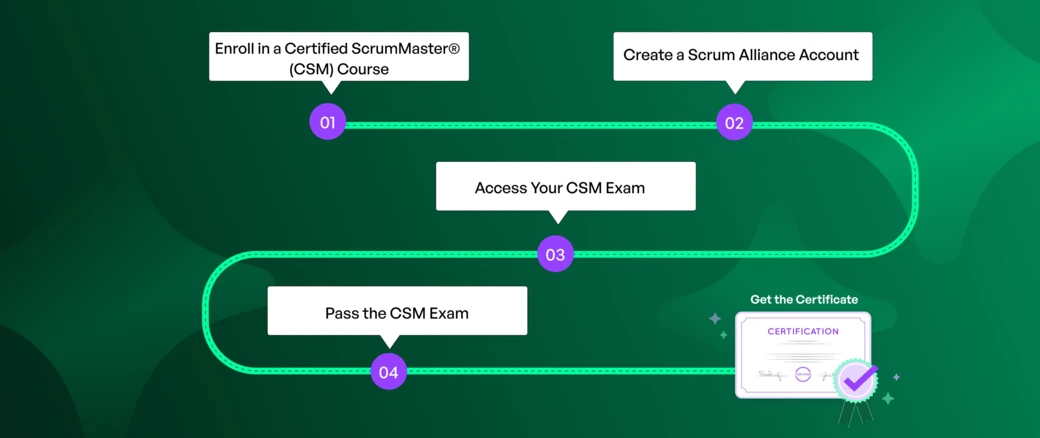
The certification process after completing scrum master training in Pune follows these steps: enrol in the training programme; attend the full 2-day live online sessions; receive the exam access link from Scrum Alliance via your registered email; log in to the Scrum Alliance portal and schedule your exam; sit the 50-question online paper within 90 days of training; score at least 34 out of 50 to pass; and download your official CSM® certificate directly from your Scrum Alliance account.
Yes. StarAgile holds Registered Education Provider (REP) status with Scrum Alliance, which means every batch of scrum master certification in Pune run through StarAgile is officially sanctioned by the governing body. The certificates issued to candidates who pass the exam are genuine Scrum Alliance credentials, not third-party equivalents. Learners can verify StarAgile's REP status directly on the Scrum Alliance website for peace of mind before enrolling.
No. StarAgile does not provide or endorse exam dumps of any kind for the CSM course in Pune. The training is delivered by experienced Certified Scrum Trainers who focus entirely on genuine conceptual understanding through live sessions, group activities, and scenario-based exercises. StarAgile does include structured mock exams and practice papers across all plans, but these are designed to build real understanding — not to shortcut the learning process that makes candidates effective Scrum Masters in practice.
Yes. StarAgile schedules regular weekend batches for CSM training in Pune, running across Saturday and Sunday with morning and evening time slot options. This makes the programme accessible for full-time working professionals who cannot step away from their jobs during the week. Weekday batches are also available for those who prefer a midweek schedule. Custom batch requests are accepted if neither standard option fits your routine.
Scrum Alliance offers a structured progression of Scrum credentials. The certified scrum master course online in Pune starts with the foundational CSM® (Certified Scrum Master), which is the entry-level credential for those new to Scrum. From there, practitioners progress to the A-CSM (Advanced Certified Scrum Master) for intermediate-level skill development, and then to the CSP-SM (Certified Scrum Professional – Scrum Master) for expert-level recognition. Each level builds on the one before it, giving professionals a clear roadmap from beginner to advanced Scrum Master.
Yes. The scrum master certification cost in Pune at StarAgile includes the CSM exam fee within the overall course price — there is nothing extra to pay before sitting the exam. This covers two free attempts within 90 days of completing training. If additional attempts are required beyond those two, Scrum Alliance charges $25 per attempt separately. The 2-year Scrum Alliance membership is also included in the fee, making the total cost of the CSM certification cost Pune package comprehensive and transparent.
After passing the CSM exam, log in to your Scrum Alliance member account and navigate to the certification section of your profile dashboard. Your CSM® certificate will be available to download in PDF format. You can save it, print it, or share it directly to your LinkedIn profile so that your certified scrum master certification in Pune credential is immediately visible to recruiters and hiring managers. Your 2-year Scrum Alliance membership also activates automatically at this point.
Completing the CSM course in Pune earns you 16 SEUs, which also count towards 20 PDUs. Since CSM renewal requires 20 SEUs at the two-year mark, these 16 units from your initial training cover the majority of your first renewal cycle before you need to seek additional Agile learning activities. Learners on the StarX and StarMax plans earn 24 PDUs/SEUs in total, effectively covering the full renewal requirement and then some.
Yes. Mock exams are included in every plan for the certified scrum master course in Pune at StarAgile. The Standard Plan comes with 2 mock exams, while the StarX and StarMax plans offer 5 mock papers plus 5 additional high-quality practice tests. Each mock replicates the actual exam structure — 50 multiple-choice questions within a 60-minute window — and results are reviewed so learners understand exactly where they stand before their real exam sitting.
The certified scrum master training online in Pune at StarAgile is conducted exclusively through live, interactive online sessions. There are no pre-recorded videos standing in for actual training. Every session runs in real time with a Certified Scrum Trainer facilitating the class, answering questions as they arise, and running group exercises that require active participation. This live format is far more effective for genuine Scrum learning and exam preparation than working through self-paced recorded content independently.
Salary figures vary based on experience, organisation size, and sector, but scrum master certification in Pune holders are generally well-positioned in the market. Entry-level Scrum Masters in Pune with the CSM credential typically earn in the range of ₹6–10 LPA. Professionals with two to five years of Scrum experience commonly move into the ₹12–20 LPA bracket. Senior Scrum Masters and Agile Coaches with additional credentials such as A-CSM or SAFe often command upwards of ₹22–28 LPA in Pune's technology and product companies. Pune's strong IT and product startup ecosystem makes it one of the better cities in India for Scrum Master earnings.
The scrum master course in Pune at StarAgile is delivered in English. Given that the Scrum Alliance exam, the official Scrum Guide, and all associated learning materials are in English, conducting training in the same language ensures learners are fully prepared for the exam environment and for working in international Agile teams where English is the primary language of communication.
Yes. StarAgile's Certified Scrum Master class in Pune integrates real-world scenarios, role-play simulations, and case studies derived from actual Scrum projects across industries. Trainers use these exercises to demonstrate how Scrum events, roles, and artefacts function in practice, giving learners a grounded perspective rather than an entirely theoretical one. Sprint simulations, working agreement exercises, and Daily Scrum role-plays are among the hands-on activities embedded into both training days.
Yes. Depending on the plan selected for the CSM course in Pune, learners receive access to dedicated career mentoring sessions — typically 2 hours with a certified professional. Beyond structured mentoring, the 24/7 WhatsApp support group allows learners to ask questions and receive guidance from trainers and peers at any point during or after the training. The post-training support structure is designed to ensure no learner feels isolated once the two training days are complete.
Yes. Assessments are built into the scrum master training in Pune at StarAgile in the form of mock exams, in-session quizzes, and group activity reviews that allow both trainers and learners to gauge understanding throughout the programme. These informal checkpoints during the training day, combined with the structured mock papers available after training, give candidates a reliable picture of their readiness before attempting the official Scrum Alliance exam. Trainers use these assessments to identify and address any knowledge gaps before the exam window opens.
The certified scrum master training in Pune has no background restriction — it is open to professionals across all functions and industries. That said, it tends to deliver the most immediate career impact for project managers, business analysts, software developers, QA professionals, and product managers who work within or alongside delivery teams. Freshers looking to enter the Agile job market and non-IT professionals from banking, insurance, healthcare, and operations also benefit significantly. The only thing that truly matters is a genuine interest in how Scrum teams operate and a willingness to apply that learning in your professional context.
StarAgile does not currently offer a standalone free demo session for the scrum master certification in Pune programme, but prospective learners are encouraged to speak directly with a StarAgile Scrum Advisor before enrolling. These advisory calls cover the course structure, batch options, plan differences, and any specific questions about the CSM exam or certification pathway. This gives you a clear picture of what to expect before committing, which serves a similar purpose to a trial session. Contact details and a consultation booking option are available on the StarAgile website.
CSM Exam and Prerequisite FAQs
There are no formal prerequisites for the scrum master certification training in Pune at StarAgile. Scrum Alliance does not mandate any specific academic qualification, industry experience, or prior Agile knowledge before enrolment. Professionals from all backgrounds — IT, finance, healthcare, operations, and beyond — join regularly without any prior exposure to Scrum. A basic understanding of project environments can help you contextualise certain concepts during training, but it is in no way a requirement. The only practical expectation is attending both days of the live training in full before the exam access link is activated on your Scrum Alliance account.
The CSM certification in Pune exam is administered online by Scrum Alliance and consists of 50 multiple-choice questions, each with a single correct answer. You have 60 minutes to complete the paper and need to answer at least 34 questions correctly — a 74% threshold — to pass. The exam is open-book, so referring to the Scrum Guide or your training notes during the session is permitted. There is no live invigilation, and the exam can be taken at any time within 90 days of completing your training — at a time and place entirely of your choosing.
The strongest foundation for passing the CSM training in Pune exam comes from fully engaging with both training days — participating in group exercises, role-plays, and trainer discussions rather than passively listening. After training, read through the Scrum Guide carefully alongside your session notes and cross-reference the key concepts covered. Work through the mock exams under timed conditions so you become comfortable with the pace the real exam demands. Use the StarAgile WhatsApp support group to raise any lingering doubts before booking your exam date. Candidates who combine thorough revision with timed mock practice consistently pass on their first attempt.
Scrum Alliance gives every candidate two free retake attempts within 90 days of completing the certified scrum master course in Pune. If both attempts are used without a pass, further sittings are available at $25 per attempt, payable directly to Scrum Alliance. StarAgile also offers unlimited retraining sessions, meaning you can re-attend a full live batch at no extra cost before attempting the exam again. In practice, the majority of learners who complete the training actively and work through the mock papers pass on their very first sitting without needing a retake.
The CSM certification in Pune has no eligibility barrier — Scrum Alliance does not set a minimum experience level, educational background, or industry-specific requirement. The course is open to freshers, mid-career professionals, senior managers, and those switching careers or industries entirely. Whether you come from software, manufacturing, banking, consulting, or public services, there is no restriction on who can enrol. The only condition is attending the two-day training in full before you are granted access to the online exam through your Scrum Alliance account.
The scrum master course in Pune exam gives candidates exactly 60 minutes to answer all 50 multiple-choice questions. That works out to roughly 72 seconds per question — a comfortable pace if you are familiar with the material, but one that leaves little room for extended deliberation on individual questions. Since the exam is open-book, the key is not speed-reading through the Scrum Guide under pressure but knowing it well enough to locate relevant sections quickly when needed. StarAgile's timed mock exams help you calibrate your pace well in advance.
You can technically step away from the screen during the CSM exam, but the 60-minute timer does not stop running while you do. Once the exam begins on the Scrum Alliance portal, the clock counts down regardless of activity. This means any time spent away is time permanently lost from your sitting. The certified scrum master training online in Pune at StarAgile includes timed mock exams specifically to help learners build the focus and discipline needed to work through the full paper in one uninterrupted session. It is always advisable to schedule your exam for a time when you know you will not be interrupted.
The certified scrum master class in Pune at StarAgile leads to the exam through the following steps: enrol and complete the 2-day live online training; receive the Scrum Alliance exam access link to your registered email once training is confirmed; log in to or create your Scrum Alliance member account; use the link to access the exam portal and schedule your sitting; complete the 50-question paper within the 60-minute window; receive your result immediately on screen; and, if you pass, log back in to your Scrum Alliance account to download your CSM® certificate in PDF format.
After completing the scrum master training in Pune, Scrum Alliance provides two free exam attempts, both available within a 90-day window from the date your training is completed. There is no upper limit on total attempts beyond those two — if further sittings are needed, each one costs $25 paid directly to Scrum Alliance. StarAgile's unlimited retraining policy means you can also re-attend the full live training programme at no additional charge before any subsequent attempt. That said, candidates who fully engage with the training and complete the mock papers rarely need to go beyond their first attempt.
The certified scrum master certification in Pune is well-suited to a broad range of professionals, but it delivers the most immediate career impact for those working in or around Agile delivery environments. Project Managers, Business Analysts, Software Developers, QA Professionals, and Product Managers all find direct relevance in the curriculum. Team Leads guiding Scrum adoption, HR professionals involved in Agile transformation, and freshers targeting Scrum Master roles in the job market are equally well-served. Non-IT professionals from finance, healthcare, logistics, and education also attend regularly and apply Scrum principles effectively in their own organisational contexts.
There is no separate registration process to manage. Once you complete the CSM course in Pune through StarAgile, Scrum Alliance automatically sends an exam invitation link to the email address you registered at the time of enrolment. Click the link, log in to your Scrum Alliance account — creating one if you do not already have it — and schedule your exam at a time that works for you within the 90-day window. No additional forms, fees, or applications are involved. The process is entirely managed through your Scrum Alliance member account from that point forward.
Yes. The CSM exam is fully open-book regardless of where you completed your training. During the 60-minute session, candidates are free to refer to the official Scrum Guide, personal notes from their certified scrum master training online in Pune sessions, or any other Scrum resources they have saved. Scrum Alliance's rationale is straightforward — the exam measures genuine understanding and the ability to apply Scrum principles, not the ability to recall definitions from memory. Having said that, over-relying on references is a time risk. Candidates who know the material well and use their resources only for confirmation consistently perform better than those who use the open-book format as a substitute for preparation.
The scrum master certification cost in Pune at StarAgile covers the exam fee within the course price — no separate payment is required before sitting the exam. This includes two free attempts within 90 days of training completion. If additional attempts are needed beyond those first two, Scrum Alliance charges $25 per sitting. As for the CSM certification cost Pune overall, each plan — Standard, StarX, and StarMax — is priced differently depending on the features included, starting from $349 (with a 30% discount applied to the regular $499 rate). The 2-year Scrum Alliance membership and CSM certificate are covered within all plans. Renewal, which falls due after two years, involves a separate $100 fee paid to Scrum Alliance directly.
To pass the CSM certification in Pune exam, candidates must answer at least 34 out of 50 questions correctly — a passing threshold that Scrum Alliance sets at 74%. Results appear immediately on screen after submission, so there is no waiting period for your outcome. All 50 questions carry equal weight, and there is no negative marking for incorrect answers, which means it is always worth attempting every question rather than leaving any blank. StarAgile's mock exams mirror this exact scoring structure, so by the time you sit the real paper, the format and expectations feel entirely familiar.
No. Scrum Alliance does not offer a re-evaluation or score review process for the CSM exam. Once a result is issued, it stands as final and cannot be contested or regraded. However, the scrum master course in Pune gives candidates two free retake attempts within 90 days of completing training, so a failed first sitting does not close the door on certification. If both free attempts are exhausted, further sittings are available at $25 each through the Scrum Alliance portal. StarAgile's unlimited retraining policy also allows you to revisit the live sessions before any subsequent attempt at no extra cost.
The CSM exam is conducted entirely online through the Scrum Alliance member portal — there are no physical test centres involved anywhere in the world. This applies equally to candidates completing their certified scrum master training in Pune through StarAgile. You sit the exam from your own device, at home or in any location with a stable internet connection, at a time you choose within the 90-day exam window. No travel, venue booking, or in-person attendance is required at any stage of the exam process. The fully online format makes scheduling straightforward and removes any location-based barriers to sitting the paper.
There is no mandatory waiting period after completing the scrum master training in Pune — your exam access link from Scrum Alliance typically arrives within a short time of your training being confirmed, and from that point, you can schedule your sitting whenever you feel ready. Most candidates opt to attempt the exam within three to seven days of training, while the concepts and trainer discussions are still fresh. The 90-day window gives you ample flexibility if you prefer more preparation time, but waiting too long can work against you as the details from the sessions naturally fade. Attempting the exam within the first week or two consistently produces the best results.
Scrum Alliance does not publish a formal set of official practice exams as part of the certification process. The preparation resources available through the certified scrum master course online in Pune at StarAgile — including structured mock papers, in-session quizzes, and post-training practice tests — are therefore an important part of how candidates get adequately prepared. The Standard Plan includes 2 mock exams, with the StarX and StarMax plans offering 5 mock papers plus 5 additional high-quality practice tests. These are built to reflect the real exam format closely enough that candidates arrive at their actual sitting with a solid, tested baseline of confidence.
After passing the CSM exam, your certificate is available almost immediately. The certified scrum master certification in Pune credential is issued digitally through your Scrum Alliance member account — there is no postal delivery or processing delay involved. Once your result registers as a pass on the portal, you can log in, navigate to your certification profile, and download your official CSM® certificate in PDF format straight away. Your 2-year Scrum Alliance membership also activates at the same time. If you wish, the certificate can be shared directly to LinkedIn from your Scrum Alliance profile, making it visible to employers without any additional steps.
Certified ScrumMaster® Course in Pune - Additional FAQs
Scrum is an Agile framework used primarily to manage complex, iterative work in a structured and transparent way. It divides project delivery into short, fixed cycles called sprints — typically one to four weeks each — during which a cross-functional team works towards a defined goal. At the end of every sprint, the team produces a potentially shippable product increment and holds a retrospective to assess what went well and what needs adjusting. Scrum's real strength lies in its simplicity: a small set of roles, events, and artefacts that together create accountability, visibility, and regular feedback loops throughout delivery.
A Scrum Master is a servant-leader whose primary job is to protect the Scrum process and enable the team to work at its best. They facilitate all Scrum ceremonies, coach the development team on Agile best practices, and work persistently to remove impediments — anything blocking the team's progress during a sprint. Unlike a traditional project manager, a Scrum Master does not assign tasks or manage individuals. Instead, they create the conditions for a self-organising team to make its own decisions, hold itself accountable, and continuously improve its ways of working, sprint by sprint.
Holding the scrum master certification in Pune consistently translates into better job opportunities, higher visibility with employers, and access to roles that specifically require Scrum expertise. Beyond career positioning, the certification deepens your understanding of iterative delivery, team dynamics, and Agile planning — skills that are genuinely valued in modern project environments. You also receive a 2-year Scrum Alliance membership, connecting you to a global practitioner community and ongoing learning resources. For professionals already employed, the credential frequently serves as the basis for internal promotions into Scrum Master or Agile Lead roles.
Earning the CSM certification in Pune gives you a formally recognised credential backed by Scrum Alliance — one of the most respected Agile governing bodies in the world. Beyond the certificate, the training builds a genuine understanding of how Scrum teams function, which makes you more effective in Agile environments from day one. Pune's strong technology and product sector means certified Scrum Masters are actively recruited, and having the credential puts you ahead of uncertified candidates at the shortlisting stage. It is also a prerequisite for higher-level Agile certifications, making it a sound first step in a long-term Agile career path.
Yes. StarAgile provides CSM training through internationally recognized and highly experienced trainers, including Narasimha Reddy Bommaka and Madhavi Ledalla, with strong expertise in Scrum and Agile.
Yes, and this is borne out by the experience of many learners. The certified scrum master certification in Pune opens doors to Scrum Master, Agile Coach, and delivery-focused positions that treat it as a baseline requirement. Many professionals who complete it move into better-defined Agile roles with improved earning potential within a relatively short time of certifying. Pune's IT corridor — home to a dense concentration of product companies and IT services firms — means demand for certified Scrum Masters stays consistently high, and the credential carries practical weight in job applications and performance conversations alike.
Traditional project management — most commonly associated with the Waterfall model — works sequentially: each phase must be completed before the next begins, and the final product is delivered at the end. Scrum works in the opposite direction. Work is broken into short sprints that each deliver a usable increment, feedback is gathered continuously, and plans are adjusted throughout rather than locked in at the start. Teams in Scrum are self-organising and cross-functional, with no strict hierarchical reporting structure. Where traditional methods treat change as a problem to be controlled, Scrum treats it as an expected and manageable part of the delivery process.
Yes, absolutely. The CSM certification in Pune is open to anyone interested in learning the Scrum framework — you do not need to be working in an Agile environment at the time of training. Many attendees join specifically because they want to introduce Scrum to their current organisation or position themselves for a role change into Agile. The practical case studies and simulations built into the training make the concepts tangible even for learners who have never participated in a sprint. Understanding the theory and tools gives you everything you need to begin applying Scrum once you are in the right environment.
No, it is not. The scrum master course in Pune at StarAgile has no experience prerequisite. Scrum Alliance does not require candidates to have previously managed projects or held any formal project management role before enrolling. The training covers the Scrum framework from the ground up, which means professionals at all stages of their career — including those with no project management background at all — can complete the course and pass the exam. Prior exposure to delivery environments can help with contextualising some concepts, but it is genuinely not a requirement for enrolment or success.
Within a Scrum team, the certified scrum master class in Pune prepares candidates to serve as facilitator, coach, and impediment remover. On a daily basis, this means running the Daily Scrum, ensuring the Sprint Planning and Retrospective meetings happen effectively, and working proactively to clear any blockers before they affect sprint delivery. The Scrum Master also shields the team from external distractions and scope intrusions that could disrupt focus during the sprint. They do not make product decisions — that sits with the Product Owner — but they ensure the conditions exist for the team to make and execute those decisions well.
The scrum master training in Pune prepares candidates for a wide range of practical responsibilities. These include facilitating all four Scrum ceremonies, coaching the team on self-organisation and cross-functional collaboration, supporting the Product Owner with backlog refinement processes, and tracking and removing impediments before they affect delivery. A Scrum Master also maintains transparency through Scrum artefacts, helps stakeholders understand Agile principles, and actively works to improve the team's processes in each retrospective. In larger organisations, Scrum Masters may also contribute to broader Agile transformation initiatives beyond their immediate team.
Yes. The certified scrum master training in Pune draws learners from banking, insurance, healthcare, manufacturing, consulting, retail, and education — not just technology. Scrum Alliance places no industry restriction on the CSM, and Scrum's principles of iterative delivery, short feedback loops, and team self-organisation translate well into any environment where teams manage complex, changing workloads. Pune's diverse economy means the credential carries value well beyond software companies. Professionals from non-IT backgrounds regularly find that CSM opens up roles in Agile transformation, operational improvement, and project delivery across a wide range of sectors.
The Scrum Master keeps the process on track by ensuring all Scrum ceremonies are held consistently and purposefully, and by addressing anything that disrupts the team's rhythm. This means removing impediments quickly, coaching the team when Scrum principles are not being followed, and facilitating productive conversations between the development team and the Product Owner when priorities or expectations are unclear. The Scrum Master also observes team dynamics and raises process concerns in retrospectives, turning problems into structured improvement actions rather than recurring frustrations. Their value is largely invisible when things are working well — and very visible when they are not.
Scrum is built on three empirical pillars: transparency, inspection, and adaptation. Transparency means all aspects of the process and the work are visible to those responsible for outcomes. Inspection means teams regularly examine their progress and practices to detect problems early. Adaptation means teams act on what they find — adjusting plans, processes, and working methods sprint by sprint. These three pillars rest on five values: Commitment, Courage, Focus, Openness, and Respect. Together, these principles create a framework that is deliberately lightweight, flexible, and driven by continuous learning rather than rigid planning.
Scrum is designed from the ground up to make collaboration the default rather than an optional extra. Daily Scrum meetings create a daily touchpoint where the team surfaces blockers and re-aligns on the sprint goal. Sprint Planning brings the whole team together to agree on what they are committing to deliver. Sprint Retrospectives create a safe, structured space to discuss what is working and what is not. The cross-functional nature of Scrum teams — where developers, testers, and other disciplines all sit within the same team — removes the handoff friction that commonly slows down traditionally structured projects and forces more direct, honest conversation.
The Scrum Master and the Product Owner play distinct but complementary roles, and the relationship between them is one of the most important dynamics in a Scrum team. The Scrum Master helps the Product Owner refine and maintain a well-ordered Product Backlog, coaches them on writing clear user stories, and ensures Sprint Planning sessions run smoothly enough for the team to understand and commit to backlog items. When there is confusion or conflict between the Product Owner and the development team, the Scrum Master facilitates resolution rather than taking sides. Keeping this relationship clear and functional directly affects the team's delivery effectiveness.
Scrum Masters regularly encounter resistance from teams or management that are accustomed to traditional hierarchical structures and see Scrum as a threat to existing authority. Managing stakeholder expectations around scope changes mid-sprint can also be a persistent challenge. In distributed teams, maintaining genuine Daily Scrum engagement without physical co-location takes real effort. Balancing the coaching side of the role with the operational task of removing impediments stretches many new Scrum Masters, particularly in organisations where the Agile transformation is still in its early stages and not yet fully supported from the top.
The CSM training in Pune at StarAgile addresses these challenges directly through case studies drawn from real projects, trainer-led discussion of common failure patterns, and group role-play exercises that put learners in the position of navigating difficult team and stakeholder situations. Experienced Certified Scrum Trainers share examples from their own careers to illustrate how Scrum implementation problems typically unfold and what effective responses look like. Post-training mentoring sessions and the 24/7 WhatsApp support community extend this learning beyond the classroom and into the real challenges learners encounter once they begin applying Scrum on actual projects.
The Agile Manifesto, written in 2001 by 17 software industry practitioners, articulates four core values and twelve supporting principles that define the Agile approach to development. Scrum is one of several frameworks built on these foundations. It operationalises the Manifesto's emphasis on individuals and interactions, working software, customer collaboration, and responding to change by providing a concrete structure — sprints, roles, and ceremonies — through which those values are put into daily practice. Understanding the Manifesto helps Scrum practitioners understand why the framework is designed the way it is, rather than following its rules without understanding the intent behind them.
Scrum's underlying principles — iterative delivery, short feedback cycles, defined team roles, and regular retrospectives — transfer well beyond software. Marketing teams use Scrum to manage campaign delivery. HR departments run Agile sprints to redesign recruitment processes. Operations teams apply sprint-based planning to improve workflows. The framework works wherever teams need to manage complex, changing work with a degree of uncertainty involved. The case studies embedded in StarAgile's programme reflect this breadth, helping learners see how Scrum applies to their own professional context regardless of whether they work in technology.
Stakeholders are not core Scrum team members, but they are an essential part of the broader Scrum ecosystem. Their primary involvement comes during Sprint Reviews, where the development team demonstrates what was built during the sprint and stakeholders provide feedback that feeds into the Product Backlog for future sprints. The Product Owner acts as the bridge between stakeholders and the team, gathering requirements and priorities from stakeholders and translating them into actionable backlog items. Keeping stakeholders appropriately informed and engaged — without allowing them to disrupt the team's sprint focus — is one of the more nuanced parts of the Scrum Master's role.
Scrum in its base form is designed for single teams of three to nine people, so it does not naturally scale to large programmes without structural support. Scaled frameworks such as SAFe (Scaled Agile Framework), LeSS (Large-Scale Scrum), and Nexus were developed specifically to address this, allowing multiple Scrum teams to work on the same product in a coordinated way. Many professionals who complete the scrum master certification in Pune go on to pursue SAFe certifications to manage enterprise-scale Agile delivery. The CSM provides the Scrum foundation on which these scaling approaches are built.
Both Scrum and Kanban are Agile approaches, but they suit different types of work. Scrum is time-boxed — it uses fixed sprints, defined ceremonies, and specific roles to manage iterative product development. Kanban is flow-based — work items move continuously through a visual board with no fixed sprints, no mandatory ceremonies, and no prescribed roles beyond the team. Scrum suits teams building something new in iterative cycles with regular stakeholder feedback. Kanban tends to fit teams managing support, maintenance, or operational work where priorities shift frequently, and work items arrive unpredictably. Many experienced Scrum teams draw on Kanban practices to improve flow within their sprints.
Yes. The scrum master certification in Pune is equally accessible and valuable for self-employed consultants, independent Agile coaches, and freelance project managers. Many client engagements in Agile transformation, team coaching, and product delivery specifically require or strongly prefer CSM-certified practitioners. Holding the credential gives freelancers a credible, third-party validation of their Scrum expertise that clients who do not know them personally can rely on. The Scrum Alliance membership that accompanies the certification also opens up networking and referral opportunities within the global Agile community — a meaningful resource for those building a consultancy practice independently.
Continuous improvement is baked into Scrum through the Sprint Retrospective — a dedicated ceremony held at the end of every sprint where the team reflects on their own process, identifies what worked and what did not, and agrees on specific changes to implement in the next sprint. Unlike traditional post-mortems that happen after a project closes, Retrospectives are iterative and recurring, which means improvement is constant rather than occasional. Over time, this creates a team culture where examining and refining ways of working is normal behaviour rather than an exceptional event triggered only by failure.
Yes. The certified scrum master course in Pune focuses entirely on the Scrum framework as a way of managing work, not on technical disciplines like coding, architecture, or software engineering. No technical background is required, and the exam does not test technical knowledge of any kind. Scrum Master roles are about facilitation, coaching, and process improvement, all of which are skills developed through experience and structured learning rather than technical expertise. Many highly effective Scrum Masters come from backgrounds in business, communications, education, and operations, and their non-technical perspective often proves an asset in managing team dynamics and stakeholder communication.
The scrum master certification cost in Pune is typically recovered fairly quickly in the context of career earnings. Entry-level Scrum Masters in Pune holding the CSM credential generally earn between RS.6–10 LPA, while professionals with two to five years of experience in Scrum environments commonly move into RS.12–20 LPA. Senior Scrum Masters, Agile Coaches, and those holding additional credentials such as A-CSM or SAFe certifications frequently earn RS.22–30 LPA in Pune's larger technology and product companies. Exact figures vary based on organisation type, industry, and individual experience, but the credential consistently places holders in a stronger negotiating position than non-certified peers.
The CSM certification cost Pune investment tends to pay back quickly, given the breadth of companies hiring for these roles. Large IT services firms, including Infosys, Wipro, Tech Mahindra, and Persistent Systems, all have significant operations in Pune and hire Scrum Masters regularly. Global consultancies such as Accenture, Capgemini, and Cognizant also recruit CSM-certified professionals for their Pune delivery centres. On the product side, Pune's growing fintech, edtech, and healthtech startup ecosystem actively seeks Agile practitioners. Engineering and manufacturing companies using Agile for non-IT initiatives represent an additional hiring segment that is expanding steadily.
From enrolment to certification, the scrum master course in Pune at StarAgile takes two days of live training — 16 hours in total. After that, most candidates spend one to three days reviewing materials and working through mock papers before sitting the exam. The exam itself takes 60 minutes. So in practical terms, the full journey from starting training to holding a valid CSM® certificate can be completed within a single week for a motivated candidate. Including the Scrum Alliance membership activation, which happens automatically on passing, the entire process is designed to be as compact and efficient as possible.
Scrum Alliance does not deliver training directly to individuals. Instead, it authorises Registered Education Providers (REPs) — such as StarAgile — to deliver the certified scrum master course online in Pune on its behalf. These REP-accredited providers must meet Scrum Alliance's standards for trainer quality and curriculum coverage, and the certificates they issue after candidates pass the exam are genuine Scrum Alliance credentials. Scrum Alliance does maintain a directory of approved training partners, but the training experience itself is delivered through providers rather than by Scrum Alliance centrally.
SEUs — Scrum Education Units — are the credit currency used by Scrum Alliance to track professional development for certification renewal. Earning 20 SEUs is one of the two routes to renewing a CSM credential every two years. PDUs — Professional Development Units — are used by PMI (Project Management Institute) to track ongoing learning for credentials such as PMP. StarAgile's CSM programme earns you 16 SEUs and 20 PDUs simultaneously, making it useful for both Scrum Alliance renewal and PMI credential maintenance. For professionals holding multiple certifications across both bodies, this dual earning is a practical efficiency.
The certified scrum master certification in Pune comes with a complimentary 2-year Scrum Alliance membership that activates automatically on passing the exam. This gives access to a global community of Scrum practitioners, a curated library of case studies, webinars, and Agile resources, discounts on future Scrum Alliance certifications, and a listing in the global certified professional directory that recruiters actively search. Membership also provides access to local and international Scrum Alliance events and community forums — practical networking resources for Pune-based professionals looking to connect with Agile practitioners both regionally and internationally.
None, formally. Scrum Alliance does not set an experience requirement for the CSM. The scrum master training in Pune at StarAgile is open to candidates at any career stage, and completing the 2-day training is the only prerequisite for sitting the exam. In practice, professionals who join with some background in project delivery or team environments tend to connect the training content to their existing experience more quickly. But the programme is built to be meaningful for complete beginners as well, and many freshers earn the credential and transition successfully into Scrum Master roles without any prior experience in Agile or project management.
Scrum teams use a variety of tools to support sprint planning, backlog management, and progress tracking. Jira is the most widely adopted tool in professional Scrum environments, used to manage product backlogs, plan sprints, and track work in progress on Kanban-style boards. Confluence is commonly used alongside Jira for documentation and team knowledge sharing. Trello, Azure DevOps, Monday.com, and Miro are also popular, depending on team size and preference. StarAgile includes a 6-hour live Jira training session as part of its CSM plans, giving learners direct exposure to the tool they are most likely to encounter on the job.
The five Scrum values are Commitment, Courage, Focus, Openness, and Respect. Commitment means the team dedicates itself to the sprint goal. Courage means being willing to raise difficult issues honestly rather than avoiding them. Focus means the team concentrates on sprint work and avoids distractions. Openness means being transparent about progress, challenges, and mistakes. Respect means treating every team member as a capable, valued contributor. These values are not decorative additions to the framework — they underpin how Scrum ceremonies and artefacts function in practice. Without them, Scrum events become procedural checkboxes rather than genuine collaborative activities.
Scrum Alliance advises against combining the Scrum Master and development team roles in the same person, particularly in teams that are new to Scrum. The Scrum Master's job requires focus on process facilitation, coaching, and impediment removal — responsibilities that are difficult to fulfil effectively while simultaneously doing development work within the same sprint. In very small teams or early-stage startups, it does sometimes happen as a pragmatic compromise, but it creates an inherent tension between the two roles. As a team matures and Scrum adoption deepens, separating the roles typically leads to better outcomes for both the process and the product.
The scrum master certification in Pune pathway through Scrum Alliance has three main levels. The Certified Scrum Master (CSM) is the foundational credential designed for practitioners new to Scrum. The Advanced Certified Scrum Master (A-CSM) is for practitioners with at least one year of Scrum Master experience who want to deepen their coaching and facilitation skills. The Certified Scrum Professional – Scrum Master (CSP-SM) is the expert-level credential for seasoned practitioners looking to demonstrate mastery. Other certifying bodies — including Scrum.org — offer the PSM I, II, and III progression as an alternative pathway. Each level builds directly on the one before it.
Scrum Alliance and the Scrum Guide both advise strongly against combining the Product Owner and Scrum Master roles in a single person. These two roles have fundamentally different — and in some respects competing — responsibilities. The Product Owner prioritises and owns the Product Backlog, making decisions about what the team builds. The Scrum Master facilitates the process and protects the team, including them from excessive demands on their sprint capacity. Combining them creates a conflict of interest that can compromise both roles. In resource-constrained organisations, it does occasionally happen in practice, but it is not a setup that Scrum Alliance recommends or endorses.
Scrum Alliance and Scrum.org are the two most prominent bodies specifically focused on Scrum credentials. Scrum Alliance — the issuer of the CSM — is member-driven and community-oriented, with an emphasis on experiential learning through registered trainer programmes. Its certifications require mandatory attendance at approved training. Scrum.org, founded by Scrum co-creator Ken Schwaber, takes a more exam-centric approach — the PSM credentials can be earned without mandatory training, relying instead on self-study. PMI (Project Management Institute) offers the PMI-ACP, which covers Agile broadly across multiple frameworks rather than Scrum specifically. Each body has strengths, and the right choice often depends on the employer landscape in your target sector.
The CSM training in Pune and the PSM (Professional Scrum Master from Scrum.org) are the two most commonly compared Scrum credentials. The CSM requires mandatory attendance at a 2-day training with an approved Certified Scrum Trainer before you can sit the exam — this makes the learning experience more guided and interactive. The PSM I exam can be taken without formal training, relying on self-study of the Scrum Guide. The CSM includes a 2-year Scrum Alliance membership and renewal requirements, while PSM credentials do not expire. In terms of employer recognition, both are well-regarded — though the CSM is more widely held in India and is often the preferred baseline for organisations new to Agile hiring.
Completing the certified scrum master class in Pune is the most direct route from zero experience to a recognised Scrum Master credential. The 2-day training programme covers everything from Agile fundamentals through to the specifics of Scrum implementation, so prior experience is not a prerequisite for completing it successfully. After earning the CSM, building practical Scrum experience can start in your current role — introducing Scrum practices incrementally, volunteering to facilitate team ceremonies, or taking on a formal Scrum Master role in a new position. Joining Scrum Alliance community forums and attending Agile meetups in Pune also accelerates the transition from newly certified to practically experienced.
The CSM course in Pune is one of a broad portfolio of programmes StarAgile delivers. In the Agile and Scrum space, StarAgile offers CSPO (Certified Scrum Product Owner), A-CSM (Advanced Certified Scrum Master), PSM (Professional Scrum Master), and Leading SAFe®, among others. In project management, PMP® and PRINCE2® courses are available. StarAgile also delivers DevOps, Data Science, Software Testing, Full Stack Development, Lean Six Sigma, ITIL, and Digital Marketing programmes. Corporate training solutions for enterprise teams are also available, tailored to specific organisational Agile transformation needs across industries.
The scrum master certification in Pune is increasingly factored into internal promotion decisions at Pune's larger technology and services companies, many of which have formalised Agile competency frameworks. Holding the CSM signals to management that an employee has invested in structured Agile learning, which often translates into visibility for Scrum Master, Delivery Lead, or Agile Coach opportunities when they arise internally. In organisations mid-way through Agile transformation, certified employees frequently become the internal champions of Scrum adoption, accelerating their own career growth in the process. The 2-year Scrum Alliance membership also provides resources that support ongoing professional development beyond the initial certification.
Yes, and this is becoming increasingly common. Marketing teams use Scrum to manage content campaigns, product launches, and creative workstreams with the same sprint-and-review structure used in software. Operations teams apply sprint-based planning to process improvement initiatives and service delivery optimisation. The framework's adaptability lies in its principles rather than its surface-level practices — any environment where teams manage complex work with evolving priorities can benefit from Scrum's structure. The certified scrum master training online in Pune at StarAgile includes examples from non-software contexts, helping learners think beyond IT applications when they begin putting the framework to work.
Yes, significantly so. An entry-level Scrum Master is typically focused on learning to facilitate Scrum ceremonies correctly, building basic coaching habits, and navigating the immediate dynamics of a single team. A senior Scrum Master or Agile Coach operates at a broader level — coaching multiple teams, driving organisation-wide Agile adoption, mentoring junior Scrum Masters, and engaging with leadership on strategic delivery challenges. The A-CSM and CSP-SM credentials from Scrum Alliance formally recognise this progression. In terms of salary and responsibility, the gap between a first-year Scrum Master and a seasoned practitioner in Pune's job market is substantial and grows further with each additional certification and year of applied experience.
Scrum adoption tends to surface existing cultural tensions as much as it creates new ones. It asks teams to be transparent about their progress — including failures — which can be uncomfortable in organisations with a strong blame culture. It distributes decision-making authority to teams, which challenges managers used to controlling work through hierarchy. Done well, Scrum shifts organisational culture towards accountability, trust, and continuous learning over time. Done poorly, it becomes a set of ceremonies layered on top of unchanged working habits — a pattern sometimes called "Scrum but." The Scrum Master plays a central role in shaping the direction the cultural shift goes, making their coaching skills as important as their process knowledge.
Yes. The CSM certification in Pune is an excellent foundation, but professionals who pair it with complementary credentials build a profile that appeals to a much wider range of employers. CSPO (Certified Scrum Product Owner) is a natural complement for those working on the product side of Agile delivery. Leading SAFe® adds value for professionals working in large enterprise environments where scaled Agile is in use. The PMI-ACP (Agile Certified Practitioner) broadens the Agile methodology coverage beyond Scrum specifically. For those targeting senior roles, the A-CSM and eventually the CSP-SM round out a Scrum-specific progression that signals genuine depth of expertise to hiring managers across industries.
Distinctions and Achievements
About Certified ScrumMaster® Training in pune
The CSM certification in Pune, delivered through Scrum Alliance-accredited sessions, validates your understanding of Agile principles and the Scrum framework. This globally recognised credential equips you with a balanced mix of applied skills and theoretical knowledge needed to succeed as a Scrum Master. Sessions are led by experienced Certified Scrum Trainers, ensuring hands-on learning grounded in real-world project scenarios. The scrum master training in Pune covers core responsibilitiesCSM exam, including facilitating Scrum ceremonies, strengthening team collaboration, and improving communication within Agile teams.
To earn your certified scrum master certification in Pune, you must complete the mandated training and clear the official Scrum Alliance exam. After finishing the certified scrum master course online in Pune, you will be well placed to guide Agile teams with confidence and enhance your professional profile. StarAgile's CSM certification in Pune is offered through flexible weekend batches alongside live instructor-led online sessions.
By enrolling in CSM training in Pune, you gain access to expert mentorship, well-structured study materials, and a comprehensive CSM study guide, ensuring practical learning aligned with current industry expectations. Beyond CSM exam readiness, the programme builds a strong Agile mindset — enabling you to manage shifting priorities, improve team performance, and deliver continuous value. Whether you are a developer, project manager, QA professional, business analyst, or someone transitioning into Agile roles, the CSM certification cost Pune investment pays back quickly in career impact. Completing this programme strengthens your credibility and positions you for leadership roles in Agile environments.
With Agile adoption deepening across Pune's corporate and technology sectors, earning a scrum master certification in Pune can give your career a meaningful and measurable push forward.
Benefits of Choosing StarAgile for CSM Certification in Pune
Choosing StarAgile for your certified scrum master training online in Pune comes with several advantages that support both effective learning and highlight the CSM Certification Benefits for long-term career growth: These advantages also align with the CSM Learning Objectives designed to build strong Agile and Scrum capabilities.
-
Gain hands-on experience through practical case studies, building the confidence to apply Scrum in real project environments
-
Access lifetime learning resources — mock exams, study materials, and exam support — throughout your CSM certification in Pune journey
-
Develop strong leadership and Agile project management capabilities through experiential learning in every scrum master course in Pune session
-
Learn to identify and address project risks early — a critical skill reinforced throughout the Agile-focused training
-
Receive a complimentary 2-year Scrum Alliance membership, connecting you to global Agile professionals and communities
-
Earn a globally recognised credential upon successfully completing the CSM course in Pune
-
Improve your employability with organisations that actively recruit Scrum-certified professionals
-
Attend flexible weekend batches through the certified scrum master class in Pune — ideal for working professionals managing busy schedules
Completing StarAgile's scrum master training in Pune strengthens your professional standing and opens new opportunities in Agile project management. The structured training equips you with the Scrum master skills to lead high-performing teams and consistently deliver results that matter.
Comprehensive Training Solutions for Enterprises













People also viewed courses like