





PMP® Training Certification in Australia
 100% Money Back Guarantee


-
 Crack PMP certification in just 40 days
-
Updated for the July 9, 2026 PMP exam changes
-
Training follows the PMBOK 8th edition
-
11 full-length mock exams included
-
Attend live training to earn 35 PMI®-approved PDUs
-
PMP application support included
-
Learn to use Generative AI in project management

PMP Course in Australia Key Features & Benefits
-
 Crack PMP certification in 40 days
-
Master the New PMP Exam — Training Updated for the July 9, 2026 Changes.
-
Training following PMBOK 8th edition
-
1000+ practice questions with detailed video explanation
-
11 mock exams
-
35 hours of comprehensive training
-
100% money-back guarantee
 Crack PMP certification in 40 days
-
PMP Application Support
-
Earn 35 PMI®-approved PDUs
-
Additional 2-day exam prep bootcamp sessions
-
Golden Ticket: 200 PMI-simulated questions
-
Doubt clarification and unlimited revision sessions
-
Learn to use Generative AI to optimize project management.
The Proven Path to PMP Certification Success
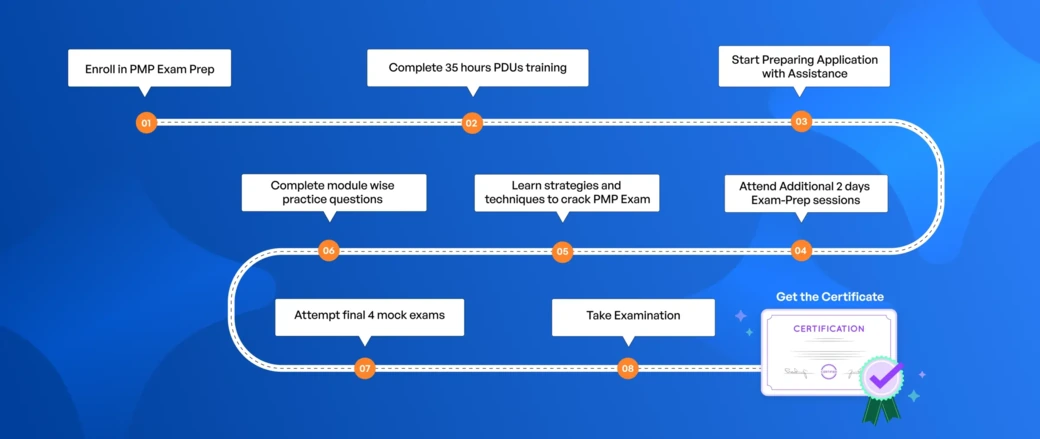
PMP Certification & Training in Australia – Complete Course Content
Learning Objectives:
This lesson introduces the PMP® certification journey and explores the role of project professionals as agents of positive change within their careers, organizations, and communities.
Topics:
-
Meet your instructor
-
Course overview and structure
-
Introduction to PMP certification
-
Understanding the PMP exam
Learning Objectives:
This lesson establishes the foundation for the course by exploring what projects and project management are. It introduces project life cycles, development approaches, and governance while connecting strategy, value delivery, and project approaches to real-world outcomes. It also addresses common misconceptions and sets expectations for the PMP journey.
Topics:
-
Understanding the PMP exam domains
-
Defining a project
-
Project life cycles and development approaches
-
Introduction to project governance
Learning Objectives:
This lesson focuses on the importance of establishing a clear project vision and building strong stakeholder alignment. Through practical examples and realistic scenarios, it explores stakeholder engagement, effective communication, and expectation management as key drivers of project success.
Topics:
-
Identifying and analyzing stakeholders
-
Creating a shared project vision
-
Planning and managing communication
-
Aligning and managing stakeholder expectations
Learning Objectives:
This lesson focuses on building and supporting high-performing project teams. It covers leadership, collaboration, conflict resolution, and knowledge sharing through practical scenarios and exam-style questions designed to strengthen decision-making skills.
Topics:
-
Leading and organizing project teams
-
Managing and resolving conflict
-
Facilitating knowledge sharing and transfer
Learning Objectives:
This lesson introduces the fundamentals of project planning, including defining scope, aligning work with value, managing resources and finances, and addressing risks. It emphasizes how these planning areas are interconnected and influence overall project performance.
Topics:
-
Defining scope and focusing on value
-
Establishing risk and compliance practices
-
Planning and managing project finances
-
Planning and managing resources
Learning Objectives:
This lesson brings the different elements of project planning together to create a practical and integrated roadmap for delivery. It covers selecting the appropriate delivery approach, developing project plans, estimating work, creating schedules, and managing quality and procurement to maximize value.
Topics:
-
Developing and implementing an integrated project management plan
-
Selecting and applying delivery approaches
-
Developing and managing the project schedule
-
Planning and optimizing quality for products and deliverables
-
Planning and managing procurement
Learning Objectives:
This lesson focuses on putting project plans into action, monitoring progress, evaluating performance, and communicating project status. It also introduces effective approaches for managing changes, resolving issues, and removing impediments that may affect project momentum.
Topics:
-
Monitoring project performance and managing project artifacts
-
Managing and controlling changes
-
Identifying and resolving issues
-
Removing impediments to project progress
Learning Objectives:
This lesson examines how projects are influenced by changing business and organizational environments. It explores organizational change, continuous improvement, and effective project and phase closure to help ensure that project outcomes continue to deliver sustainable value.
Topics:
-
Assessing changes in the external business environment
-
Supporting organizational transformation and change
-
Applying continuous improvement practices
-
Managing project and phase closure
Choose the plan that fits you best!
| Standard Plan | Training + Exam Prep | Star Max | |
|---|---|---|---|
| 35 Hours Live Virtual Training |

|
|
|
| PMI Approved 35 PDUs |
|
|
|
| Training by PMI Authorised Instructor |
|
|
|
| 6-Month LMS Access |
|
|
|
| 500+ Practice Questions |
|
|
|
| 90-Day Live Class Access |
|
|
|
| 2 Bonus Courses - Live recordings |
|
|
|
| 14 Mock Tests with Video Solutions |
|
|
|
| 6 Mock Exams |
|
|
|
| Life Time Live Class Access |

|
|
|
| In addition to above 9 Mock Exams |
|
|
|
| In addition to above 3 Bonus Courses - Live recordings |
|
|
|
| 45-Day Practice Plan |
|
|
|
| Renewal PDUs Access |
|
|
|
| 10+ PMP Sample Resumes |
|
|
|
| 2-Day Live 'Exam Prep Bootcamp' |
|
|
|
| Exclusive 11 hours video course from Industry Leader, to lay a solid foundation in agile project management principles and the Scrum Framework |
|
|
|
| Exclusive 5 hours video course from Industry leader on 'Agile Roles - Product Owner' |
|
|
|
| Microsoft certification: Transform business workflows with generative AI certification from StarAgile In Collaboration with Microsoft |
|
|
|
| Workshop with PMP Certified Candidates |
|
|
|
| PMP Exam Pass Study Plan |
|
|
|
| Handson Practice with 2750 + Exam Replica Question Bank |
|
|
|
| Live 8 hrs training on 'AI for Project Managers' |
|
|
|
| A 11 hours of 'Six Sigma Green belt' self paced course to improve quality and risk management |
|
|
|
| About 3 hours of 'Lean Business Process Management Change Skills' |
|
|
|
| A 2 hours course on 'Project Planning: Transition From Waterfall To Agile-Scrum' |
|
|
|
| About 3 hours course on 'Project Management Skills for Non-Project Managers' |
|
|
|
| About 4 hours course for 'Project Planning & Management For Software & IT Engineers' |
|
|
|
| About 7 hours course on 'Project Management Essentials' |
|
|
|
| A 6 hour course on ' Microsoft Power BI Skills' |
|
|
|
| A 2 hours chatgpt fresher course |
|
|
|
| A 2 Hours course on 'Risk Assessment and Management for Leaders' |
|
|
|


Upcoming PMP Certification & Training Batches in Australia
your batch request?



The work force is your asset. Up-Skill them with our Corporate Training Programs!
-
Unleash In-Demand Skills Across the Enterprise
-
Align Skill Development with Business Objectives
-
Drive Increased Employee Productivity
-
Leverage Immersive Learning
PMP Training in Australia Course Overview
- Positions you for higher-responsibility roles faster, since certified project managers are often trusted with larger budgets and cross-functional teams sooner than uncertified peers
- Builds a portable skill set — planning, risk control, stakeholder alignment — that holds value across industries like IT, construction, healthcare, and finance
- Creates a clear ladder from coordinator-level work toward senior PM, PMO, and eventually programme or portfolio leadership
- Opens doors internationally, given the credential's recognition well beyond the Australian market
What This Certification Offers
- A structured framework for running projects predictably, rather than relying on ad-hoc methods learned on the job
- Coverage of both traditional and agile/hybrid delivery styles, so you're equipped for whichever methodology your employer runs
- A PMP credential that acts as shared professional language across teams, vendors, and clients
Eligibility and Prerequisites
Before enrolling, it helps to know where you stand against PMI's baseline requirements, since eligibility is assessed on education and experience rather than any single qualification alone.
- Secondary diploma holders: typically need around 60 months (5 years) of verified project-leadership experience
- Bachelor's degree holders: typically need around 36 months (3 years) of verified project-leadership experience
- 35 hours of formal project management education, which structured training satisfies directly
- Experience must involve leading and directing project tasks, not just contributing as a team member
PMP Certificate

Testimonials

PMP Training in Australia Certification FAQs
Yes. The Project Management Institute (PMI) issues the PMP credential, a globally respected body, and it carries strong weight with hiring managers across Australia. Sectors such as IT, construction, healthcare, energy, and infrastructure regularly list PMP as a preferred or required qualification for project leadership roles. Hence, a PMP certification in Australia genuinely strengthens a candidate's profile in the local job market.
Pricing depends on the plan you pick. StarAgile runs a discounted introductory rate on its Standard, Training + Exam Prep, and Star Max packages, with the Standard plan starting well below the usual list price during promotional windows. Because a PMP course Australia seeker will naturally compare bundles, it's worth checking the live schedule page for the current batch pricing, since fees shift with seasonal offers and the inclusions (mock exams, bonus courses, career support) vary by tier.
Yes. The curriculum maps to the PMBOK® 8th Edition and the PMP Exam Content Outline that PMI uses worldwide, so learners in PMP training Australia sessions study the same domains—People, Process, and Business Environment—that appear on the exam, regardless of country. The material was refreshed to reflect the exam changes that took effect in mid-2026.
Yes, this is a non-negotiable PMI eligibility rule, not a StarAgile-specific policy. Every candidate, wherever they live, must document 35 hours of formal project management education before PMI will approve an exam application. StarAgile's program is structured to deliver exactly this requirement through live virtual classes, so completing the course automatically satisfies this part of the eligibility check.
Yes. StarAgile’s PMP training is aligned with PMBOK 8th Edition and the latest PMP exam launched in July 2026. It combines current project management concepts with exam-focused preparation.
No, a degree isn't compulsory. PMI offers two eligibility routes: candidates with only a secondary diploma need five years (7,500 hours) of project experience, while candidates with a four-year degree need three years (4,500 hours) of experience. Either path also requires 35 hours of training, so many experienced practitioners without a bachelor's degree still qualify for project management professional certification Australia programs.
Yes. Live, instructor-led virtual training counts the same as in-person classroom hours for PMI eligibility, as long as the provider is an authorised training partner. Learners enrolling in a project management online course Australia can complete every required contact hour from home and still meet PMI's documentation standards, making a PMP certification in Australia achievable without attending a physical classroom.
If your application is flagged for audit, PMI typically wants your secondary or degree certificates, a signed copy of your application, and letters or documentation from supervisors confirming the project hours you claimed. Keeping detailed records of project dates, hours, and responsibilities while you study makes this step far less stressful if it happens, and it's a good habit for anyone pursuing PMP certification in Australia, whether or not they're ever audited.
Most learners complete the full 35-hour curriculum, including live sessions and self-paced review, within four to six weeks, and some intensive weekday batches are designed to wrap up in about 40 days from enrolment to exam readiness. Anyone comparing a PMP course Australia timeline against other providers will find this pace fairly standard, and the exact schedule depends on whether you choose a weekday or weekend batch.
StarAgile is a PMI Authorised Training Partner, which means its content and instructors are vetted against PMI's standards. Anyone researching a PMP certification in Australia will find that learners get access to a large practice-question bank, multiple full-length mock exams, application assistance, and a money-back guarantee, all of which reduce the guesswork of preparing alone.
Yes. Classes run in weekday evening slots and weekend morning or night slots, so working professionals can attend live sessions around their job. Recorded sessions and extended learning-platform access also let you catch up if you miss a live class.
The program includes dedicated doubt-clarification sessions and unlimited revision support, so learners on this PMP course Australia track can ask questions directly and get individual guidance rather than relying only on group lectures.
Yes. Every live session is recorded and uploaded to the learning platform, so you can revisit any topic, catch a missed class, or revise before the exam at your own pace.
Depending on the plan selected, learners get access to a bank of over a thousand practice questions along with roughly a dozen full-length mock exams, plus additional mock tests with video-based solutions to help you understand mistakes rather than just see a score. This volume of practice material is one reason candidates rate this project management professional certification Australia prep track highly.
Yes. The course explicitly teaches all three delivery approaches—predictive (traditional), agile, and hybrid—because the PMP exam weighs questions across these methodologies rather than testing only classic waterfall techniques.
Yes, application guidance is included. Trainers and support staff help you document your project management experience correctly from the start, which lowers the chance of audit complications and helps you respond quickly with the right paperwork if you're selected — a detail that matters a great deal when pursuing project management professional certification Australia wide.
Yes. Depending on the plan, learners on this PMP training Australia course retain access to the learning management system for six months, with some higher tiers offering extended or lifetime access to recorded live classes and revision content.
Yes. StarAgile schedules both weekday evening batches and weekend morning, afternoon, or night batches for its PMP course Australia offering, so you can choose a schedule that fits your working hours and time zone.
Yes. Along with the technical PMP curriculum, the program provides sample resumes and career-oriented resources to help certified professionals present their new credential effectively to employers.
Yes. Instructors use practical scenarios and case-based exercises throughout the modules, connecting concepts like stakeholder management, risk planning, and scheduling to situations project managers actually encounter on the job, which is a big part of what makes this project management professional certification Australia pathway feel practical rather than purely theoretical.
Yes. StarAgile updates its material whenever PMI revises the exam content outline or reference guide, including the shift to the PMBOK® 8th Edition and the exam changes introduced in mid-2026, so learners on this PMP training Australia program always study the current framework rather than an outdated version.
Yes. Sessions are delivered live so that you can ask questions in real time, and dedicated doubt-clarification windows are built into the PMP training Australia schedule for topics that need extra explanation.
Yes. StarAgile lets candidates split the course fee into monthly instalments instead of paying the full amount upfront, making budgeting for project management courses Australia enrolments more manageable.
The combination of PMI Authorised Training Partner status, a sizeable practice-question and mock-exam library, structured application support, flexible batch timings, and a money-back guarantee is what distinguishes this program. For candidates comparing project management courses Australia wide, that mix of exam-focused preparation and post-course support is a meaningful differentiator, and it also positions this project management online course Australia option as a practical route to certification without relocating for classroom training.
PMP Course in Australia Exam FAQs
The PMP exam runs for 230 minutes and includes two optional 10-minute breaks during computer-based delivery. Question formats mix multiple-choice, multiple-response, matching, hotspot, and a small number of limited fill-in-the-blank items, so candidates preparing through PMP training Australia sessions should practise more than plain multiple-choice recall.
The exam has 180 questions in total, of which 175 are scored, and 5 are unscored pretest items PMI uses to evaluate future questions. You won't know which five are unscored, so every question should be treated as if it counts, which is one reason full-length mock exams matter so much for anyone pursuing a PMP certification in Australia.
Both options exist. PMI works with Pearson VUE test centres worldwide, and candidates can also choose PMI's online proctored exam and sit it from home, provided their computer setup and internet connection meet the technical requirements. Learners who complete a project management online course Australia often prefer the remote option since it matches the flexibility of their training.
PMI members currently pay USD 405 for the exam, while non-members pay USD 555. Annual PMI membership costs around USD 129, and since it also unlocks other discounts and resources, many candidates enrolled in a PMP course Australia find membership pays for itself through the reduced exam fee alone.
Once your 35 hours of training are complete and your PMI application is approved, you can schedule an exam date immediately through PMI's portal. There's no mandatory waiting period after approval. However, most candidates in a PMP course Australia spend a few additional weeks revising and taking mock exams before locking in a date.
The 2026 PMP Exam Content Outline includes:
People — 33%
Process — 41%
Business Environment — 26%
The latest PMP exam also emphasizes AI, sustainability, stakeholder engagement, value delivery, outcomes, and business impact.
You'll need a valid, government-issued photo ID that matches the name on your PMI application exactly — a passport or driver's licence typically works. For in-person testing, bring the physical ID; for online proctoring, you'll show the same ID to the camera during the check-in process before the exam begins, a step covered in most PMP training Australia induction sessions.
Yes. PMI charges a reduced re-examination fee for each retake attempt, separate from the original exam fee, and members again pay less than non-members. Factor a possible retake into your overall project management professional certification Australia costs from the start.
Yes, for computer-based testing, you typically receive a preliminary pass/fail result on screen immediately after submitting your final answer, with the official score report following shortly after through your PMI account—a quick turnaround that many candidates pursuing PMP certification in Australia appreciate after weeks of preparation.
PMI does not publish a fixed passing percentage. Instead, PMI sets the passing standard through a psychometric analysis of question difficulty and your performance. You're measured against proficiency levels across the People, Process, and Business Environment domains rather than a single raw score — a nuance that any solid project management professional certification Australia prep course should explain clearly rather than leaving candidates guessing at a target number.
A workable structure spends the first week reviewing PMBOK® concepts and the exam content outline, the second and third weeks working through domain-specific practice questions and at least two full-length mock exams, and the final week revisiting weak areas, taking a final mock exam under timed conditions, and resting before exam day. Many PMP certification candidates in Australia pair this with a structured course so the sequencing is handled for them rather than planned from scratch.
Common missteps include relying on the PMBOK® guide alone without covering agile and hybrid content, underestimating how much of the exam is situational rather than definitional, skipping timed mock exams until the final days, and not tracking project management experience hours accurately enough to survive a PMI audit if selected. Structured PMP training Australia programs address most of these by building mock exams and application guidance into the schedule.
Based on the latest exam content outline, People and Process together account for the majority of the exam weight, with People at roughly a third, Process at just over 40 per cent, and Business Environment making up the rest, with a stronger emphasis than before on sustainability, stakeholder value, and business outcomes. Most candidates find the Process domain the most content-heavy simply because it covers the widest range of planning, execution, and monitoring activities, which is why project management professional certification Australia prep tends to allocate the most study hours there.
With 230 minutes for 180 questions, you have roughly 75 seconds per question on average, though situational items take longer to read than they do to answer. A practical approach is to flag uncertain questions and move on rather than getting stuck, then return to flagged items during the optional breaks or at the end if time allows — a pacing skill most PMP course Australia mock-exam sessions are specifically designed to build.
These questions describe a short project scenario — a stakeholder conflict, a schedule slip, a risk that has materialised — and ask what the project manager should do next. They test judgment and applied knowledge rather than memorised definitions, which is why case-based teaching is a core part of most project management courses Australia providers include in their curriculum.
Treat each full-length mock exam as a rehearsal: sit it in one sitting under the real 230-minute time limit, review every wrong answer to understand the underlying concept rather than just memorising the correct choice, and track your domain-level scores over multiple mock exams to see whether weak areas are actually improving. Consistently scoring well above the practice threshold on your final one or two mock exams is a reasonable signal of readiness for a project management professional certification Australia candidate to book their exam date.
Most candidates book their exam two to four weeks after finishing formal training, which gives enough runway for focused revision and multiple mock exams without losing momentum from a longer gap. Booking too far out risks losing the momentum built during PMP course Australia sessions, while booking immediately after training without any dedicated revision window often leaves gaps in weaker domains.
Beyond your government-issued photo ID, make sure your PMI application status shows as eligible, you know your exam confirmation and authorisation details, and — if applicable — you have your PMI membership number on hand. For online proctored exams, also confirm your ID and workspace meet PMI's setup requirements the day before, not the morning of — a checklist most PMP training Australia providers walk candidates through before the exam window opens.
Many first-time candidates pursuing a PMP certification in Australia find it demanding rather than impossible — the difficulty usually comes from the exam's situational question style rather than raw content volume. Candidates who complete structured project management online course Australia preparation, work through enough practice questions, and sit multiple timed mock exams generally report the real exam feels manageable rather than unpredictable.
Review incorrect answers thoroughly rather than just noting the score, retake practice questions you got wrong after a few days to check retention, simulate real exam conditions (single sitting, no notes, full time limit) for at least your last two mock exams, and keep a running log of which knowledge areas keep tripping you up so your final revision week targets them directly. This kind of disciplined review is what separates strong finishers among project management courses Australia enrolments from candidates who plateau early.
PMP Certification in Australia Additional FAQs
Pay varies by seniority, industry, and location, but as a general guide: professionals early in their careers pursuing PMP certification in Australia typically sit in the 90,000–110,000 AUD range, mid-career practitioners with several years of delivery experience often earn 110,000–150,000 AUD, and senior project managers or programme managers frequently clear $150,000 AUD, with some roles in complex industries exceeding $180,000 AUD. Certification alone doesn't guarantee the top end of that range — it's usually the combination of credentialing with proven delivery experience, stakeholder management skill, and sector knowledge that pushes salaries higher.
Neither certification universally wins — it depends on the industry and organisation type. PMP Australia carries more weight with multinationals, IT firms, and globally operating companies, thanks to its worldwide recognition and methodology-agnostic framework. PRINCE2 has stronger traction in UK-influenced sectors like government, construction, and infrastructure, where its structured, process-driven approach fits established governance models. Many experienced Australian PMs end up holding both. The deciding factor usually comes down to sector: a PMP training Australia background travels better across international employers.
- IT and technology: PMP training Australia equips professionals to run software delivery, infrastructure rollouts, and digital transformation initiatives, and its inclusion of agile and hybrid practices makes it relevant to sprint-based development teams.
- Construction: The credential strengthens capability in scheduling, resource allocation, procurement, and risk management — all central to keeping large builds on time and on budget.
- Finance: Professionals with PMP certification in Australia are better placed to lead process improvement, regulatory compliance projects, and system implementations that demand rigorous documentation and risk control.
- Engineering: The certification supports managing multi-phase technical projects, cross-functional engineering teams, and the scope and quality control that large infrastructure or manufacturing projects require.
Across all four sectors, the underlying value is the same: a shared vocabulary and a standardised approach to planning, executing, and closing projects, which makes it easier for holders of a project management professional certification Australia credential to move between industries.
Certification opens the door, but hiring managers consistently rate these as equally, if not more, important:
- Stakeholder communication and expectation management
- Budgeting and financial tracking under real constraints
- Risk identification and mitigation planning
- Comfort with project software (MS Project, Jira, Asana, Smartsheet, etc.)
- Team leadership and conflict resolution
- Vendor and contract management
- The judgement to adapt process to context, rather than following a framework rigidly
Most candidates build these alongside a PMP course Australia programme rather than expecting the certificate alone to cover them, and ongoing project management training Australia opportunities help keep these skills current. A well-rounded PMP course Australia curriculum increasingly builds these practical skills into its case studies rather than treating them as separate from exam content.
Yes. PMI maintains active local chapters in major Australian cities — including Sydney, Melbourne, Brisbane, Perth, and Adelaide — that run regular meetups, workshops, and PDU-eligible sessions. These are useful both for maintaining certification credits and for building the kind of professional network that often leads to referrals and job opportunities. Anyone pursuing PMP Australia as a career move will find these chapters a practical way to meet local practitioners, alongside LinkedIn groups and industry meetups that add further informal networking channels.
Yes. Eligibility for PMP certification in Australia is based on education level and verified project management experience/hours, not citizenship or visa status. International students who have accumulated the required experience — either before arriving in Australia or through local work (including relevant internships or part-time roles, where visa conditions allow) — can apply. The main hurdle is usually meeting the experience-hour threshold rather than any eligibility restriction tied to student status, and many international students bridge that gap with a part-time PMP training Australia programme while they accumulate the required hours.
StarAgile offers:
35 hours of live PMP training
35 PMI-approved PDUs
Latest PMP exam preparation
Practice questions and mock exams
2-day exam preparation bootcamp
PMP application support
Revision and doubt clarification
LMS learning resources
Generative AI training
The training covers PMBOK 8th Edition and the latest PMP exam.
Yes — this is actually one of the more common misconceptions about PMP training Australia providers cover. Since a 2021 exam update, the certification content spans predictive (waterfall), agile, and hybrid delivery approaches roughly evenly, rather than assuming a purely traditional methodology. That makes it relevant to organisations running Scrum, Kanban, SAFe, or blended delivery models, which describes a large share of Australian tech and product teams today.
PMI requires a set number of documented, verifiable months leading and directing projects (the exact threshold depends on your education level—roughly 36 months for degree holders and 60 months for those without a four-year degree —alongside the 35 hours of formal project management education most PMP course Australia providers deliver). Practical ways to build that experience include:
- Taking on project coordinator or assistant project manager roles as a stepping stone
- Volunteering to lead cross-functional initiatives within your current job, even outside a formal PM title
- Freelance or contract project work, which counts if properly documented
- Community, non-profit, or university-based project leadership
- Keeping a running log of project scope, your role, dates, and outcomes as you go, so the PMI application process is straightforward later
A structured course gives candidates three things self-study struggles to match: the mandatory 35 contact hours, a study plan mapped to the current exam domains, and mock exams that build comfort with PMP's scenario-based questions. On PMP certification Australia cost: PMI's exam fee alone runs roughly AUD 860–900 for non-members and AUD 625–650 for members, and a good PMP online course Australia provider typically bundles training, materials, and mocks into one package. Total PMP certification cost Australia — training, membership, and exam fee combined — usually falls between AUD 1,200 and AUD 2,800, so it's worth comparing providers. Note that the PMP exam cost Australia candidates pay PMI directly stays fixed no matter which training partner you choose. Look for a PMI Authorised Training Partner offering real instructor access and full-length mock exams, not just recorded lectures.
Demand spans large consulting firms, banks and financial institutions, telecommunications companies, government agencies, engineering and construction contractors, and major IT services providers. Rather than naming a fixed list (hiring patterns shift), the more reliable approach is to monitor job boards such as Seek and LinkedIn for a project management professional certification Australia credential as a listed or preferred qualification, and to track which industries in your city are currently investing in large infrastructure, digital transformation, or compliance-driven projects — that's usually where demand concentrates.
- Project Manager / Senior Project Manager
- Programme Manager
- Project Coordinator moving into a full PM role
- PMO Analyst or PMO Lead
- Delivery Manager (common in IT and agile-heavy organisations)
- Portfolio Manager (at the more senior end)
- Consultant roles in project and change management
Employers hiring for any of these titles will often list PMP certification in Australia as a preferred or required qualification in the job posting itself, and completing a recognised PMP training Australia programme before applying makes it easier to speak confidently to that requirement at interview.
Construction and infrastructure, information technology, financial services, healthcare (particularly digital health and hospital system projects), energy and utilities, and government/public sector all show consistent demand. Infrastructure and IT tend to lead, driven by ongoing capital works programs and digital transformation spending respectively, and providers of PMP training Australia report the strongest enrolment numbers from professionals in exactly these sectors.
Yes, though it works as an accelerant rather than a guarantee. Certification shows you understand governance, risk, stakeholder management, and delivery frameworks to a standard employers recognise—building the credibility needed for promotion conversations. Combined with a track record of successfully delivered projects and visible leadership on your current team, choosing PMP Australia as your credentialing path meaningfully strengthens the case for moving into a lead PM or programme-level role.
Yes. Programme management is essentially project management applied across multiple related projects with shared strategic goals, and a Project Management Professional (PMP) certification Australia holder already has solid grounding in portfolio alignment, benefits realisation, and cross-project risk. Many professionals pair PMP with PMI's Program Management Professional (PgMP) credential once they're ready to formalise that transition.
Most treat it as a strong signal of baseline competency and commitment to the profession, especially when shortlisting for corporate or enterprise-scale roles. It's rarely the sole deciding factor, though — recruiters still weigh it against demonstrated project outcomes, industry-specific experience, and interview performance around real scenarios. In smaller companies or industries without a strong PM certification culture, its influence can be lighter. Recruiters assessing a project management professional certification Australia holder will typically cross-check the credential against real delivery examples raised in the interview, so a PMP course Australia certificate works best paired with concrete project stories.
- Agile certifications (CSM, PMI-ACP) if you're not already agile-fluent
- Data literacy — reading dashboards, tracking KPIs, using reporting tools
- Change management capability (Prosci/ADKAR is common in Australia)
- Sector-specific knowledge (construction codes, financial regulation, healthcare compliance, depending on your target industry)
- Negotiation and vendor management
- Communication skills for presenting to executive stakeholders
A good PMP course Australia programme will often touch on several of these alongside core exam content, and ongoing project management training Australia sessions after certification help keep them sharp.
Yes, this is one of its more practical advantages. Because PMP training Australia is built around a methodology rather than an industry, it gives hiring managers in a new sector a common reference point to evaluate your capability, even if your prior experience was elsewhere. That said, industry-specific knowledge still matters for a smooth transition, so pairing the credential with some sector research or a short bridging course helps.
- PgMP (Program Management Professional) for those heading toward programme-level roles
- PfMP (Portfolio Management Professional) for portfolio and strategic-level work
- PMI-ACP (Agile Certified Practitioner) for deeper agile credibility
- PMI-RMP (Risk Management Professional) for risk-heavy sectors like construction or finance
- Change management certifications (Prosci) for transformation-focused roles
Choosing the right next step usually depends on which direction your project management professional certification Australia journey is heading—technical delivery, agile leadership, or strategic portfolio work.
Many professionals treat a project management professional certification Australia credential as the foundation, then layer these on as their career progresses, sometimes returning to their original PMP training Australia provider for advanced-level courses along the way.
Document real project outcomes wherever possible — scope, budget, timeline, and the measurable result you delivered. Include case studies (even brief ones) that show your problem-solving under real constraints, keep records of stakeholder feedback or testimonials, and where confidentiality allows, quantify results (cost savings, time saved, risk avoided). Some professionals build this portfolio work directly into a PMP course Australia capstone project, since many providers now design assignments around real or simulated case studies. A portfolio that shows judgement and outcomes, not just task completion, differentiates you far more than the certificate alone — and it's often the deciding factor between two candidates who both list the same PMP course Australia qualification on their resume.
Yes, particularly because PMP training Australia providers increasingly design their programmes with remote and hybrid delivery roles in mind, and the credential itself gives remote employers confidence in your process discipline without needing to observe you in person. Remote and hybrid PM roles have grown steadily in Australia, especially in tech and consulting, and PMP is commonly listed as preferred or required because it signals structured communication and reporting habits that matter more when a team isn't co-located.
Hybrid delivery capability (comfort moving between agile and traditional approaches), data-driven decision-making, stakeholder and change management, risk and resilience planning (particularly post-pandemic supply chain and vendor risk awareness), and digital tool fluency across platforms like Jira, Asana, and Microsoft Project all rank highly. Soft skills — particularly communication and adaptability — continue to be cited by employers as differentiators between similarly qualified candidates.
The curriculum behind a project management professional certification Australia holder's exam — covering benefits management, stakeholder alignment across initiatives, and organisational strategy — gives project managers the conceptual grounding programme management builds on. In practice, the transition usually happens by taking on responsibility for more interrelated projects, demonstrating the ability to manage interdependencies and shared resources, and then formalising that scope with a programme management title—often supported by pursuing PgMP once PMP experience is established.
PMP is a portable, internationally recognised credential that Australian employers can quickly validate, which helps offset uncertainty about overseas experience or unfamiliar qualifications. Combining it with local market research (which industries are hiring, which cities have the strongest demand), networking through PMI chapter events, enrolling in a reputable PMP online course Australia to bridge any local knowledge gaps, and, where possible, gaining some local project experience — even through contract or volunteer work — gives international professionals the fastest path to building credibility in the Australian market.
Distinctions and Achievements
About PMP Certification & Training in Australia
A project management course is structured training that teaches the core discipline of planning, executing, controlling, and closing projects within set scope, budget, and timeline constraints. It covers areas like risk management, stakeholder communication, resource allocation, scheduling, and quality control, spanning both traditional and agile delivery methods. Rather than teaching theory alone, a good course builds practical judgement — how to sequence work, manage competing priorities, and keep teams aligned under real pressure. For professionals pursuing PMP certification in Australia, such a course also maps directly to PMI's exam framework, ensuring the hours studied count toward formal eligibility while building genuinely usable, job-ready project leadership skills.
Benefits of a Project Management Course in Australia
Choosing the right training partner shapes how smoothly you move through PMP certification in Australia — from meeting PMI's eligibility rules to passing the PMP exam on your first attempt. StarAgile is a PMI-authorised provider, so its PMP course Australia is designed to meet PMI's mandatory 35 contact-hour requirement, not just serve as a general refresher. For working professionals balancing a job and study, that matters because every hour counts toward actual exam eligibility, not just general learning.
What's included:
- 35 live, instructor-led contact hours satisfying PMI's education requirement
- Curriculum mapped to the current PMBOK Guide and all three exam domains — People, Process, Business Environment
- PMI-certified trainers with real project experience
- Extensive mock exams for scenario-based question practice
- Real-world case studies and practical exercises
- Extended access to study materials for revision
- PDUs earned on completion
- Flexible weekday/weekend batches for working professionals
- Guidance aimed at first-attempt exam success
Completing structured project management courses Australia does more than tick an eligibility box — it changes how prepared you actually are to lead real projects afterwards.
Career benefits:
- Stronger earning potential compared to non-certified peers
- Faster resume shortlisting, since PMP is a commonly preferred qualification
- Global recognition, useful if you relocate or work with international teams
- Transferable skills — leadership, stakeholder communication, risk planning
- Networking exposure through trainers and fellow candidates
- A credible base for progressing toward PMO or programme management roles
- Exam-day confidence built through repeated mock testing and mentor feedback
Together, structured content, trainer access, and exam-focused practice turn PMP certification in Australia from a credential you're merely eligible for into one you're genuinely prepared to use — both to pass the exam and to perform well in the role that follows.
For professionals comparing options, this kind of guided pathway is often faster and less stressful than self-study, since a set schedule, expert mentorship, and built-in accountability keep preparation on track rather than leaving it to chance around a busy work calendar.
Comprehensive Training Solutions for Enterprises













People also viewed courses like