







The Lean Startup is a method for building a business by testing ideas with real customers before investing heavily in a finished product, replacing long business plans with fast, evidence-based learning through small experiments.
The method was named by Eric Ries in his 2011 book and built on the Toyota Production System (TPS) and Steve Blank's customer development model. The lean startup approach fits anyone working with limited budgets, uncertain markets, or new technology, which describes most modern businesses.
Quick Answer: Lean Startup is a method for testing business ideas with real customers before scaling. It uses the Build-Measure-Learn loop, MVPs, and validated learning to replace guesswork with evidence. Coined by Eric Ries in 2011, the lean startup model is now used by startups like Dropbox and Airbnb, and by enterprises through frameworks like SAFe.
What Is a Lean Startup, in Simple Terms?
The Lean Startup is a business-building approach that turns guesswork into evidence by testing assumptions with small, fast experiments instead of long planning cycles.
This method turns guesswork into evidence. You begin with a clear assumption — for example, "busy parents will pay for healthy meal kits delivered in 30 minutes" — and design a small experiment to test whether that idea holds up. If real customers respond, you keep going. If they don't, you change direction.
The thinking came from Eric Ries, who shaped the approach after working with Steve Blank's customer development process and the agile software Development. The link to lean manufacturing is direct: any work that doesn't help you learn what customers really want is treated as waste. Modern lean startup methodologies all trace their roots back to this single insight — eliminate waste by validating assumptions early.
The mindset shift is subtle but powerful. Most founders ask, "Will this product succeed?" The lean startup approach pushes them to ask a better question first — "Should we even build this product?"
How Does the Build-Measure-Learn Loop Drive Speed?
The Build-Measure-Learn loop drives speed by compressing each product decision into a single short cycle of building, measuring, and learning — letting teams validate or kill ideas in weeks instead of months.
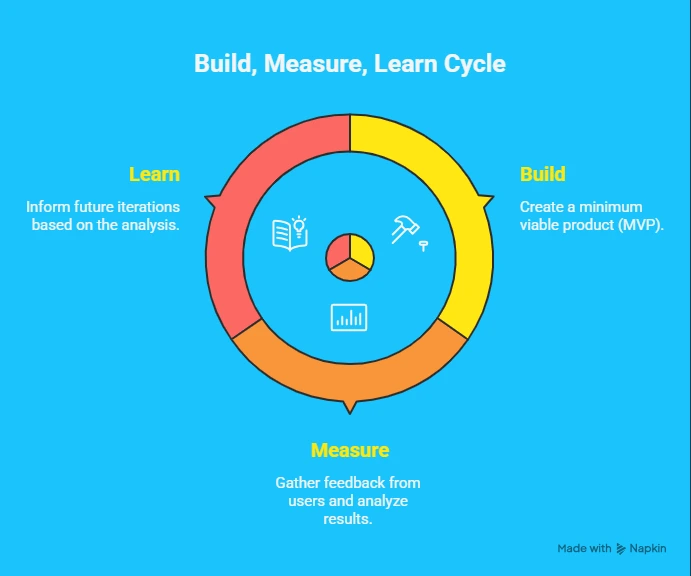
The Build-Measure-Learn loop is the engine of the whole method. Each round has three steps:
-
Build a small version of your product or feature.
-
Measure how real users respond using simple, honest metrics.
-
Learn whether your idea was right, half-right, or wrong.
The faster you complete each loop, the faster you find product-market fit — or kill an idea that won't work. Early-stage founders who run this loop in weeks tend to overtake competitors who are still polishing PowerPoint decks.
The output of a single loop is what Eric Ries calls validated learning: a clear, evidence-based answer to one question about your business.
What Are the Five Core Principles You Must Know?
The five core principles of Lean Startup are the Build-Measure-Learn loop, Minimum Viable Product, validated learning, innovation accounting, and pivot or persevere.
The whole method rests on five ideas that work together as a system, not a checklist.
Inside the lean startup methodology
-
Build-Measure-Learn loop — the speed engine described above.
-
Minimum Viable Product (MVP) — the smallest thing you can put in front of customers that still teaches you something useful.
-
Validated learning — measuring progress by what you've proven, not by features shipped.
-
Innovation accounting — tracking real signals like activation, retention, and referrals instead of vanity numbers like total downloads.
-
Pivot or persevere — make a clear-eyed call after each loop: change direction or keep going.
Each piece reinforces the others. Skip one, and the system breaks. An MVP without validated learning is just a half-built product. Innovation accounting without honest pivot decisions is just a report nobody reads.
What Are the Six MVP Types You Can Test With?
The six most-used MVP types are the Video MVP, Landing Page MVP, Concierge MVP, Wizard of Oz MVP, Prototype MVP, and Single-Feature MVP — each suited to a different testing scenario.
An MVP isn't always code. It's whatever helps you answer your riskiest question with the least effort. Here are the six most-used formats:
| MVP Type | What It Looks Like | Best Used For | Real Example |
| Video MVP | A short demo or explainer video is shown before any product is built. | Tech and SaaS ideas that are hard to prototype | Dropbox — a 3-minute video pulled in 75,000 sign-ups overnight |
| Landing Page MVP | A one or two-page website collecting emails or pre-orders | Almost any product or service idea | Buffer — a simple two-page site, tested whether people would pay for scheduled posts |
| Concierge MVP | The team manually delivers the service that the software will eventually automate | Marketplaces, service platforms, B2B products | Airbnb — founders photographed apartments and ran bookings by hand |
| Wizard of Oz MVP | The interface looks automated; humans do the work behind the scenes | AI products, complex automation | Zappos — the founder bought shoes from local stores after each order |
| Prototype MVP | A clickable wireframe with no working backend | Mobile apps, software with heavy UX | Common in early Indian startup pitches and user testing rounds |
| Single-Feature MVP | Launch with only the one feature your business depends on | When the core value is already very clear | Instagram stripped its predecessor, Burbn, down to photo sharing alone |
Pick the format that tests your biggest unknown — not the one that looks the most impressive.
How Does the Lean Startup Compare With a Traditional Startup?
A Lean Startup learns by doing through fast Build-Measure-Learn cycles, while a traditional startup plans extensively before launching, which means it handles uncertainty far better.
The two approaches differ in how they handle uncertainty.
| Area | Lean Startup Methods | Traditional Startup |
| Core belief | Learn by doing | Plan before acting |
| Product cycle | Build → Measure → Learn → Repeat | Long development, then a single big launch |
| Customer role | Involved from day one | Asked only after launch |
| Risk profile | Spread across many small bets | Concentrated in one launch moment |
| Spending pattern | Small, milestone-based | Large and upfront |
| Success measure | Validated learning and the ability to pivot | Sticking to the original plan |
| Best fit | New markets, new tech, unclear demand | Mature markets with predictable demand |
Where does the lean startup approach really win?
The lean startup approach pays off most when nobody knows what the market wants, which is almost every modern category. In stable industries with proven demand, traditional planning can still hold its own. But in software, climate tech, fintech, edtech, and most consumer apps, the lean approach saves cash and time while keeping the team honest.
What Are the Real Benefits of Going Lean?
The main benefits of going lean are lower spending, faster launches, tighter customer fit, smarter decisions, stronger investor pitches, and less waste.
The payoff shows up across cost, speed, and confidence.
-
Lower spend — teams stop building features no one asked for, often cutting early product costs by a third or more.
-
Faster launches — shipping a working core takes weeks, not quarters.
-
Tighter customer fit — each loop pulls the product closer to what users need.
-
Smarter decisions — choices come from data on real behaviour, not opinions in a meeting room.
-
Stronger investor pitches — showing real traction beats polished business plans.
-
Less waste — anything that doesn't help you learn is cut, in line with the original lean manufacturing roots.
Indian companies are built on the lean startup model.
Indian companies built on the lean startup model
The Indian ecosystem is full of examples.
-
Flipkart began by selling books online and delivering them by hand before building a full e-commerce platform — a textbook concierge MVP.
-
Zomato launched as a simple restaurant menu aggregator before adding delivery, a single-feature MVP.
-
OYO tested its budget hotel concept in one property before scaling.
-
Freshdesk used a landing page to gauge demand before writing serious code.
Each one validated cheaply, learned fast, and only scaled what worked.
What Are the Common Mistakes Founders Make in a Lean Startup?
Common mistakes include treating the MVP as a half-built product, chasing every piece of feedback, mistaking activity for progress, mistiming pivots, and skipping innovation accounting.
The lean startup approach looks simple on paper, but many teams trip over the same few traps. Spotting them early saves months of wasted effort and a lot of money.
Treating the MVP as a half-built product — the goal isn't a smaller version of the product, it's a faster lesson. Teams that ship a stripped-down version with no clear hypothesis end up with neither learning nor a working product. Always start with the question you want answered, not the feature list you want to build.
Chasing every piece of feedback — listening to customers matters, but reacting to every comment pulls the product in ten directions. Research on lean thinking has long flagged this risk: too much feedback can dilute a strong vision. The BBC iPlayer team backed their hunch even when early feedback was harsh, and they were proved right when home broadband finally caught up to their idea.
Mistaking activity for progress — running ten experiments a month feels productive, but if none of them answers your riskiest question, you're just busy. Each loop should target one clear assumption, not a long wish list. Quality of learning beats speed of motion.
Pivoting too late or too soon — founders often cling to a dying idea past the evidence, or pivot at the first sign of resistance. Both are costly. A disciplined pivot decision rests on data across two or three loops, not on a single bad week or a single loud customer.
Skipping innovation accounting — without honest metrics like activation, retention, and cohort behaviour, teams quietly drift back to vanity numbers, and the whole system stops working. The discipline of measurement is what separates lean from luck.
The fix for all five is the same: write the assumption first, design the smallest test that proves or breaks it, then act on what the data says — even when it isn't the answer you hoped for.
What Is Lean Startup in SAFe?
Lean Startup in SAFe is the application of Build-Measure-Learn cycles within the Scaled Agile Framework's Continuous Delivery Pipeline, enabling large enterprises to test new business ideas at the same speed as a small startup.
SAFe formalises this through the Lean Startup Cycle, where Agile Release Trains run quick experiments on Minimum Viable Products before committing to full-scale development. Each MVP is treated as a hypothesis. If validated, the team perseveres and scales the idea through normal SAFe planning. If the data says otherwise, the team pivots — without burning quarters of engineering budget.
This matters because enterprise innovation usually fails for one reason: too much investment before any real customer signal. SAFe solves that by embedding lean startup methodologies into Program Increment planning, so big organisations can innovate like small ones.
How Can You Turn Lean Thinking Into Career Growth?
You can turn Lean thinking into career growth by combining hands-on experimentation skills with a recognised agile certification, such as the Leading SAFe® Certification, which signals enterprise-scale Lean-Agile capability to hiring managers.
Lean thinking has moved well beyond garage startups. Large enterprises now run lean experiments inside their innovation teams, product squads, and digital transformation programmes. Hiring managers increasingly look for professionals who can frame hypotheses, run small tests, and lead a Build-Measure-Learn cycle inside a regulated, cross-functional environment.
This is where structured agile training pays off. The Leading SAFe Certification trains you to apply lean agile principles and SAFe agile principles at the scale most enterprises run on — multiple teams, shared backlogs, quarterly planning, and outcome-based metrics. It connects the startup mindset to enterprise execution, which is the exact bridge most product, project, and program roles now demand.
If you already lead teams, work in product, or want to move into agile transformation roles, building this credential turns lean instincts into a career-defining skill.
Your Next Step
The Lean Startup is less a framework and more a habit — test your assumptions, listen to real users, and trust evidence over opinions. Founders who stick with this habit build sharper products. Professionals who carry this habit into corporate roles become the people teams trust to lead change.
If you want to take this further, a recognised certification gives the playbook real structure and a career signal employers look for.
Frequently Asked Questions
1. What does Lean Startup mean?
Lean Startup is a method for building a business through small experiments and customer feedback instead of long upfront planning. The goal is to learn quickly and waste less, so teams invest only in ideas that real users have already validated.
2. What is an MVP in a Lean Startup?
Minimum Viable Product (MVP) is the simplest version of your idea that lets you test your biggest assumptions with real users. It can take many forms — a video, a landing page, a clickable prototype, or even a manually delivered service.
3. Is Lean Startup the same as Agile?
No, Lean Startup and Agile are two different things that often work together. Agile is a way of building software in short sprints, one level higher and decides what to build and why.
4. What is a pivot in a Lean Startup?
A pivot is a planned change in business direction based on what you learned from a Build-Measure-Learn cycle. Eric Ries lists about ten types, including customer-segment pivots, technology pivots, and revenue-model pivots. A pivot is a strategic decision, not a sign of failure.
5. Where can I learn Lean Startup principles formally?
You can learn Lean Startup principles formally through agile and product certifications offered by recognised training providers. Programmes like the Leading SAFe Certification cover lean thinking inside the wider agile and enterprise context, which is the format most working professionals need.