








Product prioritization is the process of deciding which features, fixes, or ideas your team should build first, based on value, effort, and impact. If you've ever sat in a planning meeting where five people had five different "top priorities," you already know why this matters. This guide breaks down what it looks like in practice, the frameworks that work, and how to build a roadmap your whole team can agree on.
What Is Product Prioritization?
Product prioritization is the practice of ranking product ideas, features, and fixes so teams know what to build first, next, and later. It's less about picking "good ideas." Most backlog items are technically good. It's more about picking the right ones for right now, given limited time, budget, and people.
Think of it like packing a suitcase for a trip. You can't bring your entire closet. You bring what fits and matters for where you're going. Prioritization works the same way: it forces trade-offs so your roadmap doesn't turn into a wish list.
How It Fits Into the Bigger Picture
This connects to the broader question people ask early on: what is product management? In short, it's the discipline of guiding a product's strategy, roadmap, and execution from idea to launch to ongoing improvement. What is product management without prioritization? It's mostly guesswork. Prioritization is the decision-making engine that keeps it grounded in reality, not opinion.
Why Is Product Prioritization Important?
This is important because it stops teams from spreading themselves too thin across too many half-finished ideas. Without it, roadmaps become a collection of everyone's favorite request instead of a strategic plan.
Here's the blunt truth: most product launches don't hit their business goals, and many shipped features end up barely used. Teams that make decisions with data and structure, rather than gut feeling, are far more likely to launch things that move the needle. Why is product prioritization important? Because it turns a long, noisy backlog into a short, defensible list of what to build now.
The Real Cost of Skipping It
When teams skip it, a few predictable things happen:
-
Engineering time gets split across too many small requests
-
Valuable projects get delayed as urgent-but-small tasks jump the queue
-
Stakeholders lose trust in the roadmap as priorities shift weekly
-
Teams ship features nobody asked for, while real pain points sit untouched
Why is product prioritization important in a growing company specifically? Because as more people (sales, support, leadership, customers) start requesting things, the noise multiplies. Without a system, the loudest voice wins, not the best idea.
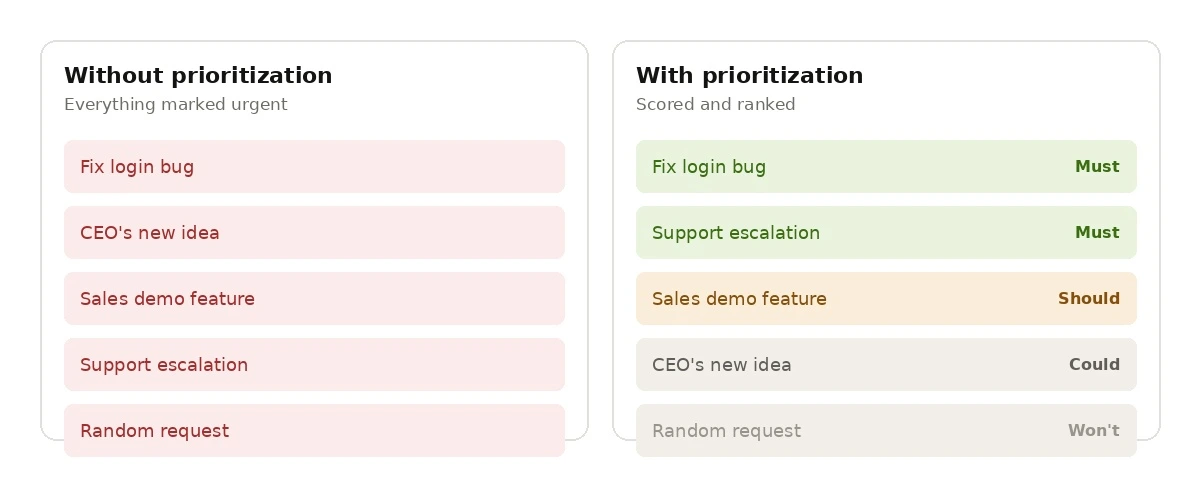
Quick Snapshot: With vs. Without Prioritization
The difference shows up quickly once you compare the two side by side. Without prioritization, roadmaps shift every sprint, decisions get made based on who asked last, and the team burns out chasing everything at once. Stakeholders argue over priorities because there's no shared logic behind them, and features ship without moving any real numbers.
With a working prioritization process, things look different:
-
The roadmap stays stable and defensible from one sprint to the next
-
Decisions should be based on data and impact, not on who spoke up last
-
The team focuses on fewer, bigger wins instead of spreading themselves thin
-
Stakeholders can see the reasoning behind each choice, so there's less to argue about
-
Shipped features tie back to real outcomes instead of sitting unused
What Are the Best Product Prioritization Frameworks?
There isn't one "correct" product prioritization framework. It depends on your team size, how much data you have, and how fast you need to decide. Below are the ones worth knowing.
RICE
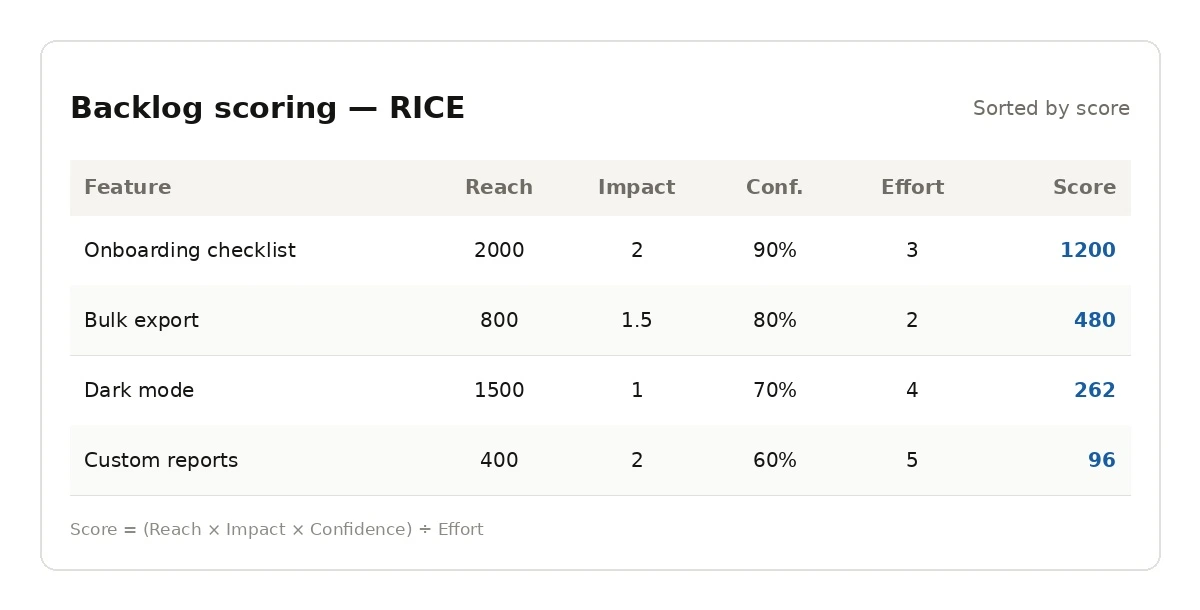
RICE scores each idea on Reach, Impact, Confidence, and Effort, then combines them into one number you can rank against. It's the go-to when you have some data and want to compare many ideas objectively.
MoSCoW
MoSCoW sorts work into Must-have, Should-have, Could-have, and Won't-have. It's fast, works well in a room full of different stakeholders, and forces the hardest but most useful conversation: what are we not doing?
Kano Model
The Kano model groups features by how they affect customer satisfaction: basic expectations, performance features, and delighters. It's especially useful when you're trying to find what will genuinely surprise and please users, not just keep them from complaining.
Value vs. Effort
A simple two-axis matrix: plot ideas by expected value against expected effort. Anything high-value and low-effort goes first. It's the quickest framework to run with a whiteboard and no spreadsheet.
Comparing the Frameworks
| Framework | Best For | Speed | Data Needed |
| RICE | Ranking many features objectively | Medium | Moderate to high |
| MoSCoW | Fast alignment across stakeholders | Fast | Low |
| Kano | Understanding customer satisfaction | Slow | User research |
A common approach: use Kano to understand what matters, RICE to score and rank it, then MoSCoW to make the final scope cut. Each answers a different question (value, ranking, or scope), so combining them beats relying on just one.
How Do You Effectively Prioritize Product Development?
To prioritize product development effectively, you need a repeatable process, not a one-time meeting. Here's a straightforward sequence that works for teams of almost any size.
Step-by-Step Process
-
Collect everything in one place. Pull requests from customers, support, sales, and internal teams into a single backlog. Scattered lists are the first reason prioritization breaks down.
-
Define your scoring criteria. Decide what "impact" means for your product: revenue, retention, activation, or something else.
-
Score and rank. Apply your chosen framework consistently across every item.
-
Sanity-check with strategy. Is the top of the list in supporting this quarter's goals? If not, something's off.
-
Communicate the "why." Share the reasoning behind the ranking, not just the ranking, so stakeholders trust it.
-
Revisit regularly. Priorities shift, so revisit the list every sprint or month, not just once a quarter.
Common Mistakes That Derail Prioritization
-
Letting the loudest stakeholder set the roadmap
-
They use a different framework every time, so nothing is comparable
-
Scoring based on assumptions instead of real user data
-
Never say no to anything, so everything stays a "high priority"
The goal isn't a perfect framework. It's consistency. Teams that reuse the same method sprint after sprint build a track record they can point back to when priorities get questioned.
What Should You Look for in a Prioritization Tool?
Most teams outgrow spreadsheets eventually. Look for a few specific things when shopping around.
Features That Actually Matter
| Features | Why It Matters |
| Custom scoring fields | Lets you adapt RICE, MoSCoW, or your own formula |
| Visual roadmap view | Easily share priorities with non-PM stakeholders |
| Feedback collection | Keeps customer requests tied to backlog items |
| Integration with dev tools | Avoids duplicate work between planning and execution |
| Historical tracking | Shows how priorities and scores have changed over time |
A tool won't fix a broken process, but a good one makes it much easier to stick with.
How Do You Handle Conflicting Priorities From Different Teams?
This is a common real-world sticking point that basic guides rarely cover.
When sales wants a feature, support wants a bug fixed, and leadership wants a new initiative, the fix isn't picking a favorite team. It's routing every request through the same scoring system. If a sales request scores lower than a support one, that's the answer, regardless of who asked. Document the score and share it. This single act resolves more roadmap conflict than any meeting ever will.
How Do You Know if Your Prioritization Is Working?
A few honest signs that the process is working:
-
The team can explain why something is or isn't on the roadmap without a long debate
-
Shipped features that show measurable change in the metric they were meant to improve
-
Stakeholders to stop escalating requests directly to engineers
-
The backlog shrinks or stays steady instead of growing endlessly
If none of these are true, it's not a reason to abandon prioritization. It's a sign to tighten your criteria and revisit it more often.
Should You Get a POPM Certification to Prioritize Better?
If prioritization is a core part of your job, a POPM certification (SAFe Product Owner/Product Manager) is worth considering. It's a two-day, credential-backed course that teaches backlog management, feature and story writing, and prioritization within a Lean-Agile framework, along with how to run Program Increment planning within a wider Agile Release Train.
Who Gets the Most Out of It
| You are... | POPM helps with... |
| A new product owner or PM | Structured frameworks instead of learning by trial and error |
| Working within a SAFe organization | Speaking the same language as your Agile Release Train |
| Managing multiple backlogs | Synchronizing priorities across teams and stakeholders |
| Aiming for a leadership track | A recognized credential that signals prioritization expertise |
A certification won't replace judgment, and it won't fix a team that ignores its own scoring system. What it does is give you a shared vocabulary and a proven structure, so prioritization discussions stop starting from scratch every time.
Wrapping Up
Product prioritization isn't a one-time exercise. It's an ongoing habit that keeps your team focused on what matters. Whether you lean on RICE, MoSCoW, Kano, or a mix of all three, the goal is the same: fewer surprises, clearer trade-offs, and a roadmap people trust. Start small, stay consistent, and revisit often.