








Have you ever noticed your mother calculating your family's expenses and writing them down? Why should this be written? Is it important? Or is it only for home? Budgeting is familiar to organisations of every size too.
The answer is yes, it matters. Your mother is not just recording numbers. She is looking ahead: what will groceries cost next month, will the school fees fit, and is there room for a festival or an emergency?
Budget forecasting is that same forward look, using past data and expected trends to predict income, expenses, and cash flow. This guide covers the meaning, models, tools, steps and common mistakes so that you can plan with confidence.
What Does Budget Forecasting Actually Mean?
It is the process of estimating future revenue, costs and cash flow so you can set realistic spending plans. It turns historical figures and market expectations into a forward-looking financial view that teams can act on.
How Is a Forecast Different From a Budget?
A budget is a fixed plan, while a forecast is a flexible prediction. Budgeting and forecasting work best together: the budget sets targets, and the forecast shows whether you are on track.
- Purpose: A budget sets spending targets, while a forecast predicts likely results.
- Time frame: Budgets usually cover one year, while forecasts can run monthly, quarterly or on a rolling basis.
- Update: Budgets change rarely, while forecasts are refreshed more often.
- Flexibility: Budgets stay fixed, while forecasts adjust as conditions change.
Why Does Forecasting Matter for Your Business?
It matters because it exposes cash shortages before they hurt, guides hiring and investment, and keeps every team working from the same numbers. Key benefits include:
- Early warning of cash gaps
- Smarter spending and hiring decisions
- Stronger investor and lender confidence
- Faster response to market changes
- Clear accountability between planned and actual results
What Are the Main Budget Forecasting Models?
The main budget forecasting models are straight-line, moving average, regression and rolling forecasts, plus scenario planning for uncertain conditions. Choose based on your data quality and business stability.
|
Model |
How it works |
Best for |
Limitation |
|
Straight-line |
Applies a steady growth rate to past results |
Stable businesses |
Ignores seasonality |
|
Moving average |
Averages recent periods to smooth swings |
Seasonal or noisy data |
Lags behind sudden change |
|
Regression |
Links results to drivers such as price or ad spend |
Data-rich teams |
Needs clean data |
|
Rolling forecast |
Adds a new period as each one closes |
Fast-changing firms |
Needs frequent effort |
|
Scenario |
Builds best, base and worst cases |
High uncertainty |
More work to maintain |
Quantitative vs Qualitative Approaches
Quantitative budget forecasting models rely on numbers and statistics. Qualitative approaches use expert judgment, sales team input and market research, which helps when there is no history, such as a new product launch. Most teams blend both.
Which Budget Forecasting Tools Should You Use?
Use spreadsheets if you are small, cloud planning software if you are growing, and enterprise platforms if you manage many entities. The best budget forecasting tools match your team size, data sources and reporting needs.
- Spreadsheets (Excel, Google Sheets): Best for startups and small teams because they are low-cost and flexible.
- Cloud planning software (Planful, Workday Adaptive Planning): Suits mid-size firms that need collaboration and automation.
- Enterprise platforms (Anaplan, Oracle NetSuite): Built for large organisations that need scale and system integration.
What Features Should You Look For?
Look for budget forecasting tools that connect to your accounting system and offer scenario modelling, version control, dashboards and role-based access.
How Do You Create a Forecast Step by Step?
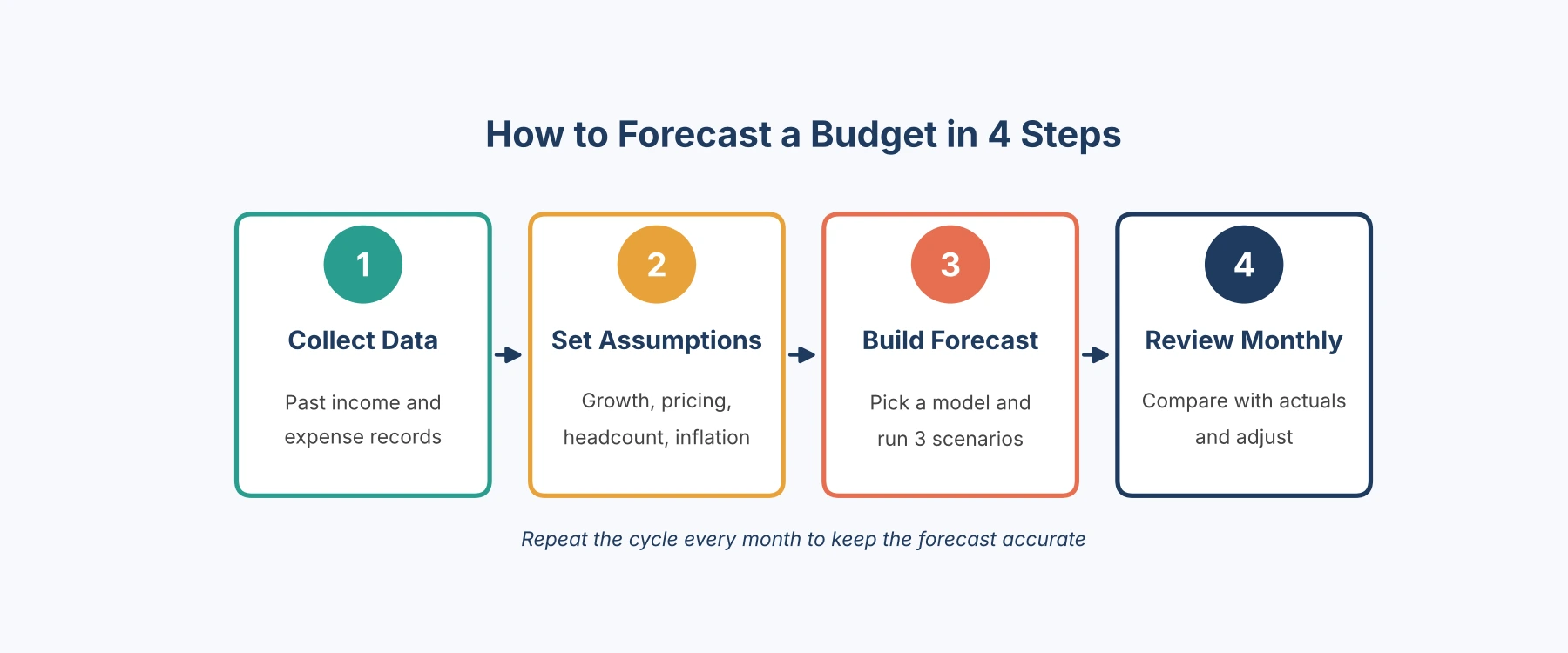
Collect past data, set assumptions, choose a model, build the forecast, then review and update it regularly. Follow these steps:
- Gather two to three years of income and expense data.
- Identify drivers such as sales volume, pricing, headcount and inflation.
- Write down clear assumptions.
- Select a model from the table above.
- Build base, best and worst scenarios.
- Compare the forecast with actuals each month and adjust.
Effective budgeting and forecasting is a cycle, not a one-time task.
What Is a Simple Example?
Use this formula: forecast revenue = last period revenue x (1 + expected growth rate). If last quarter's revenue was 100,000 and you expect 8 per cent growth, next quarter's forecast is 108,000.
What Does Budget Forecasting Look Like in the Real World?
Case study: Mission Health
Mission Health is a group of seven hospitals. Every year, it made a budget, which is a plan for how much money it would earn and spend. Making this plan took 3 to 5 months.
There was a problem. After just 3 months, the plan was often no longer correct, because things had changed. So all that time and effort was not very useful.
What did they do?
Mission Health stopped making one big plan for the whole year. Instead, it started updating its money plan again and again as the year went on. This is called a rolling forecast. The plan keeps moving forward with new information, like a map that updates as you travel.
It still kept a yearly goal, but it no longer spent months building a detailed yearly budget.
Simple takeaway: Think of it like planning a trip. If you plan every detail months ahead, the plan may fail when the weather or the roads change. It is better to check and adjust your plan along the way. A forecast works the same way. Keep updating it, so your decisions match what is really happening.
Source: Becker’s Hospital Review, “This health system threw out its annual budget — here’s why.”
What Mistakes Should You Avoid?
Avoid unrealistic assumptions, outdated data, ignored seasonality and treating a forecast as final. Common errors include:
- Using overly optimistic growth rates
- Relying on a single scenario
- Skipping variance analysis
- Depending on manual spreadsheets with no version control
- Leaving out department heads who own the numbers
How Often Should You Update a Forecast?
Update monthly for most businesses, weekly for cash-tight or fast-moving ones, and quarterly at the very minimum. Regular updates keep the forecast useful as conditions change.
Which KPIs Measure Forecast Accuracy?
Track forecast variance, mean absolute percentage error (MAPE) and cash runway to judge how reliable your predictions are.
- Forecast variance: The gap between actual and forecast results (actual minus forecast).
- MAPE: The average size of your forecast errors (average of absolute error divided by actual).
- Cash runway: The months of cash you have left (cash balance divided by monthly net burn).
What Skills Help You Forecast Better?
Spreadsheet fluency, financial analysis, data storytelling and agile planning habits help most. Professionals who complete a CSM Course learn iterative planning and stakeholder communication, which fit rolling forecasts well. Pairing a CSM Course with finance training gives you both the numbers and the teamwork skills to keep forecasts current.
What Is the Key Takeaway You Can Act On Today?
A forecast creates value only when you build it, check it against reality and keep improving it. Perfect accuracy is not the goal. Better decisions are.
Use this simple action plan:
- This week: Pull your last 24 to 36 months of income and expense data.
- This month: Choose one model from the table, write down your assumptions and build base, best and worst cases.
- Every month after that: Compare actual results with the forecast, record the variance and adjust.
- Every quarter: Review your model and tools, and upgrade only when your spreadsheet starts to slow you down.
Teams that treat forecasting as a habit, not a yearly chore, spot cash gaps early, hire with confidence and work from one shared set of numbers. Start small today, and each cycle will make your next forecast sharper.
What Else Do People Ask About Forecasting a Budget?
1. Is a forecast the same as a projection?
No. A forecast predicts what is most likely to happen based on data, while a projection shows what could happen if chosen assumptions hold.
2. Can a small business forecast without software?
Yes. A spreadsheet with monthly income, fixed costs, variable costs and a cash balance line is enough to start.
3. How far ahead should you forecast?
Most teams look 12 months ahead for the yearly plan and 13 weeks ahead for cash. Longer horizons carry more uncertainty, so widen your scenarios.
4. What data do you need first?
Past income and expense statements, a list of fixed commitments and your current sales pipeline or order data.