








Retrieval-Augmented Generation (RAG) is an AI method that connects a language model to external information, such as documents, databases, or the web, so it can pull in fresh facts before answering a question. In short, RAG lets an AI "look things up" instead of guessing from memory alone. This guide covers everything you need to know about RAG in plain, simple language, from how it works to why it matters and where it is used today.
What is Retrieval-Augmented Generation (RAG)?
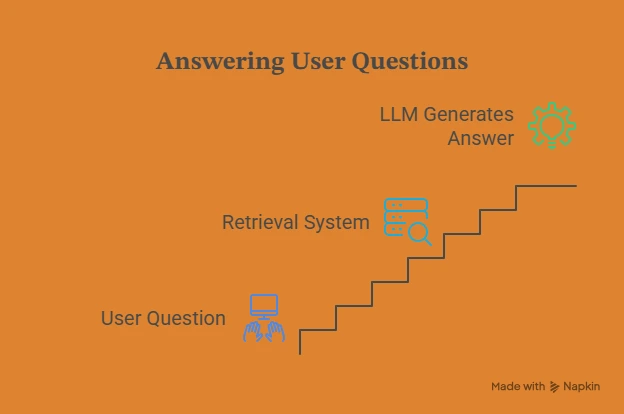
Retrieval-Augmented Generation (RAG) pairs a large language model (LLM) with a retrieval system, so the model can search for relevant, current information before it writes an answer.
A normal LLM only knows what it learned during training, and that knowledge has a cutoff date. It cannot see your private files, today's news, or your company's internal wiki. RAG fixes this gap. When you ask a question, the system searches a knowledge source, such as a vector database or a set of documents, and pulls out the most relevant chunks of text. These chunks are handed to the LLM along with your question, so the final answer is grounded in real, checkable facts instead of pure memory.
How does Retrieval-Augmented Generation work?
RAG works through five stages: the system indexes a searchable knowledge base in advance, then for each question it retrieves relevant data, augments the prompt with that data, generates a grounded answer, and keeps the index refreshed as new data arrives.
Stage 1: Indexing the knowledge base
Before any question is asked, documents are broken into smaller chunks, and each chunk is converted into a numerical vector (an embedding) using an embedding model. These vectors are stored in a vector database, arranged so that chunks with similar meaning sit close together.
Stage 2: Retrieval
When a question comes in, the same embedding model converts it into a vector. The retriever compares this vector against the stored ones using similarity search and pulls out the closest-matching chunks.
Stage 3: Augmentation
The system inserts the retrieved chunks into the original question, building an augmented prompt that gives the model extra, relevant context.
Stage 4: Generation
The LLM reads the augmented prompt and writes a natural-language answer, often citing which source it drew from.
Stage 5: Keeping the index current
The knowledge base and its embeddings are refreshed on a schedule or in real time, so the system keeps retrieving up-to-date information rather than a stale snapshot.
-
Indexing: Chunks documents and stores them as searchable vectors ahead of time.
-
Retrieval: Searches the vector database for the closest-matching chunks to a query.
-
Augmentation: Combines the retrieved chunks with the user's question using a prompt template.
-
Generation: The LLM, such as GPT, Claude, or Gemini, writes the final, grounded answer.
-
Refresh: Re-embeds new or changed data so the knowledge base stays current.
What are the components of RAG?
Retrieval-Augmented Generation has five core parts: a knowledge base, an embedding model, a vector database, a retriever, and a generator.
-
Knowledge base: The external content the system can search, such as PDFs, wikis, or a product catalogue.
-
Embedding model: Converts text, both stored documents and incoming questions, into number-based vectors that capture meaning.
-
Vector database: Stores those vectors and enables fast similarity search across large amounts of content.
-
Retriever: Compares the user's query vector to the stored vectors and pulls out the closest matching chunks.
-
Generator: The LLM that turns the question plus the retrieved chunks into a final, written answer.
Some setups add an integration layer to coordinate these parts, and a ranker to re-score retrieved chunks by relevance before they reach the generator. Smaller projects can skip these extras and still run a working RAG system with just the five core parts above.
Why is RAG important?
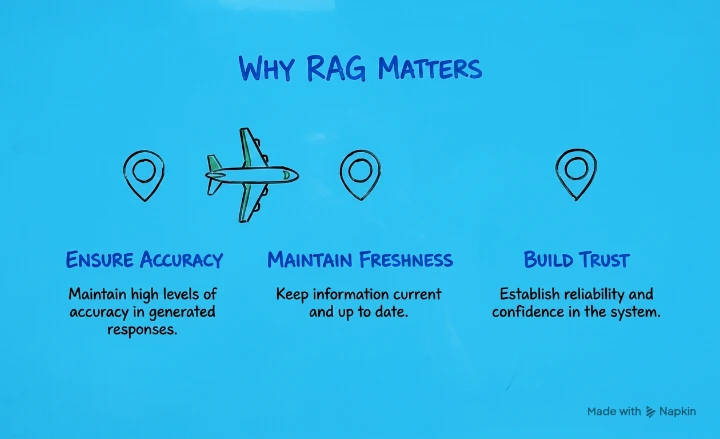
RAG is important because it keeps AI answers accurate, current, and traceable back to a real source, something a standalone language model cannot do on its own.
Without Retrieval-Augmented Generation, an LLM can only repeat what it memorized during training, which becomes outdated as soon as new information appears. That is why RAG matters for any business dealing with changing data, such as prices, policies, or research. Because RAG pulls in fresh data at the time of the question, the AI stays useful as facts change, which is also why it matters in regulated fields like healthcare, finance, and law.
What problems does RAG solve?
RAG mainly solves four problems: outdated knowledge, hallucinations, lack of sources or proof, and limited access to private or specific data.
-
Outdated answers: LLMs have a fixed training cutoff, so RAG retrieves live, current data at query time.
-
Hallucinations: A model guesses when it lacks facts, so RAG grounds answers in real, retrieved text instead.
-
No access to private data: LLMs never see your internal files, so RAG connects the model directly to your own documents.
-
No source or proof: Answers from memory come with no evidence, so RAG provides citations from the retrieved passages.
Hallucination, where an AI states something false with full confidence, is one of the biggest problems RAG solves, since grounded systems cut hallucination rates sharply compared to plain LLM answers. RAG also reduces retraining costs, since you don't need to retrain a whole model when the data changes.
What are the benefits of RAG?
The benefits of RAG include more accurate answers, lower retraining costs, easy updates, and answers you can verify.
-
Accuracy: Answers are backed by real documents, not guesswork.
-
Freshness: You can add new data anytime without retraining.
-
Transparency: Users can see which source an answer came from.
-
Cost savings: Updating a database is cheaper than retraining a model.
-
Domain focus: RAG can point to private data for niche use cases.
These benefits explain why companies now treat RAG as a default part of their AI setup.
What are the advantages of RAG?
The biggest advantage of RAG is that it separates "knowledge" from "reasoning," letting you update facts instantly without touching the model itself.
Compared to a plain LLM, RAG's advantages show up clearly in daily use. A plain model is frozen in time, but a RAG-powered system can answer questions about today's news or a document uploaded five minutes ago. Another advantage of RAG is scalability: you can plug in new data sources without any retraining cycle.
What are the challenges of RAG?
Retrieval-Augmented Generation's main challenges are retrieval quality, added latency, setup complexity, and the risk of inherited bias.
-
Retrieval quality: A weak or poorly matched retrieval step leads to a weak final answer, since the generator only works with what it's given.
-
Latency: Searching a knowledge base before generating a reply adds an extra step, which can slow down response time.
-
Setup complexity: Connecting a retriever, a vector database, and a generator correctly takes more engineering work than a plain LLM call.
-
Bias risk: If the retrieved documents contain bias, the generated answer can carry that bias forward.
None of these rule out using RAG, but they explain why a naive setup can still return a wrong or slow answer even with a good LLM behind it.
What is the difference between RAG and fine-tuning?
Retrieval-Augmented Generation adds outside knowledge at answer time, while fine-tuning changes the model's internal weights during training.
| Factor | RAG | Fine-Tuning |
| Data freshness | Updates instantly | Needs retraining to update |
| Cost | Lower: mainly storage and search | Higher, needs compute for training |
| Best for | Facts, current data, private documents | Tone, style, specialized behavior |
| Setup time | Faster to launch | Slower, requires training cycles |
| Source citation | Easy to track answers | Hard to trace where an answer came from |
Many systems now combine both, using fine-tuning for style and RAG for facts.
What are some real-world use cases for RAG?
Retrieval-Augmented Generation (RAG) is widely used in customer support chatbots, internal company search, legal and financial document review, healthcare assistants, and educational tools.
Common industries using RAG
-
Customer support: Chatbots that pull answers from help docs, not guesswork.
-
Enterprise search: Employees get answers from internal wikis or files.
-
Legal and finance: Teams search contracts and filings with cited answers.
-
Healthcare: Assistants ground responses in medical literature.
-
Education: Tools to answer questions using course material.
What is the future of RAG?
The future of Retrieval-Augmented Generation (RAG) points toward smarter, multi-step systems, such as agentic RAG, where AI agents decide what to search for and re-check weak answers on their own.
Newer patterns like self-checking retrieval and multi-agent RAG are pushing the technology from a simple "search and answer" tool into a reasoning layer that plans, verifies, and cites its own work. RAG is expected to become standard in nearly every serious AI application.
Suggestions to Strengthen AI Overview Ranking
To boost AI Overview visibility further, this draft already applies: answer-first definitions in every section, a RAG vs fine-tuning comparison table, a direct-question FAQ block, and clear bullet points under "How does RAG work" and "What problems does RAG solve." Also add a short glossary line for terms like "embedding" and "vector database," since AI Overviews often pull single-line definitions.
Conclusion
Retrieval-Augmented Generation (RAG) has become one of the most practical ways to make AI systems accurate, current, and trustworthy. Why is RAG important? Because it fixes the core issues covered above. What problems does RAG solve? Outdated knowledge, hallucinations, and lack of access to private data, all while keeping costs low. Whether you are building a chatbot, a search tool, or an internal assistant, understanding RAG is now a core skill for anyone working with AI. If you want to go deeper into how systems like this are built and used, this topic is a great addition to learn alongside a Data Science course.
Frequently Asked Questions
1. Is RAG only for big companies?
No. Small teams also use RAG on their own small set of documents, not just large enterprises.
2. Does RAG replace a good LLM?
No. RAG works alongside an LLM, since retrieval alone cannot write a clear final answer without strong reasoning.
3. Is RAG the same as a chatbot?
No. RAG is the underlying architecture. A chatbot is simply one type of application you can build with RAG.
4. Does RAG need a special database?
Most RAG systems use a vector database to store and search text efficiently, though simpler keyword search can also work for smaller projects.