




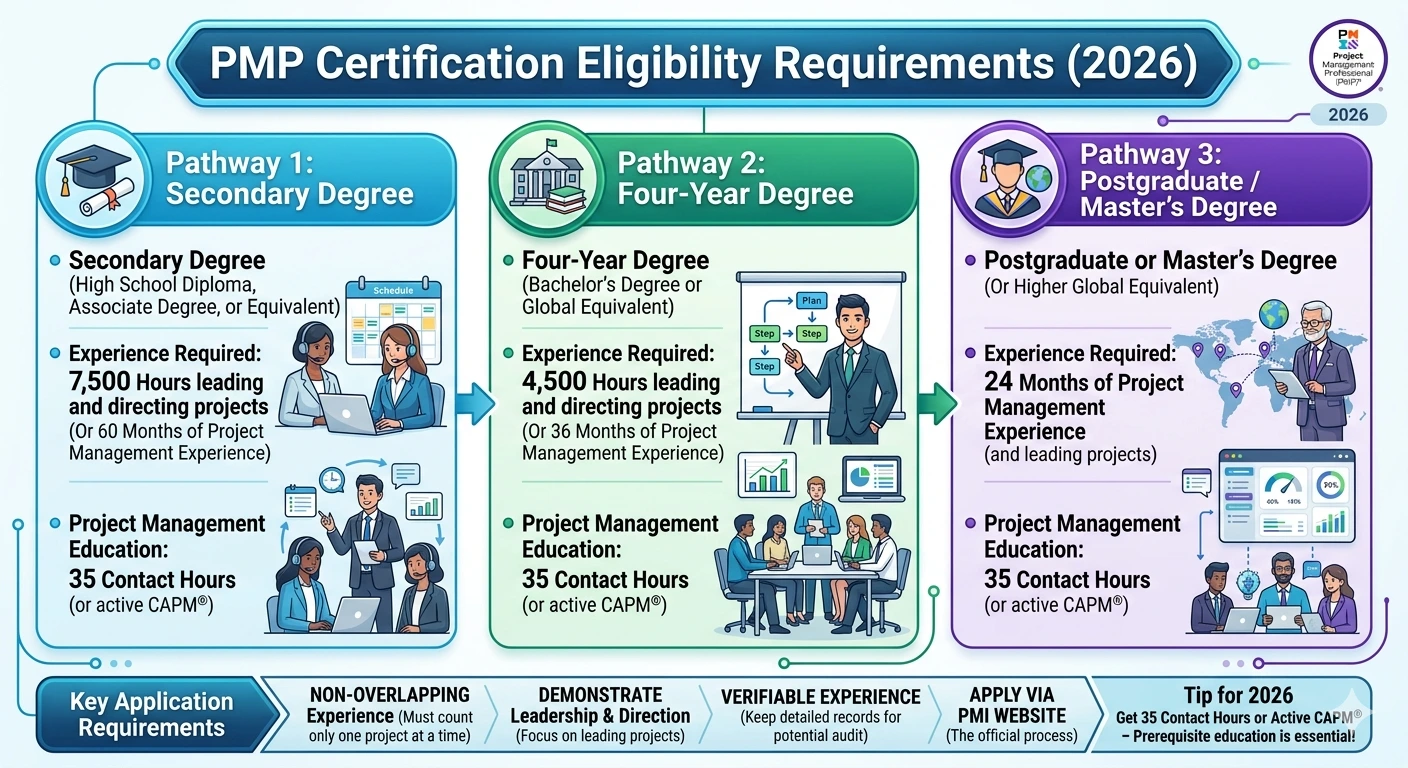
 Three education pathways to meet PMP eligibility



What is PMP Certification?
The Project Management Professional (PMP) certification, offered by the Project Management Institute (PMI), is one of the most recognized credentials for project managers worldwide. In 2026, PMP certification continues to be highly valuable as organizations increasingly seek professionals skilled in Agile, hybrid project management, digital transformation, risk management, and leadership. PMP-certified professionals often gain better career opportunities, higher salaries, and global recognition because the certification validates both practical project management experience and formal training. Since PMI follows strict eligibility criteria, candidates must understand the PMP requirements, experience pathways, and application process before applying for the exam.
Also Read:Lean Six Sigma vs PMP
Why Get PMP Certified?
In 2026, PMP certification remains one of the most valuable credentials for professionals involved in project delivery and business transformation. The certification demonstrates your ability to manage projects using predictive, Agile, and hybrid methodologies in modern work environments.
Organizations increasingly rely on PMP-certified professionals to lead cross-functional teams, manage budgets, mitigate risks, and ensure successful project execution. With digital transformation and AI-driven operations expanding across industries, project managers with globally recognized certifications are becoming even more valuable.
PMP-certified professionals typically earn higher salaries compared to non-certified peers. Research consistently shows that PMP certification can increase earning potential by 16% to 25%, depending on industry, experience, and geographic location.
Another major advantage of PMP certification is global recognition. Since PMI credentials are accepted in over 200 countries, PMP certification enables professionals to pursue international career opportunities and leadership positions.
The PMP exam also validates your understanding of:
- Predictive project management
- Agile frameworks
- Hybrid project delivery approaches
- Stakeholder engagement
- Risk and quality management
- Leadership and communication skills
As organizations continue adapting to remote collaboration, AI-assisted workflows, and digital project environments, PMP certification helps professionals remain competitive and future-ready.
Who Should Apply for PMP Certification?
PMP certification is ideal for professionals responsible for planning, leading, executing, monitoring, or delivering projects. Even if your job title does not explicitly include “Project Manager,” you may still qualify if your responsibilities involve project-related work.
Professionals who should consider PMP certification include:
- Project Managers managing enterprise initiatives
- Team Leads supervising project execution
- Program Managers handling multiple projects
- Delivery Managers overseeing client engagements
- IT professionals managing implementations and migrations
- Construction professionals handling infrastructure projects
- Manufacturing professionals managing operations improvement projects
- Business Analysts coordinating business transformation initiatives
- Consultants leading client-focused project engagements
- Product Owners collaborating with Agile teams
In 2026, employers value professionals who can manage both technical execution and business alignment. PMP certification demonstrates your capability to handle project constraints, stakeholder expectations, timelines, and strategic goals.
If you already have hands-on project experience, PMP certification can strengthen your credibility and accelerate your transition into senior leadership roles.
PMP Certification Eligibility Requirements is as follows:
| Educational Qualification | Required Project Management Experience |
| High school diploma or secondary school certificate | Minimum 5 years of experience |
| Associate degree or technical/vocational qualification | Minimum 4 years of experience |
| Bachelor’s degree or higher | Minimum 3 years of experience |
| GAC-accredited bachelor’s/postgraduate degree | Minimum 2 years of experience |
Additional Eligibility Requirements:
• 35 hours of project management training required
• CAPM-certified professionals may receive training-hour exemption
• Experience must be earned within the last 10 years
• Applicants should have experience leading or directing projects
What are 4500/7500 hours of project management experience, how is it counted, and how should one gain it?
PMI requires candidates to demonstrate practical experience managing projects. The 4,500 or 7,500 hours refer to the time spent leading and directing project activities.
Your project management experience may include:
- Planning project activities
- Managing project schedules
- Leading project teams
- Monitoring project progress
- Managing stakeholders
- Controlling project risks and costs
- Coordinating project communication
- Closing projects successfully
These hours can be accumulated through full-time employment, consulting assignments, freelance projects, volunteer work, or organizational initiatives.
Candidates are encouraged to maintain detailed records of their project experience in spreadsheets or documentation systems. Recording project dates, responsibilities, deliverables, and stakeholder interactions can simplify the PMI application process.
If you currently lack sufficient project management experience, you can build experience through:
- Event management initiatives
- Team leadership opportunities
- Community projects
- Cross-functional business initiatives
- Process improvement activities
- Migration and implementation projects
Professionals early in their careers may need additional time to accumulate qualifying project experience before applying for PMP certification.
When managing projects, understanding the purpose of project and business objectives of the project is essential. This enables project managers to align execution strategies with organizational goals and deliver measurable business value.
Also Read:Project Audit
Educational Pathways for PMP Certification
Educational qualifications play a major role in PMP eligibility. PMI provides multiple pathways so professionals from various academic backgrounds can qualify for the certification.
Secondary Degree Holders
Candidates with a secondary degree such as a high school diploma or associate degree must demonstrate 7,500 hours of project management experience.
Bachelor’s Degree Holders
Professionals with a four-year degree require 4,500 hours of project management experience.
Postgraduate Degree Holders
Candidates with postgraduate qualifications or master’s degrees can qualify with 24 months of project management experience.
In 2026, many professionals bridge their knowledge gaps through:
- PMI-authorized PMP training programs
- Online project management courses
- Agile and Scrum certification programs
- Hybrid project management workshops
- Corporate project leadership training
Modern PMP exam preparation programs also include exposure to:
- Agile methodologies
- Predictive project management
- Hybrid delivery models
- AI-assisted project management tools
- Digital collaboration platforms
These pathways help professionals from both technical and non-technical backgrounds develop the competencies required for the PMP exam.
What to do if one doesn't meet PMP Certification Requirements?
If you currently do not meet PMP eligibility criteria, the Certified Associate in Project Management (CAPM®) certification may be a suitable alternative.
CAPM certification is designed for professionals with limited project management experience who want to establish foundational project management knowledge.
Benefits of starting with CAPM include:
- Building project management fundamentals
- Gaining recognition in entry-level project roles
- Understanding PMI frameworks and terminology
- Developing experience required for PMP eligibility later
Professionals can gain practical project management experience after earning CAPM and later transition to PMP certification once they meet the required experience criteria.
Also Read:Project Activities
PMP Certification Application Process
Applying for PMP certification requires careful documentation of your education, project management training, and project experience. Understanding the process in advance can help you avoid delays and application rejections.
Step 1: Get your Documents Ready
Before starting your application, collect all required educational and professional information.
If you want to understand exactly what to study, refer to the 2026 PMP study outline for a structured overview of the syllabus.
Project Management Training
To qualify for PMP eligibility, candidates must complete 35 contact hours of formal project management education.
You should document:
- Training provider name
- Course title or certification program
- Total training hours completed
- Completion certificates and supporting evidence
Professional Project Experience
Candidates must also document project experience clearly and accurately.
Include:
- Organization names
- Job titles and responsibilities
- Project descriptions
- Leadership responsibilities
- Start and end dates for each project
- Outcomes and deliverables achieved
Step 2: Create Your Profile on the PMI website
Create your online account on the official PMI website.
- Existing PMI members must still create an online account.
- Your PMI account provides access to the PMP application portal, exam details, and PMI resources.
- Candidates can also explore PMI study materials and understand the product audit process.
Step 3: Complete the Application and Submit it.
After organizing your information, complete the PMP application carefully.
- Log in to your PMI account.
- Navigate to the PMP certification page.
- Click “Apply for PMP.”
- Enter your educational and project experience details.
- Use the “Save as Draft” feature if needed.
- Review your application thoroughly before submission.
- Submit the application for PMI review.
- PMI typically reviews applications within five business days.
- Once approved, pay the PMP examination fee.
- PMI members receive discounted exam fees.
Step 4: Complete Your PMP Exam
After payment approval, schedule your PMP examination.
Candidates can choose:
- Test center-based examination
- Online proctored examination
Online exams allow candidates to take the PMP exam remotely while following PMI’s online proctoring guidelines.
Also Read:Project Management Consultant
Frequently Asked Questions
1) Can I apply for the PMP Exam if I am not a project manager?
Yes. A “Project Manager” title is not mandatory for PMP eligibility. PMI evaluates your actual project management responsibilities rather than your job title.
If your work includes planning, leading, coordinating, monitoring, or delivering projects, you may qualify for the PMP exam.
Also Read:Associate Project Manager Salary
2) Can I use my projects in any industry for my PMP eligibility?
Yes. PMI accepts project management experience from multiple industries including:
- IT
- Construction
- Healthcare
- Manufacturing
- Transportation
- Finance
- Consulting
- Telecommunications
The important factor is demonstrating project management responsibilities and leadership involvement.
Read More:Project Time Management
3) Can I apply for the PMP exam if I only have experience managing operations?
Operations management and project management are different. However, certain operational initiatives involving process improvement, migration, implementation, transformation, or organizational change may qualify as project management experience.
PMI focuses on temporary initiatives with defined objectives, timelines, and deliverables.
Related Article:Responsibility Assignment Matrix
4) How do I prove PMP experience?
PMI may conduct random audits to verify the information submitted in your PMP application.
Candidates may be asked to provide:
- Supervisor references
- Experience documentation
- Project summaries
- Educational certificates
It is important to maintain accurate and verifiable project records.
Also Read:Stakeholder Expectations
5) How to get 35 contact hours to meet PMP Requirement?
You can complete the required 35 contact hours through a recognized project management training provider or PMI-authorized training partner.
Candidates should retain completion certificates and proof of attendance for application verification.
You can check out our PMP Certification Training delivered by PMI® Authorized Training Partners (PMI® - ATP) with expert mentorship, exam support, and practical learning resources.
The Continuing Certification Requirements (CCR) program also requires professionals to maintain their certifications through ongoing learning and professional development activities.
Fuel Your Research Journey – Dive Into the Latest Project Management Research Topics.
6) What are the ways to gather required experience for PMP Certification Requirements?
Professionals can gain project management experience through:
- Managing initiatives within current job roles
- Leading process improvement projects
- Coordinating volunteer activities
- Participating in community development initiatives
- Managing freelance or side projects
- Supporting digital transformation initiatives
- Handling migration and implementation projects
- Taking leadership responsibilities in cross-functional teams
Consistently participating in project-related activities helps professionals gradually build the experience required for PMP certification eligibility.