





CSM® Certification in Mumbai with AI - Certified ScrumMaster in 2 Days
 100% Money Back Guarantee


-
 Expert-led CSM Mumbai training with Certified Scrum Trainers
-
Authorised Licensed Training Partner (LTP) of Scrum Alliance
-
100% money-back guarantee, subject to terms
-
Exam fee included in the course fee
-
Live online sessions by CSTs with 15+ years of experience
-
Free 2-year Scrum Alliance membership
-
Mock exams, 100 interview questions and 10 sample resumes


Scrum Master Certification in Mumbai - Key Features
-
 2 Days Online Training
-
Delivered by CSTs
-
20 PDUs and 16 SEUs
-
Get certified on 2nd Day
 2 Days Online Training
-
Scrum Alliance Exam Fee Included
-
2-year Scrum Alliance Membership
-
100% Money Back Guarantee
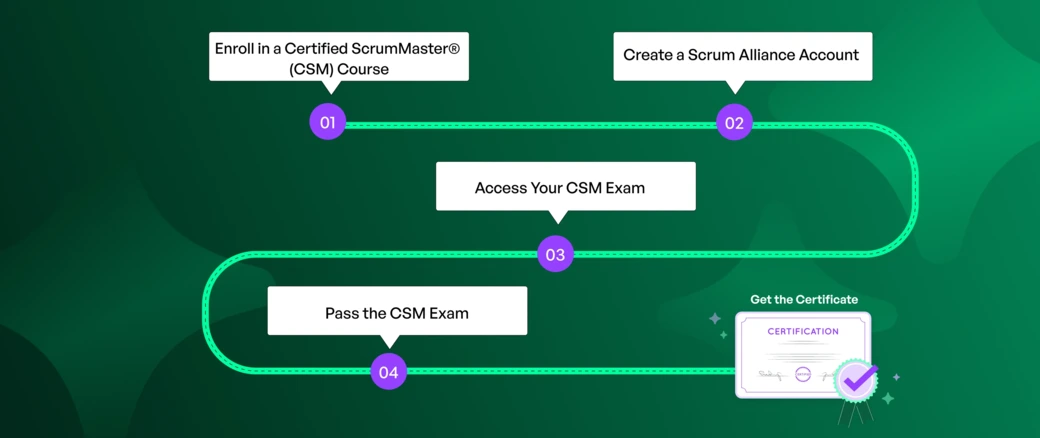
The Proven Path to CSM Certification Success
Certified ScrumMaster® Course Content
- Individual and Interaction over Processes and tools
- Working software over comprehensive documentation
- Customer collaboration over contract negotiation
- Responding to change over following a plan
- Our highest priority is to satisfy through early and continuous delivery of valuable software.
- Welcome changing requirements even late in development. Agile processes harness change for the customer’s competitive advantage.
- Deliver working software frequently, from a couple of weeks to a couple of months, with a preference to the shorter timescal
- Business people and developers must work together daily throughout the project.
- Build projects around motivated individuals. Give them the environment and support they need, and trust them to get the job done
- The most efficient and effective method of conveying information to and within the development team is a face-to-face conversation.
- Working software is the primary measure of progress.
- Agile processes promote sustainable development. The sponsors, developers, and users should be able to maintain a constant pace indefinitely.
- Continuous attention to technical excellence and good design enhances agility.
- Simplicity — the art of maximizing the amount of work not done is much essential.
- The best architectures, requirements, and designs emerge from self-organizing teams
- At regular intervals, the team reflects on how to become more effective, then tunes and adjusts its behavior accordingly.
- Defined/Empirical Process
- Agile Introduction
- Scrum Values
- Aerial view of Scrum
- Scrum Framework
- Scrum Artifacts – Product Backlog, Sprint Backlog, Increment
- Product Backlog Refinement
- Scrum Roles – Product Owner, Development Team, ScrumMaster
- Sprint Planning
- Sprint execution
- Daily Scrum
- & Sprint Retrospective
- Definition of Done & Acceptance Criteria
- Requirements in agile
- Estimation – Story points & Ideal days
- Sprint and Release Burn charts
- Release planning using Velocity
- Self organizing teams
- Working agreements
- Tools & Techniques used by scrum teams
- Distributed team
- Role of Managers in Scrum
- QA Role
- Dedicated teams
- User stories
- Velocity
- Burn down charts
- Definition of done
- Relative estimating
- Don’t be afraid to ask for help and communicate your problems and schedules
- Always be on time for the meetings
- Transparency– This leads to transparent flow of information throughout the project and organization thereby creating a very open work culture.
- Inspection – Inspection of the scrum activities through the use of different techniques and feedback from client
- Adaptation- Adaptation involves making improvements in the process by learning through inspection.
- What went well?
- What did not go well?
- What did not go well? What needs improvement and what are the points to improve?
Every product backlog item gets declared as DONE it must be accepted by all team members and they must in advance know when it is called DONE. Here the team must be appraised of how a work is done, what are the standards required to be obeyed, and the different ways to verify whether it is done.
Each user story will have a specific criteria description called the acceptance criteria for that story.
Learn the need for being agile in your software development projects. Understand the key concepts of the development using the agile approach which is driven by value. It is a well-organized project management process. Also, know how to embrace flexible planning methods. Become collaborative with the team, scrum master, and product owner.
a)Trivia About Agile Methodology
In order to correct issues cropping up due to the waterfall method, a new development practice was introduced in 2001 by a set of people called Agile Methodology. The main concept adapted in Agile is the iterative way. Set of software industry giants met in Snowbird, UT in 2000 to discuss this method. Then they decided to differentiate agile from the traditional method with some values and called them Agile Manifesto
b) Agile Framework – A Brief Overview
Agile's iterative software development method follows many frameworks including Scrum, Lean, Kanban, Extreme Programming, Feature-driven development etc. It is a big list and Scrum is the most commonly used framework. The scrum will focus on three roles to go through the development cycle: the scrum masters, developers and product owners.
c) Agile Manifesto
The set of values defined for Agile methodology is called Agile Manifesto. It was written in Feb 2001 by 17 independent software techies. There were several written among which 4 values were accepted by all which is given below.
- The project can become successful when it depends on people than tools, and discussions must be encouraged than implementing hardcore
- Working on the product should be encouraged rather than focussing on documentation.
- Customer satisfaction is the key over negotiating the contract.
- Reacting to the changes and not strictly following a plan.
d) Key Principles in Agile
The Agile Manifesto gave birth to 12 agile principles.
- Customer satisfaction is the prime objective and this can be achieved by delivering projects on-time with the expected outcome.
- Accept changes at any stage of development and produce a competitive product to the customer
- Continuously sharing working software with the client instead of sharing documentation about project status
- Business team and development team work collaboratively.
- Provide support to the team with a motivated working environment.
- Conducting daily stand up meetings to let the team meet face to face.
- Measure work progress with the working software.
- Promote sustainable development.
- Good design will improve agility.
- Keep the entire process simple and discuss solutions more than worrying about the problem.
- Empower team to come up with ideas.
- Introduce games during meetings to ease team tension and increase productivity.
- How to get to these principles will be explained during the training.
Learn about how the Scrum Master facilitates the Scrum Team and conditions where he doesn’t.
Unlike in waterfall method, QA role is to write test cases and report bugs, in a scrum team QA has an extended role. QA team takes part in the daily meetings along with all team members. They are allowed to discuss with the business analyst and development team. They are part of the test planning phase. The team not only writes test cases but also the acceptance test cases to provide support to the product owner. Story estimation sessions will not happen without the QA team. They help in providing more realistic estimates. In short, the QA team is as equal to the development in the scrum projects.
Yes, that’s how you can easily remember the five values of the scrum process. C FOR C means to Commit you to need Courage. To develop Courage you need to Focus With Open mind and Respect all in the team.
You got it right, it is Commitment – Focus – Openness – Respect – Courage
Scrum process empowers the team to speak and share their views. Therefore scrum managers must understand the team strength and the product owner need. The manager should discuss with the team and let know the product owner to decide on the product backlog item. This will motivate the team to work towards delivery. The manager must never be biased and push team for delivery. Ensure that the team commits and support them during every sprint to combat issues. The manager must not think of bossing around but work along with the team to lead them to successful completion.
The framework of Scrum is simple and it deals efficiently with the changing situations. The work gets split into iterations. It is because during the development process the priority changes due to the situation, user mindset, technology etc. Therefore, the framework focuses on splitting the project into sequences of iterations called sprint. Every sprint will last for a maximum of 4 weeks. Therefore the complexity of the project is split and all changes are accommodated during the sprint meeting. There is not much of a loss and also the user gets the output per the expectation.
The framework is simply understood as Planning – Executing – Learning – Taking Actions. This will continue until the end result is achieved. Every sprint meeting will be in length to plan from the education of the previous sprint.
These days working with people across the globe on projects cannot be avoided. It is not possible to meet all at one table to discuss. Therefore managing teams with documentation might be effective but time-consuming and hence organization must embrace an agile way to work with distributed teams.
Even though it has its own flip side, still it is the best way to work with distributed teams. Remember that people remain the same irrespective of the geography and hence getting work done by setting expectation is quick. Also, use technology to meet people for daily stand up and execute the project efficiently.
- Tuckman’s Group Development Tools and Technique – Forming, Storming, Norming, Performing, Adjourning.
- Scrum Master tools Cynefin Framework – Simple, Complicated, Complex, and Chaotic.
- The Japanese Shu Ha Ri – Shu – self-disciplining, Ha – Innovate things, Ri – Execution
- Root cause analysis
Scrum artifacts are basically the set of information that the scrum team uses to make future decisions and set their goals. These details help in discussing how the product is developed, actions to produce it and actions performed during the projects. It includes the following elements:
- Product Backlog
- Product Increment and Definition of Done
- Sprint Backlog
- Burndown Charts
Scrum meetings happen when the scrum master, product owner, and development team meet to discuss the goals and the procedure to implement the same. There are many aspects of scrum meetings including:
- Sprint planning meeting
- Daily scrum meeting
- Sprint review meeting
- Sprint retrospective meeting
- Release planning meeting
- Every team member is given stick-it notes and asked to write their views about the project, deadline, completion etc.
- A good 3 minutes is given to each person to fill the following blank we can complete the task when we ……………………. Let each write their want. They can write 3 to 5 ideas.
- Ask everyone to read one idea each and make sure that the other person does not repeat the same idea.
- Have one person to make a note of all the ideas on the board.
- Take voting from all to come to a common working agreement from the list mentioned in the board.
The people responsible for coding and developing the project is called the development team. The team that test the bug and fixes the issues is called the testing team. As far as scrum projects are considered the entire team is called a scrum team which includes developers, testers, product owners, scrum master, and the high-level stakeholders. These teams are self-organising in agile development and are independent to complete their task. They don’t require anyone to monitor but they manage themselves.
The objective of release planning is to plan and make the scope, budget, and date for the incremental delivery in an agile project. Planning to have multiple sprints until the final product is released is discussed in the release planning meeting.
Every member of the scrum team and the stakeholders are part of this release plan meeting and it happens during each sprint activity. The release planning is done with the help of the product planning output and the pace at which the team completes the product backlog item per each sprint. This pace is nothing but the speed of the team and termed as velocity in agile projects.
- Four or more week longer sprints
- Bigger team size
- Complex backlog items
Choose the plan that fits you best!
| Standard Plan | StarX Plan | StarMax Plan | |
|---|---|---|---|
| Delivered by CSTs , Get 16 PDUs and SEUs |

|
|
|
| 100% Money Back Guarentee |
|
|
|
| Enjoy 2-Year Membership with Scrum Alliance |
|
|
|
| 100 -Interview Preparation Questions |
|
|
|
| Get 10 Sample Resumes |
|
|
|
| 3 High quality Mock Exams |
|
|
|
| Exclusive 11 hours video course from Industry Leader, to lay a solid foundation in agile project management principles and the Scrum Framework |

|
|
|
| Exclusive 13 hours video course from Industry Leader, to lay a solid foundation in agile scrum Master and the Scrum Framework |
|
|
|
| Microsoft certification: Transform business workflows with generative AI certification from StarAgile In Collaboration with Microsoft |
|
|
|
| Additional 2 High Quality Mock Exam |
|
|
|
| Microcredentials: AI For Scrum Master Certification by Scrum Alliance* |
|
|
|
| Talk to a Hiring Manager, 1:1 for 20 mins |
|
|
|
| 6 Hours Jira Live Virtual Training with 6 PDUs |
|
|
|
| 6 hours AI For Scrum Master - Live Virtual session with 6 PDUs |
|
|
|
| A 2 hours chatgpt fresher course |
|
|
|
| A 1 hour course to improve coaching and mentoring |
|
|
|
| A 1 hour course to resolve conflict resolution and Problem Solving |
|
|
|
| A 1 hour course to 'Creating and Maintaining a Positive Remote Team Culture' |
|
|
|


Upcoming Batches For CSM® Training in Mumbai
your batch request?



The work force is your asset. Up-Skill them with our Corporate Training Programs!
-
Unleash In-Demand Skills Across the Enterprise
-
Align Skill Development with Business Objectives
-
Drive Increased Employee Productivity
-
Leverage Immersive Learning
Certified Scrum Master Certification Training in Mumbai - Overview

A Certified Scrum Master credential can meaningfully shift your career, opening doors to Scrum Master and Agile roles in organisations that deliver through Scrum.
Career Impact
- Opens doors to Scrum Master, Agile coach and delivery roles
- Builds credibility with a Scrum Alliance credential recognised worldwide
- A CSM certification in Mumbai supports promotions and role changes
- Connects you to the Scrum Alliance community through a 2-year membership
What We Offer
- 2 days of live online CSM Mumbai training led by Certified Scrum Trainers
- Exam fee included, with two free attempts within 90 days
- 20 PDUs and 16 SEUs, plus mock exams and practice tests
- 100 interview-preparation questions and 10 sample resumes
- Certified Scrum Master Course Eligibility and Prerequisites
- No formal prerequisites for Mumbai CSM batches
- Basic Agile knowledge helps but isn’t essential
- You need to complete the full training before taking the csm exam
Certified ScrumMaster (CSM®) Sample Certificate

Testimonials

CSM Course in Mumbai - Certification FAQs
The course covers Lean, Agile and Scrum principles, Scrum values, the three Scrum roles, events, artefacts, estimation with story points, release planning, burndown charts and user stories. The CSM Mumbai syllabus also includes team dynamics, working agreements and backlog refinement. Each theme builds on the last, moving from Agile basics to Scrum events, estimation and team practice.
The credential stays valid for two years, and there's a three-month grace period after expiry to retain member benefits. Your CSM Mumbai credential comes with a 2-year Scrum Alliance membership, so renewal can be planned from day one. Setting a reminder to collect SEUs during those two years makes renewal far easier when the date approaches.
Log in to your Scrum Alliance account, earn 20 SEUs and pay the $100 renewal fee, or earn another Scrum Alliance certification such as A-CSM or CSPO, which renews your CSM automatically. The training itself gives you 16 SEUs towards that total. The three-month grace period gives you extra time if you miss the original date, and keeping your CSM Mumbai credential current helps you stay visible to employers.
StarAgile is a Licensed Training Partner and Registered Education Provider of Scrum Alliance, authorised to deliver eligible certification training through Certified Scrum Trainers. Every Mumbai CSM learner therefore follows an official route to the credential. This means the course content, trainers and certification process meet Scrum Alliance's own standards rather than a provider's self-declared ones.
Yes, the course is delivered only online, as live, interactive sessions led by Certified Scrum Trainers. This CSM Mumbai programme lets you join from home or the office, with group activities throughout. All you need is a laptop or tablet and a stable internet connection, and you can ask questions live throughout the two days.
Yes, Scrum Alliance certifies professionals worldwide, so the credential is recognised globally. Employers in India and abroad value a Mumbai CSM professional who holds a Scrum Alliance credential when hiring for Scrum Master and Agile coach roles. Because Scrum is used by organisations around the world, the credential travels well if you later move to another city or country.
Yes, the course includes case studies, group activities and role-playing exercises so you practise Scrum in realistic situations. This CSM Mumbai programme prepares you for real Scrum practice, not just the exam. Working through these scenarios in groups also shows you how other professionals approach the same problems.
Your 2-year Scrum Alliance membership gives access to webinars, study materials and networking, and plans add video courses on Agile and Scrum. Each Mumbai CSM learner can also stay connected through mentoring meetings and WhatsApp groups. Revisiting these resources regularly helps you keep your Scrum knowledge current and prepares you for the renewal cycle.
You receive the Certified ScrumMaster® credential from Scrum Alliance after passing the exam, delivered as a PDF through your Scrum Alliance account. This CSM certification in Mumbai also comes with a 2-year membership. Keep the PDF safe, as you can share it with employers or add it to your professional profiles.
Complete the two-day live training, receive the exam link from Scrum Alliance by email, schedule and pass the online exam, then download your certificate. Following these steps gets you a CSM certification in Mumbai without any separate application process. There's no separate application step beyond completing the training and passing the exam, so the process stays simple.
Yes, the exam fee is included in the course fee, with two free attempts within 90 days. The CSM Mumbai fee therefore covers training, the exam and the 2-year membership, with only extra attempts costing $25 each. Only if you need more than two attempts would you pay extra, so the budget is easy to plan.
Log in to your Scrum Alliance account, find the download option on the dashboard and click to download your certificate as a PDF. Every Mumbai CSM learner can find the certificate in the same account for future reference. If you can't see the certificate yet, the StarAgile support team can help you check your account details.
Yes, mock tests and practice papers are included, and the plans list up to 5 high-quality mock exams. They help you become comfortable with the 50-question, open-book exam format, which is why this CSM Mumbai programme emphasises regular practice. Taking several mock tests under timed conditions is the most effective way to build confidence before your first real attempt.
It's conducted live, with no pre-recorded videos, so you interact directly with the trainer and other learners. This CSM training Mumbai format relies on discussion and activities rather than passive viewing. Live delivery also means your questions are answered on the spot, which pre-recorded videos cannot offer.
There are no formal eligibility requirements, and basic Agile knowledge is helpful but not essential. You only need to attend the full training before the exam, so Mumbai CSM batches are open to professionals from any background. Having some Agile knowledge beforehand is a bonus, but the trainer explains the key concepts from the beginning.
The training takes two days, delivered as two sessions on weekends or three shorter sessions on weekdays. This CSM training Mumbai schedule is followed by the online exam within the 90-day window covered by two free attempts. Because the live sessions are compact, many learners prepare for the exam in the following days while the material is fresh.
The fee covers live training by CSTs, the exam fee, a 2-year Scrum Alliance membership, mock exams and learning resources, with extras varying by plan. This CSM certification in Mumbai package keeps the total cost predictable. Because the exam fee and membership are bundled, you don't need to budget for these items separately.
Yes, the Scrum Alliance exam fee is included, and you get two free attempts within 90 days of training. The exam has 50 multiple-choice questions in 60 minutes, and you need 74% (34 correct) to earn your Scrum Master certification Mumbai credential. If you need a second attempt, you can use it within the same 90-day window at no extra charge.
Yes, beginners are welcome because the course starts with Agile and Scrum fundamentals and has no formal prerequisites. This CSM Mumbai course explains each role, event and artefact step by step before moving on to estimation and planning. Beginners also benefit from group activities, where experienced participants share practical examples from their own teams.
Yes, the two-day format and weekend batches mean most professionals can attend without extended leave. Many Mumbai CSM participants come from finance, healthcare and manufacturing, as well as IT. A weekend batch is a popular option, as it avoids clashes with weekday work commitments.
Yes, StarAgile schedules both weekday and weekend batches, which run live online. Choosing CSM Mumbai batches that match your work routine helps you attend every session and be ready for the exam. You can view upcoming dates on the StarAgile website and pick the batch that fits your calendar best.
Yes, mock tests, practice papers and trainer guidance are included, along with tips for the open-book exam. These make it easier to earn a CSM certification in Mumbai, since you'll have practised the format before the real attempt. Practising under time limits helps you manage the 60 minutes comfortably, since the exam has 50 questions.
You receive the Certified ScrumMaster® credential from Scrum Alliance after passing the exam, along with a 2-year membership. This CSM Mumbai credential is delivered as a PDF through your Scrum Alliance account. Your Scrum Alliance account also records your membership status, which is helpful when you plan your renewal.
Support includes 100 interview-preparation questions, 10 sample resumes, a 20-minute chat with a hiring manager and ongoing mentoring. Ranked #1 CSM training provider by Zee News, StarAgile is often described as the best institute for scrum master certification in Mumbai. These resources help you present your Scrum skills clearly and approach interviews with confidence.
CSM Exam FAQs
The exam is conducted online by Scrum Alliance and has 50 multiple-choice questions to be completed in 60 minutes. It is open-book, and you need 74% to pass, so understanding the CSM Mumbai syllabus matters more than memorising definitions.
Attend the full two days, revise your course notes and the Scrum Guide, and take timed mock tests to find weak areas. Many Mumbai CSM learners find that reviewing mistakes from practice papers does more for their confidence than extra reading.
Anyone interested in Scrum can enrol, as there are no formal eligibility requirements and no prior certification is needed. This CSM Mumbai course welcomes beginners, project managers, developers, testers and business analysts, as long as they attend the full training before the exam.
You get 60 minutes to answer all 50 questions. You can pause the exam if you need to, but the clock keeps running, so candidates earning a CSM certification in Mumbai should choose a quiet slot and a stable internet connection.
Yes, the exam is open-book, so you can refer to Scrum resources while answering. The 60-minute limit still applies, so searching for every answer isn't realistic, and preparation remains the best strategy for the real attempt.
You need 74%, which means at least 34 of the 50 questions answered correctly. Practising with mock exams during your Scrum Master certification Mumbai preparation helps you reach that level comfortably before the real attempt.
Enrol in the training, complete the two live days, receive the exam link from Scrum Alliance by email, then schedule and take the online exam. These steps keep the CSM Mumbai process simple, with no separate application to submit.
The exam has 50 multiple-choice questions in total, and you must answer at least 34 correctly to pass. Every Mumbai CSM candidate sees the same format, so mock tests during the course are good practice for it.
The exam is an online, open-book test made up of multiple-choice questions on Scrum concepts such as roles, events, artefacts and values. A candidate pursuing a CSM certification in Mumbai can expect the questions to reflect what is taught in the live sessions.
StarAgile doesn't publish a fixed waiting period, so you can plan your next attempt within the 90-day free window. If you want to confirm any timing rule for your account, the StarAgile support team can check it for you.
The exam is conducted online by Scrum Alliance, so there's no test centre visit. You can take the CSM Mumbai exam from home or the office, ideally with a stable internet connection and a quiet space.
Focus on the Scrum Guide, the Scrum values, the three roles, events, artefacts, estimation and backlog management, using your course notes and mock exams. This revision pattern suits anyone preparing for a CSM certification in Mumbai.
Once the training ends, you receive the exam link from Scrum Alliance and can attempt the exam straight away. Mumbai CSM learners have 90 days to use their two free attempts, so you can revise first if you prefer.
After you pass, the certificate is available in your Scrum Alliance account, where you can download it as a PDF from the dashboard. If it doesn't appear, the StarAgile support team can help you check your account details.
You can download your certificate from your Scrum Alliance account and start using your 2-year membership, which gives access to resources and the Scrum community. Many CSM Mumbai graduates then update their profiles and begin applying for Scrum Master roles.
You can use your second free attempt within the 90-day window, and there's no re-evaluation of a failed exam. Reviewing weak areas and retaking a mock test first is the best approach before your next attempt.
Certified Scrum Master® Certification in Mumbai - Additional FAQs
A Scrum Master is a servant leader who helps the team understand and follow Scrum, facilitates events such as the daily scrum and retrospective, and removes obstacles that slow delivery. Learners in the CSM Mumbai programme practise these responsibilities through case studies and role-plays, so the role feels practical rather than theoretical.
Sessions are led by Certified Scrum Trainers approved by Scrum Alliance, including Narasimha Reddy Bommaka, who has 18+ years of experience and has delivered 250+ CSM trainings. This depth of real project experience is a key reason many learners call StarAgile the best institute for scrum master certification in Mumbai.
Scrum is built on empirical process control, self-organising teams, collaboration, time-boxed sprints, value-based prioritisation and iterative delivery. Mumbai CSM learners study how each principle shows up in Scrum events and artefacts, so the ideas connect to everyday teamwork.
Yes, project management experience isn't required, because the course starts with Agile and Scrum fundamentals and has no formal prerequisites. A CSM certification in Mumbai gives career-changers and freshers a structured start, and group exercises help you build confidence quickly.
The Scrum Master helps the team stay focused on its sprint goal, protects it from distractions and coaches members on Scrum practices and self-organisation. They also help the team improve through retrospectives, so the group becomes more effective with every sprint.
At its core, Scrum rests on three pillars: transparency, inspection and adaptation, supported by the values of Commitment, Focus, Openness, Respect and Courage. The CSM Mumbai training shows how these ideas shape every event, from sprint planning to the retrospective.
Scrum builds collaboration into its structure through daily scrums, sprint planning, sprint reviews and retrospectives, which bring the team and stakeholders together regularly. Because the team shares one goal and one backlog, people talk early rather than working in silos.
The Scrum Master supports the Product Owner by helping keep the backlog clear, coaching on backlog techniques and encouraging regular conversations with the team. Mumbai CSM sessions use scenarios that show how this partnership works when priorities change.
The course uses practical exercises, real-world case studies and trainer advice to show how to handle resistance to change, impediments and stakeholder gaps. This CSM Mumbai programme lets you rehearse these situations in groups before facing them in a real team.
Common obstacles include resistance to change, low stakeholder involvement, unresolved impediments, weaker collaboration and balancing several responsibilities at once. A good Scrum Master tackles these through coaching, transparency and steady conversations rather than force.
Yes, Scrum principles such as short cycles, transparency and continuous feedback suit marketing, operations, HR and manufacturing as well as software. Mumbai CSM participants often come from finance, healthcare and non-IT teams, which shows how widely the framework travels.
Scrum itself is designed for a single team, but organisations scale it with frameworks such as SAFe when several teams work together. The fundamentals you learn on the course remain the foundation for coordinating at that larger scale.
Scrum is a structured methodology with sprints, defined roles and events, while Kanban is a visual workflow method focused on continuous flow and limiting work in progress. Some teams combine both, using Scrum's rhythm with Kanban's visibility.
Scrum builds improvement into every sprint through retrospectives, iterative delivery and regular inspection and adaptation. During CSM Mumbai sessions, learners practise running retrospectives that lead to real changes rather than repeated complaints.
The training takes two days, delivered as two sessions on weekends or three shorter sessions on weekdays, followed by the online exam. This CSM Mumbai schedule is compact, so most working professionals can attend without extended leave.
No, the Scrum Master is a servant leader who facilitates the process but doesn't do development work. Keeping the roles separate lets the Scrum Master stay focused on removing impediments and coaching, rather than being pulled into delivery tasks.
The five values are Commitment, Focus, Openness, Respect and Courage. They guide how team members behave, build trust and make decisions, which is why they sit behind every Scrum role and event.
A CSM certification in Mumbai opens doors to Scrum Master, Agile coach and delivery roles in organisations that deliver through Scrum. Because the credential is recognised worldwide, it also supports moves into larger or international teams.
Common roles include Scrum Master, Agile coach, project manager and delivery manager, while some professionals move into product roles after further training. Mumbai CSM graduates often start as Scrum Masters before taking on coaching or programme responsibilities.
It builds credibility, supports a move into Scrum Master positions and provides a base for advanced certifications such as A-CSM and CSP-SM. A CSM Mumbai credential also comes with a 2-year Scrum Alliance membership for continued learning.
Facilitation, coaching, communication, conflict resolution, servant leadership and the ability to remove impediments are all key. Alongside a CSM certification in Mumbai, these skills grow fastest through regular practice with real teams.
Start with the CSM training and exam, volunteer to facilitate Scrum events, practise on real projects and build a record of improvements you've supported. A CSM certification in Mumbai gives you structure for each step of that journey.
Technology, finance, healthcare and manufacturing all hire Certified ScrumMasters, and the course is independent of industry. Organisations such as Accenture, Amazon, Deloitte and TCS are among those named by StarAgile, and many Mumbai CSM learners target such employers.
Volunteer to facilitate daily scrums or retrospectives, join internal Agile teams, run Scrum on side projects and take part in community groups. Your 2-year membership after CSM Mumbai training gives access to webinars and networking.
Highlight your CSM credential, the Scrum events you've facilitated, impediments you removed, tools such as Jira and measurable team improvements. Mention your CSM certification in Mumbai near the top, and use StarAgile's 10 sample resumes as a guide.
Revise Scrum roles, events, artefacts and values, and prepare examples of handling conflict, impediments and stakeholder pressure. StarAgile's CSM Mumbai plans provide 100 interview-preparation questions, and a Scrum Master interview bootcamp is also offered.
A typical path runs from Scrum Master to senior Scrum Master, Agile coach, programme or delivery manager and then Agile transformation lead. CSM Mumbai graduates can strengthen this path with advanced certifications and experience coaching multiple teams.
Distinctions and Achievements
About Certified ScrumMaster® Certification Training in Mumbai
A Scrum Master is the servant leader of a Scrum team, helping everyone understand and follow Scrum while removing the obstacles that slow delivery. Rather than managing people or assigning tasks, the Scrum Master facilitates the daily scrum, sprint planning, sprint review and retrospective, coaches the team towards self-organisation and works with the Product Owner to keep the backlog clear. Certified Scrum Master (CSM) is the entry-level credential from Scrum Alliance that validates these skills. A CSM certification in Mumbai is earned through a live two-day course led by a Certified Scrum Trainer and an online, open-book exam.
The CSM Mumbai training covers Scrum roles, events, artefacts and values, so the Scrum Master certification Mumbai professionals earn can be the first step towards Scrum Master or Agile coach roles.
Benefits of Certified Scrum Master Certification
StarAgile makes earning your Scrum credential straightforward, pairing Certified Scrum Trainers who have 15+ years of experience with interactive sessions built around real Scrum situations. This CSM Mumbai programme brings training, the exam fee and a membership together in one price.
What’s Included
- 2 days of live online training with group activities and case studies
- Scrum Alliance exam fee, with two free attempts within 90 days
- Free 2-year Scrum Alliance membership, plus 20 PDUs and 16 SEUs
- Mock exams, practice tests, 100 interview-preparation questions and 10 sample resumes
Career Benefits
- A globally recognised credential that supports Scrum Master and Agile coach roles
- Practical facilitation and coaching skills you can apply straight away
- A CSM certification in Mumbai that employers recognise, backed by community access and mentoring
- Flexible Mumbai CSM batches on weekdays and weekends
Comprehensive Training Solutions for Enterprises













People also viewed courses like